

9 Magnetism of Individual Nanoparticles Probed by X-Ray …
235
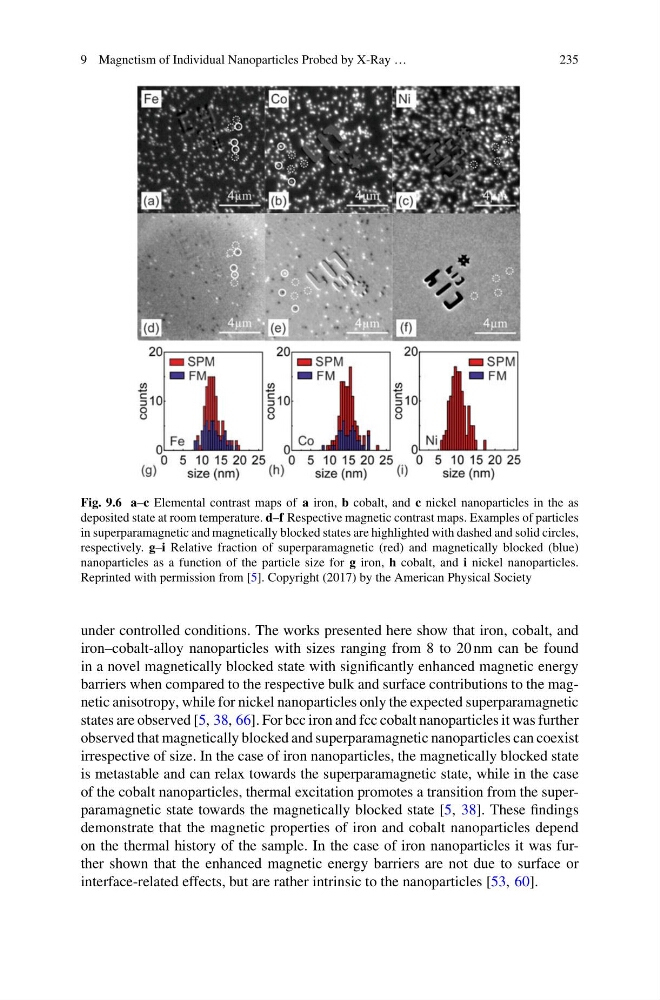
Fig. 9.6 a–c Elemental contrast maps of a iron, b cobalt, and c nickel nanoparticles in the as
deposited state at room temperature. d–f Respective magnetic contrast maps. Examples of particles
in superparamagnetic and magnetically blocked states are highlighted with dashed and solid circles,
respectively. g–i Relative fraction of superparamagnetic (red) and magnetically blocked (blue)
nanoparticles as a function of the particle size for g iron, h cobalt, and i nickel nanoparticles.
Reprinted with permission from [5]. Copyright (2017) by the American Physical Society
under controlled conditions. The works presented here show that iron, cobalt, and
iron–cobalt-alloy nanoparticles with sizes ranging from 8 to 20 nm can be found
in a novel magnetically blocked state with significantly enhanced magnetic energy
barriers when compared to the respective bulk and surface contributions to the magnetic anisotropy, while for nickel nanoparticles only the expected superparamagnetic
states are observed [5, 38, 66]. For bcc iron and fcc cobalt nanoparticles it was further
observed that magnetically blocked and superparamagnetic nanoparticles can coexist
irrespective of size. In the case of iron nanoparticles, the magnetically blocked state
is metastable and can relax towards the superparamagnetic state, while in the case
of the cobalt nanoparticles, thermal excitation promotes a transition from the superparamagnetic state towards the magnetically blocked state [5, 38]. These findings
demonstrate that the magnetic properties of iron and cobalt nanoparticles depend
on the thermal history of the sample. In the case of iron nanoparticles it was further shown that the enhanced magnetic energy barriers are not due to surface or
interface-related effects, but are rather intrinsic to the nanoparticles [53, 60].
235
Fig. 9.6 a–c Elemental contrast maps of a iron, b cobalt, and c nickel nanoparticles in the as
deposited state at room temperature. d–f Respective magnetic contrast maps. Examples of particles
in superparamagnetic and magnetically blocked states are highlighted with dashed and solid circles,
respectively. g–i Relative fraction of superparamagnetic (red) and magnetically blocked (blue)
nanoparticles as a function of the particle size for g iron, h cobalt, and i nickel nanoparticles.
Reprinted with permission from [5]. Copyright (2017) by the American Physical Society
under controlled conditions. The works presented here show that iron, cobalt, and
iron–cobalt-alloy nanoparticles with sizes ranging from 8 to 20 nm can be found
in a novel magnetically blocked state with significantly enhanced magnetic energy
barriers when compared to the respective bulk and surface contributions to the magnetic anisotropy, while for nickel nanoparticles only the expected superparamagnetic
states are observed [5, 38, 66]. For bcc iron and fcc cobalt nanoparticles it was further
observed that magnetically blocked and superparamagnetic nanoparticles can coexist
irrespective of size. In the case of iron nanoparticles, the magnetically blocked state
is metastable and can relax towards the superparamagnetic state, while in the case
of the cobalt nanoparticles, thermal excitation promotes a transition from the superparamagnetic state towards the magnetically blocked state [5, 38]. These findings
demonstrate that the magnetic properties of iron and cobalt nanoparticles depend
on the thermal history of the sample. In the case of iron nanoparticles it was further shown that the enhanced magnetic energy barriers are not due to surface or
interface-related effects, but are rather intrinsic to the nanoparticles [53, 60].