

232
A. Kleibert
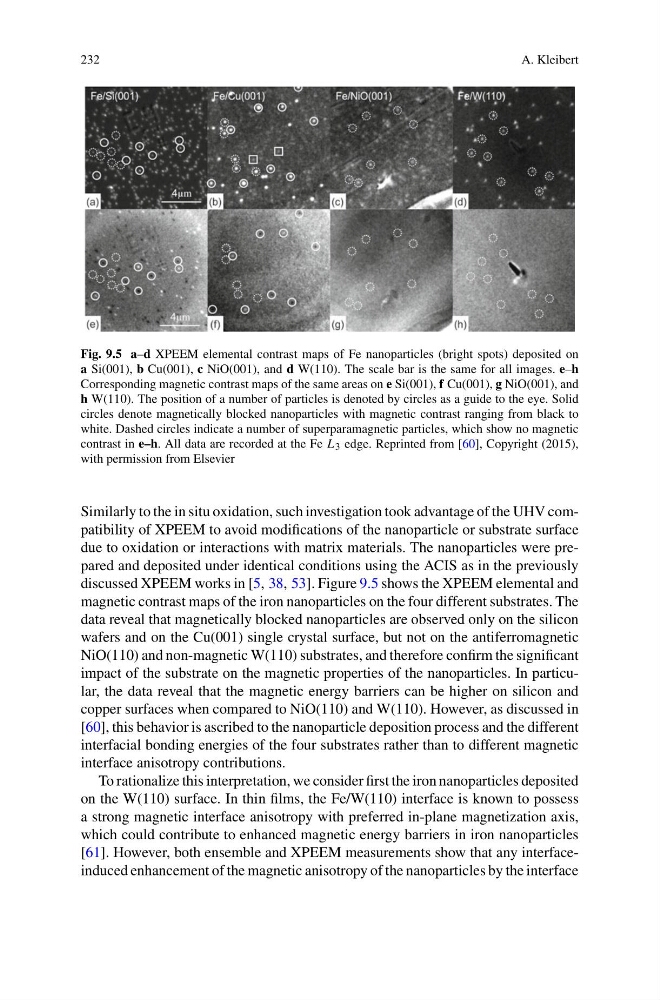
Fig. 9.5 a–d XPEEM elemental contrast maps of Fe nanoparticles (bright spots) deposited on
a Si(001), b Cu(001), c NiO(001), and d W(110). The scale bar is the same for all images. e–h
Corresponding magnetic contrast maps of the same areas on e Si(001), f Cu(001), g NiO(001), and
h W(110). The position of a number of particles is denoted by circles as a guide to the eye. Solid
circles denote magnetically blocked nanoparticles with magnetic contrast ranging from black to
white. Dashed circles indicate a number of superparamagnetic particles, which show no magnetic
contrast in e–h. All data are recorded at the Fe L 3 edge. Reprinted from [60], Copyright (2015),
with permission from Elsevier
Similarly to the in situ oxidation, such investigation took advantage of the UHV compatibility of XPEEM to avoid modifications of the nanoparticle or substrate surface
due to oxidation or interactions with matrix materials. The nanoparticles were prepared and deposited under identical conditions using the ACIS as in the previously
discussed XPEEM works in [5, 38, 53]. Figure 9.5 shows the XPEEM elemental and
magnetic contrast maps of the iron nanoparticles on the four different substrates. The
data reveal that magnetically blocked nanoparticles are observed only on the silicon
wafers and on the Cu(001) single crystal surface, but not on the antiferromagnetic
NiO(110) and non-magnetic W(110) substrates, and therefore confirm the significant
impact of the substrate on the magnetic properties of the nanoparticles. In particular, the data reveal that the magnetic energy barriers can be higher on silicon and
copper surfaces when compared to NiO(110) and W(110). However, as discussed in
[60], this behavior is ascribed to the nanoparticle deposition process and the different
interfacial bonding energies of the four substrates rather than to different magnetic
interface anisotropy contributions.
To rationalize this interpretation, we consider first the iron nanoparticles deposited
on the W(110) surface. In thin films, the Fe/W(110) interface is known to possess
a strong magnetic interface anisotropy with preferred in-plane magnetization axis,
which could contribute to enhanced magnetic energy barriers in iron nanoparticles
[61]. However, both ensemble and XPEEM measurements show that any interfaceinduced enhancement of the magnetic anisotropy of the nanoparticles by the interface
A. Kleibert
Fig. 9.5 a–d XPEEM elemental contrast maps of Fe nanoparticles (bright spots) deposited on
a Si(001), b Cu(001), c NiO(001), and d W(110). The scale bar is the same for all images. e–h
Corresponding magnetic contrast maps of the same areas on e Si(001), f Cu(001), g NiO(001), and
h W(110). The position of a number of particles is denoted by circles as a guide to the eye. Solid
circles denote magnetically blocked nanoparticles with magnetic contrast ranging from black to
white. Dashed circles indicate a number of superparamagnetic particles, which show no magnetic
contrast in e–h. All data are recorded at the Fe L 3 edge. Reprinted from [60], Copyright (2015),
with permission from Elsevier
Similarly to the in situ oxidation, such investigation took advantage of the UHV compatibility of XPEEM to avoid modifications of the nanoparticle or substrate surface
due to oxidation or interactions with matrix materials. The nanoparticles were prepared and deposited under identical conditions using the ACIS as in the previously
discussed XPEEM works in [5, 38, 53]. Figure 9.5 shows the XPEEM elemental and
magnetic contrast maps of the iron nanoparticles on the four different substrates. The
data reveal that magnetically blocked nanoparticles are observed only on the silicon
wafers and on the Cu(001) single crystal surface, but not on the antiferromagnetic
NiO(110) and non-magnetic W(110) substrates, and therefore confirm the significant
impact of the substrate on the magnetic properties of the nanoparticles. In particular, the data reveal that the magnetic energy barriers can be higher on silicon and
copper surfaces when compared to NiO(110) and W(110). However, as discussed in
[60], this behavior is ascribed to the nanoparticle deposition process and the different
interfacial bonding energies of the four substrates rather than to different magnetic
interface anisotropy contributions.
To rationalize this interpretation, we consider first the iron nanoparticles deposited
on the W(110) surface. In thin films, the Fe/W(110) interface is known to possess
a strong magnetic interface anisotropy with preferred in-plane magnetization axis,
which could contribute to enhanced magnetic energy barriers in iron nanoparticles
[61]. However, both ensemble and XPEEM measurements show that any interfaceinduced enhancement of the magnetic anisotropy of the nanoparticles by the interface