

228
A. Kleibert
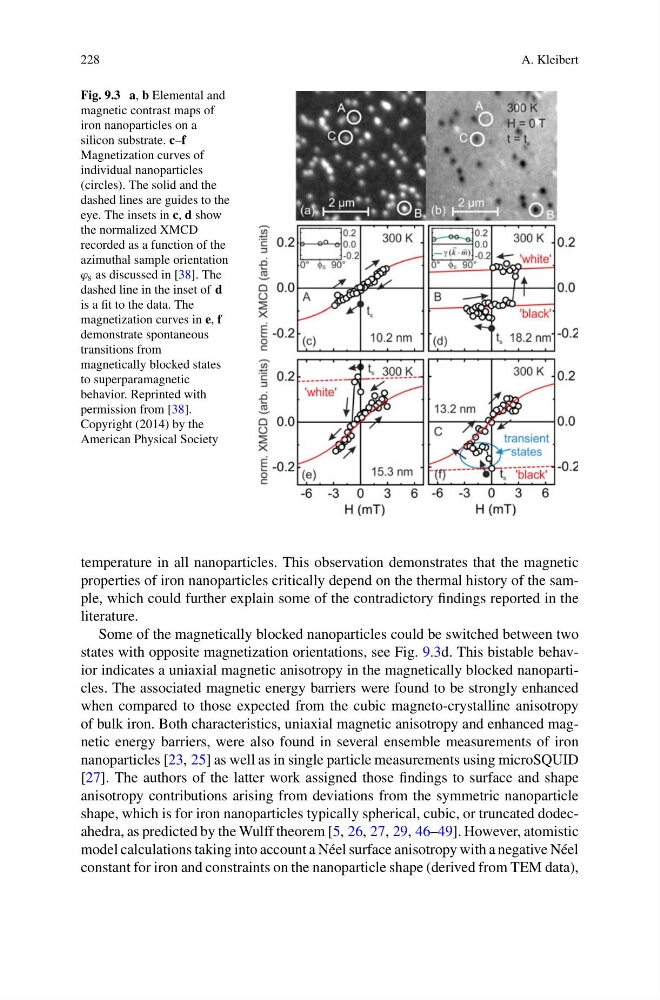
Fig. 9.3 a, b Elemental and
magnetic contrast maps of
iron nanoparticles on a
silicon substrate. c–f
Magnetization curves of
individual nanoparticles
(circles). The solid and the
dashed lines are guides to the
eye. The insets in c, d show
the normalized XMCD
recorded as a function of the
azimuthal sample orientation
ϕ s as discussed in [38]. The
dashed line in the inset of d
is a fit to the data. The
magnetization curves in e, f
demonstrate spontaneous
transitions from
magnetically blocked states
to superparamagnetic
behavior. Reprinted with
permission from [38].
Copyright (2014) by the
American Physical Society
temperature in all nanoparticles. This observation demonstrates that the magnetic
properties of iron nanoparticles critically depend on the thermal history of the sample, which could further explain some of the contradictory findings reported in the
literature.
Some of the magnetically blocked nanoparticles could be switched between two
states with opposite magnetization orientations, see Fig. 9.3d. This bistable behavior indicates a uniaxial magnetic anisotropy in the magnetically blocked nanoparticles. The associated magnetic energy barriers were found to be strongly enhanced
when compared to those expected from the cubic magneto-crystalline anisotropy
of bulk iron. Both characteristics, uniaxial magnetic anisotropy and enhanced magnetic energy barriers, were also found in several ensemble measurements of iron
nanoparticles [23, 25] as well as in single particle measurements using microSQUID
[27]. The authors of the latter work assigned those findings to surface and shape
anisotropy contributions arising from deviations from the symmetric nanoparticle
shape, which is for iron nanoparticles typically spherical, cubic, or truncated dodecahedra, as predicted by the Wulff theorem [5, 26, 27, 29, 46–49]. However, atomistic
model calculations taking into account a Néel surface anisotropy with a negative Néel
constant for iron and constraints on the nanoparticle shape (derived from TEM data),
A. Kleibert
Fig. 9.3 a, b Elemental and
magnetic contrast maps of
iron nanoparticles on a
silicon substrate. c–f
Magnetization curves of
individual nanoparticles
(circles). The solid and the
dashed lines are guides to the
eye. The insets in c, d show
the normalized XMCD
recorded as a function of the
azimuthal sample orientation
ϕ s as discussed in [38]. The
dashed line in the inset of d
is a fit to the data. The
magnetization curves in e, f
demonstrate spontaneous
transitions from
magnetically blocked states
to superparamagnetic
behavior. Reprinted with
permission from [38].
Copyright (2014) by the
American Physical Society
temperature in all nanoparticles. This observation demonstrates that the magnetic
properties of iron nanoparticles critically depend on the thermal history of the sample, which could further explain some of the contradictory findings reported in the
literature.
Some of the magnetically blocked nanoparticles could be switched between two
states with opposite magnetization orientations, see Fig. 9.3d. This bistable behavior indicates a uniaxial magnetic anisotropy in the magnetically blocked nanoparticles. The associated magnetic energy barriers were found to be strongly enhanced
when compared to those expected from the cubic magneto-crystalline anisotropy
of bulk iron. Both characteristics, uniaxial magnetic anisotropy and enhanced magnetic energy barriers, were also found in several ensemble measurements of iron
nanoparticles [23, 25] as well as in single particle measurements using microSQUID
[27]. The authors of the latter work assigned those findings to surface and shape
anisotropy contributions arising from deviations from the symmetric nanoparticle
shape, which is for iron nanoparticles typically spherical, cubic, or truncated dodecahedra, as predicted by the Wulff theorem [5, 26, 27, 29, 46–49]. However, atomistic
model calculations taking into account a Néel surface anisotropy with a negative Néel
constant for iron and constraints on the nanoparticle shape (derived from TEM data),