

9 Magnetism of Individual Nanoparticles Probed by X-Ray …
225
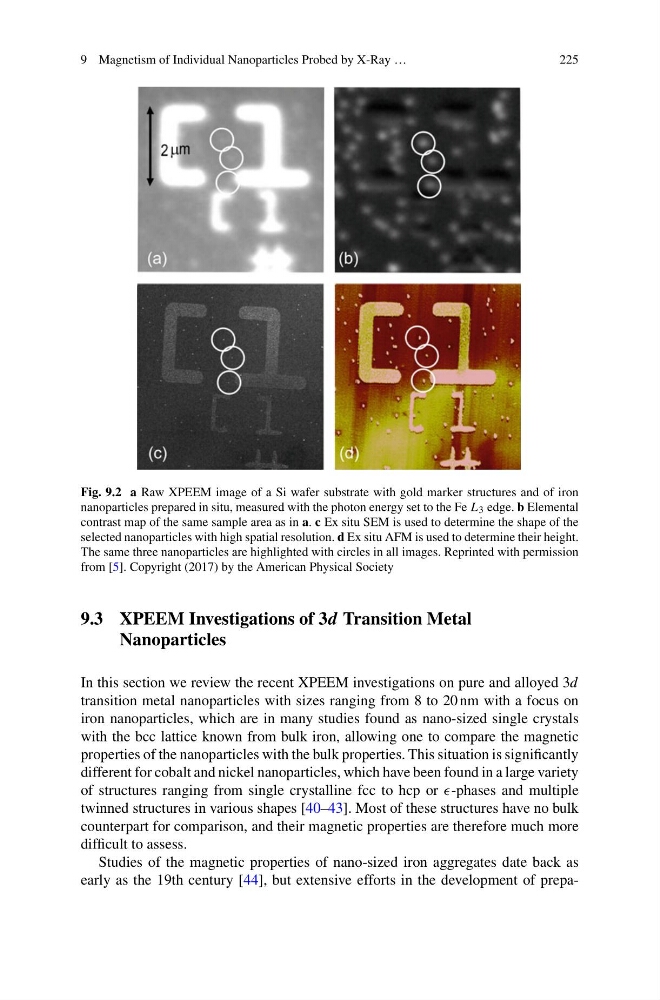
Fig. 9.2 a Raw XPEEM image of a Si wafer substrate with gold marker structures and of iron
nanoparticles prepared in situ, measured with the photon energy set to the Fe L 3 edge. b Elemental
contrast map of the same sample area as in a. c Ex situ SEM is used to determine the shape of the
selected nanoparticles with high spatial resolution. d Ex situ AFM is used to determine their height.
The same three nanoparticles are highlighted with circles in all images. Reprinted with permission
from [5]. Copyright (2017) by the American Physical Society
9.3 XPEEM Investigations of 3d Transition Metal
Nanoparticles
In this section we review the recent XPEEM investigations on pure and alloyed 3d
transition metal nanoparticles with sizes ranging from 8 to 20 nm with a focus on
iron nanoparticles, which are in many studies found as nano-sized single crystals
with the bcc lattice known from bulk iron, allowing one to compare the magnetic
properties of the nanoparticles with the bulk properties. This situation is significantly
different for cobalt and nickel nanoparticles, which have been found in a large variety
of structures ranging from single crystalline fcc to hcp or -phases and multiple
twinned structures in various shapes [40–43]. Most of these structures have no bulk
counterpart for comparison, and their magnetic properties are therefore much more
difficult to assess.
Studies of the magnetic properties of nano-sized iron aggregates date back as
early as the 19th century [44], but extensive efforts in the development of prepa-
225
Fig. 9.2 a Raw XPEEM image of a Si wafer substrate with gold marker structures and of iron
nanoparticles prepared in situ, measured with the photon energy set to the Fe L 3 edge. b Elemental
contrast map of the same sample area as in a. c Ex situ SEM is used to determine the shape of the
selected nanoparticles with high spatial resolution. d Ex situ AFM is used to determine their height.
The same three nanoparticles are highlighted with circles in all images. Reprinted with permission
from [5]. Copyright (2017) by the American Physical Society
9.3 XPEEM Investigations of 3d Transition Metal
Nanoparticles
In this section we review the recent XPEEM investigations on pure and alloyed 3d
transition metal nanoparticles with sizes ranging from 8 to 20 nm with a focus on
iron nanoparticles, which are in many studies found as nano-sized single crystals
with the bcc lattice known from bulk iron, allowing one to compare the magnetic
properties of the nanoparticles with the bulk properties. This situation is significantly
different for cobalt and nickel nanoparticles, which have been found in a large variety
of structures ranging from single crystalline fcc to hcp or -phases and multiple
twinned structures in various shapes [40–43]. Most of these structures have no bulk
counterpart for comparison, and their magnetic properties are therefore much more
difficult to assess.
Studies of the magnetic properties of nano-sized iron aggregates date back as
early as the 19th century [44], but extensive efforts in the development of prepa-