

8 Magnetic Self-Assembling of Spherical Co Nanoparticles …
207
Table 8.5 Structural and
magnetic parameters
extracted from the GISAXS
patterns, the ZFC
magnetization curves and the
hysteresis. δq1/2: the half
width at half maximum; D c-c :
center-to-center NC distance;
D i-p : border to border distance
of NCs considering a NC size
of 7.5 nm; T B : blocking
temperature; M s : saturation
magnetization; Msnat/Msann:
ratio of native M s to annealed
M s ; H c : coercivity
Sample
D c-c (nm) D i-p (nm) T B (K)
Co fcc (Native)
10.5 ± 0.1 3.0 ± 0.5 112 ± 3
Co hcp (Annealed at 350 °C) 9.7 ± 0.1 2.2 ± 0.5 280 ± 3
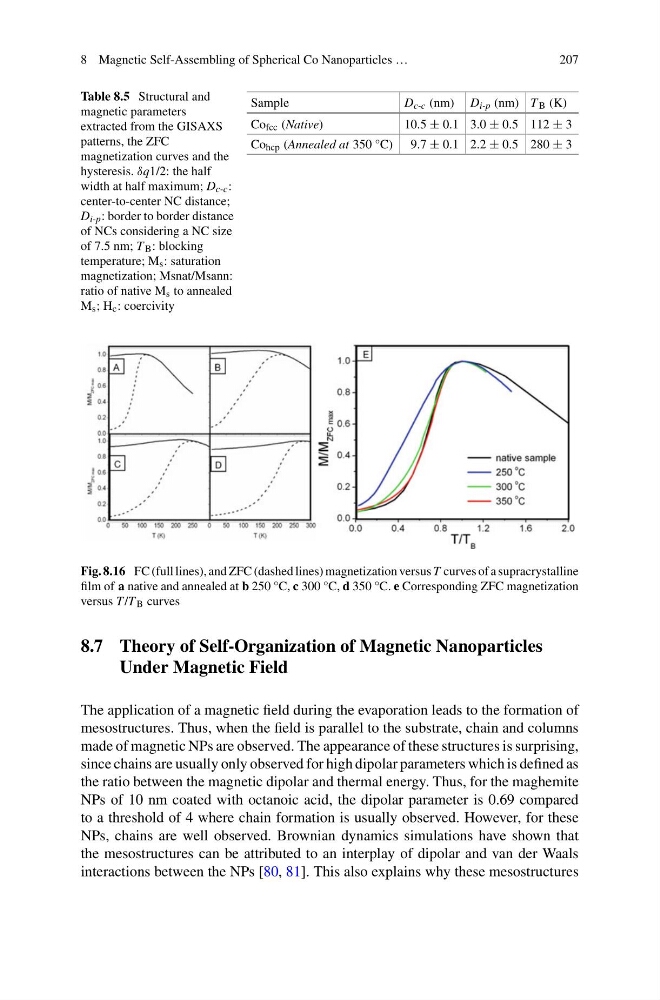
Fig. 8.16 FC (full lines), and ZFC (dashed lines) magnetization versus T curves of a supracrystalline
film of a native and annealed at b 250 °C, c 300 °C, d 350 °C. e Corresponding ZFC magnetization
versus T /T B curves
8.7 Theory of Self-Organization of Magnetic Nanoparticles
Under Magnetic Field
The application of a magnetic field during the evaporation leads to the formation of
mesostructures. Thus, when the field is parallel to the substrate, chain and columns
made of magnetic NPs are observed. The appearance of these structures is surprising,
since chains are usually only observed for high dipolar parameters which is defined as
the ratio between the magnetic dipolar and thermal energy. Thus, for the maghemite
NPs of 10 nm coated with octanoic acid, the dipolar parameter is 0.69 compared
to a threshold of 4 where chain formation is usually observed. However, for these
NPs, chains are well observed. Brownian dynamics simulations have shown that
the mesostructures can be attributed to an interplay of dipolar and van der Waals
interactions between the NPs [80, 81]. This also explains why these mesostructures
207
Table 8.5 Structural and
magnetic parameters
extracted from the GISAXS
patterns, the ZFC
magnetization curves and the
hysteresis. δq1/2: the half
width at half maximum; D c-c :
center-to-center NC distance;
D i-p : border to border distance
of NCs considering a NC size
of 7.5 nm; T B : blocking
temperature; M s : saturation
magnetization; Msnat/Msann:
ratio of native M s to annealed
M s ; H c : coercivity
Sample
D c-c (nm) D i-p (nm) T B (K)
Co fcc (Native)
10.5 ± 0.1 3.0 ± 0.5 112 ± 3
Co hcp (Annealed at 350 °C) 9.7 ± 0.1 2.2 ± 0.5 280 ± 3
Fig. 8.16 FC (full lines), and ZFC (dashed lines) magnetization versus T curves of a supracrystalline
film of a native and annealed at b 250 °C, c 300 °C, d 350 °C. e Corresponding ZFC magnetization
versus T /T B curves
8.7 Theory of Self-Organization of Magnetic Nanoparticles
Under Magnetic Field
The application of a magnetic field during the evaporation leads to the formation of
mesostructures. Thus, when the field is parallel to the substrate, chain and columns
made of magnetic NPs are observed. The appearance of these structures is surprising,
since chains are usually only observed for high dipolar parameters which is defined as
the ratio between the magnetic dipolar and thermal energy. Thus, for the maghemite
NPs of 10 nm coated with octanoic acid, the dipolar parameter is 0.69 compared
to a threshold of 4 where chain formation is usually observed. However, for these
NPs, chains are well observed. Brownian dynamics simulations have shown that
the mesostructures can be attributed to an interplay of dipolar and van der Waals
interactions between the NPs [80, 81]. This also explains why these mesostructures