

200
J. Richardi et al.
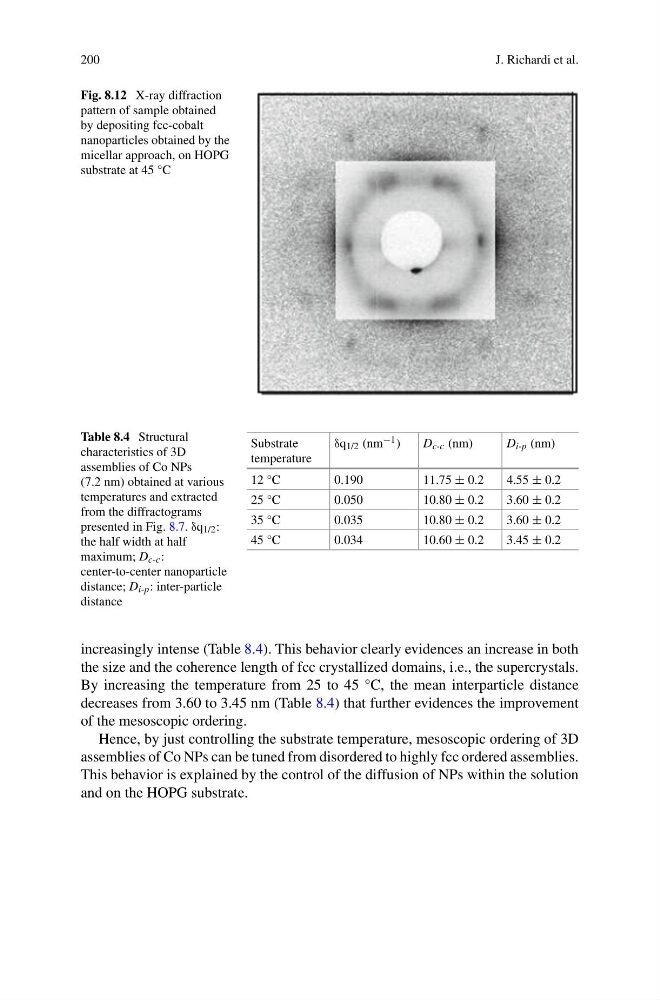
Fig. 8.12 X-ray diffraction
pattern of sample obtained
by depositing fcc-cobalt
nanoparticles obtained by the
micellar approach, on HOPG
substrate at 45 °C
Table 8.4 Structural
characteristics of 3D
assemblies of Co NPs
(7.2 nm) obtained at various
temperatures and extracted
from the diffractograms
presented in Fig. 8.7. δq 1/2 :
the half width at half
maximum; D c-c :
center-to-center nanoparticle
distance; D i-p : inter-particle
distance
Substrate
temperature
δq 1/2 (nm −1 )
D c-c (nm)
D i-p (nm)
12 °C
0.190
11.75 ± 0.2
4.55 ± 0.2
25 °C
0.050
10.80 ± 0.2
3.60 ± 0.2
35 °C
0.035
10.80 ± 0.2
3.60 ± 0.2
45 °C
0.034
10.60 ± 0.2
3.45 ± 0.2
increasingly intense (Table 8.4). This behavior clearly evidences an increase in both
the size and the coherence length of fcc crystallized domains, i.e., the supercrystals.
By increasing the temperature from 25 to 45 °C, the mean interparticle distance
decreases from 3.60 to 3.45 nm (Table 8.4) that further evidences the improvement
of the mesoscopic ordering.
Hence, by just controlling the substrate temperature, mesoscopic ordering of 3D
assemblies of Co NPs can be tuned from disordered to highly fcc ordered assemblies.
This behavior is explained by the control of the diffusion of NPs within the solution
and on the HOPG substrate.
J. Richardi et al.
Fig. 8.12 X-ray diffraction
pattern of sample obtained
by depositing fcc-cobalt
nanoparticles obtained by the
micellar approach, on HOPG
substrate at 45 °C
Table 8.4 Structural
characteristics of 3D
assemblies of Co NPs
(7.2 nm) obtained at various
temperatures and extracted
from the diffractograms
presented in Fig. 8.7. δq 1/2 :
the half width at half
maximum; D c-c :
center-to-center nanoparticle
distance; D i-p : inter-particle
distance
Substrate
temperature
δq 1/2 (nm −1 )
D c-c (nm)
D i-p (nm)
12 °C
0.190
11.75 ± 0.2
4.55 ± 0.2
25 °C
0.050
10.80 ± 0.2
3.60 ± 0.2
35 °C
0.035
10.80 ± 0.2
3.60 ± 0.2
45 °C
0.034
10.60 ± 0.2
3.45 ± 0.2
increasingly intense (Table 8.4). This behavior clearly evidences an increase in both
the size and the coherence length of fcc crystallized domains, i.e., the supercrystals.
By increasing the temperature from 25 to 45 °C, the mean interparticle distance
decreases from 3.60 to 3.45 nm (Table 8.4) that further evidences the improvement
of the mesoscopic ordering.
Hence, by just controlling the substrate temperature, mesoscopic ordering of 3D
assemblies of Co NPs can be tuned from disordered to highly fcc ordered assemblies.
This behavior is explained by the control of the diffusion of NPs within the solution
and on the HOPG substrate.