

8 Magnetic Self-Assembling of Spherical Co Nanoparticles …
191
organometallic precursors instead of inorganic. The first one is related to carbonyl
metal complexes (CMC, CO 2 (CO) 8 ) and their thermal decomposition to generate
NPs [16, 18]. The second one is dealing with hydrocarbyl complexes (HC) such as
Co(η
3 -C 8 H 13 ) (η
4 -C 8 H 12 ) that readily decompose at lower temperature under a high
pressure of dihydrogen [17]. However, the use of carbon monoxide as ligand (CMC
approach) or a pressure of hydrogen (HC approach) still requires specific equipment
in the laboratory. Moreover, these organometallic precursors are not readily available
on a large scale and often as for the micellar route, annealing is necessary to reach
pure hcp-Co phases (See above).
Based on the cobalt(II) salt and the cobalt(0 or I) organometallic approaches, a
novel strategy has been developed by using a well-defined cobalt (I) halide complexes
(ClCo(PPh 3 ) 3 ) in presence of oleylamine (OAm) which should act as the solvent,
the surfactant and as the reducing reagent [18]. Using this Co(I) complex heating in
degassed OAm at 190 °C during 1 h, the formation of spherical monodispersed Co
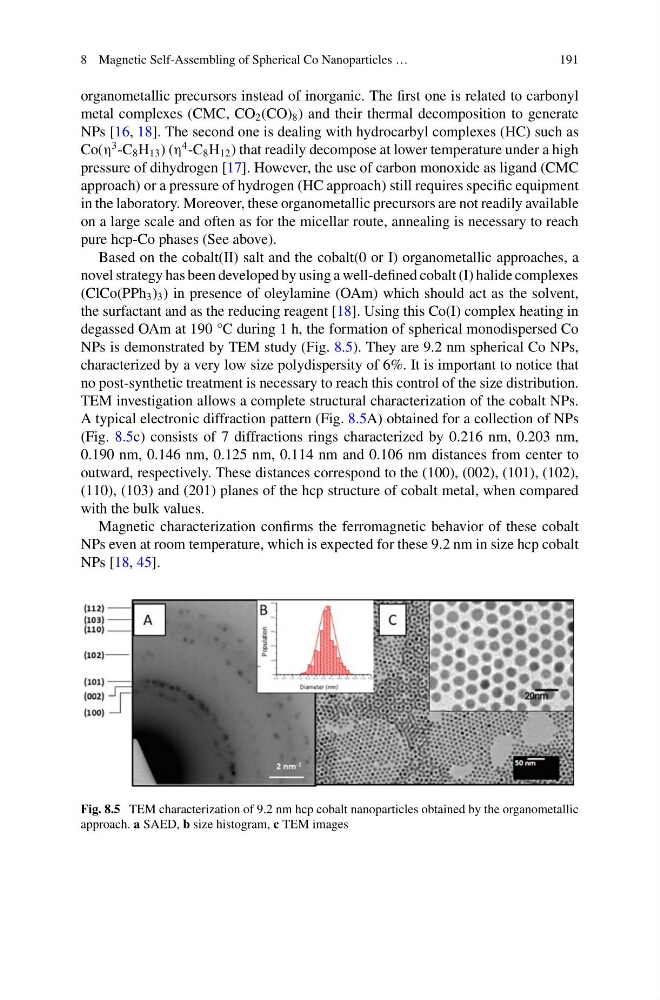
NPs is demonstrated by TEM study (Fig. 8.5). They are 9.2 nm spherical Co NPs,
characterized by a very low size polydispersity of 6%. It is important to notice that
no post-synthetic treatment is necessary to reach this control of the size distribution.
TEM investigation allows a complete structural characterization of the cobalt NPs.
A typical electronic diffraction pattern (Fig. 8.5A) obtained for a collection of NPs
(Fig. 8.5c) consists of 7 diffractions rings characterized by 0.216 nm, 0.203 nm,
0.190 nm, 0.146 nm, 0.125 nm, 0.114 nm and 0.106 nm distances from center to
outward, respectively. These distances correspond to the (100), (002), (101), (102),
(110), (103) and (201) planes of the hcp structure of cobalt metal, when compared
with the bulk values.
Magnetic characterization confirms the ferromagnetic behavior of these cobalt
NPs even at room temperature, which is expected for these 9.2 nm in size hcp cobalt
NPs [18, 45].
Fig. 8.5 TEM characterization of 9.2 nm hcp cobalt nanoparticles obtained by the organometallic
approach. a SAED, b size histogram, c TEM images
191
organometallic precursors instead of inorganic. The first one is related to carbonyl
metal complexes (CMC, CO 2 (CO) 8 ) and their thermal decomposition to generate
NPs [16, 18]. The second one is dealing with hydrocarbyl complexes (HC) such as
Co(η
3 -C 8 H 13 ) (η
4 -C 8 H 12 ) that readily decompose at lower temperature under a high
pressure of dihydrogen [17]. However, the use of carbon monoxide as ligand (CMC
approach) or a pressure of hydrogen (HC approach) still requires specific equipment
in the laboratory. Moreover, these organometallic precursors are not readily available
on a large scale and often as for the micellar route, annealing is necessary to reach
pure hcp-Co phases (See above).
Based on the cobalt(II) salt and the cobalt(0 or I) organometallic approaches, a
novel strategy has been developed by using a well-defined cobalt (I) halide complexes
(ClCo(PPh 3 ) 3 ) in presence of oleylamine (OAm) which should act as the solvent,
the surfactant and as the reducing reagent [18]. Using this Co(I) complex heating in
degassed OAm at 190 °C during 1 h, the formation of spherical monodispersed Co
NPs is demonstrated by TEM study (Fig. 8.5). They are 9.2 nm spherical Co NPs,
characterized by a very low size polydispersity of 6%. It is important to notice that
no post-synthetic treatment is necessary to reach this control of the size distribution.
TEM investigation allows a complete structural characterization of the cobalt NPs.
A typical electronic diffraction pattern (Fig. 8.5A) obtained for a collection of NPs
(Fig. 8.5c) consists of 7 diffractions rings characterized by 0.216 nm, 0.203 nm,
0.190 nm, 0.146 nm, 0.125 nm, 0.114 nm and 0.106 nm distances from center to
outward, respectively. These distances correspond to the (100), (002), (101), (102),
(110), (103) and (201) planes of the hcp structure of cobalt metal, when compared
with the bulk values.
Magnetic characterization confirms the ferromagnetic behavior of these cobalt
NPs even at room temperature, which is expected for these 9.2 nm in size hcp cobalt
NPs [18, 45].
Fig. 8.5 TEM characterization of 9.2 nm hcp cobalt nanoparticles obtained by the organometallic
approach. a SAED, b size histogram, c TEM images