

188
J. Richardi et al.
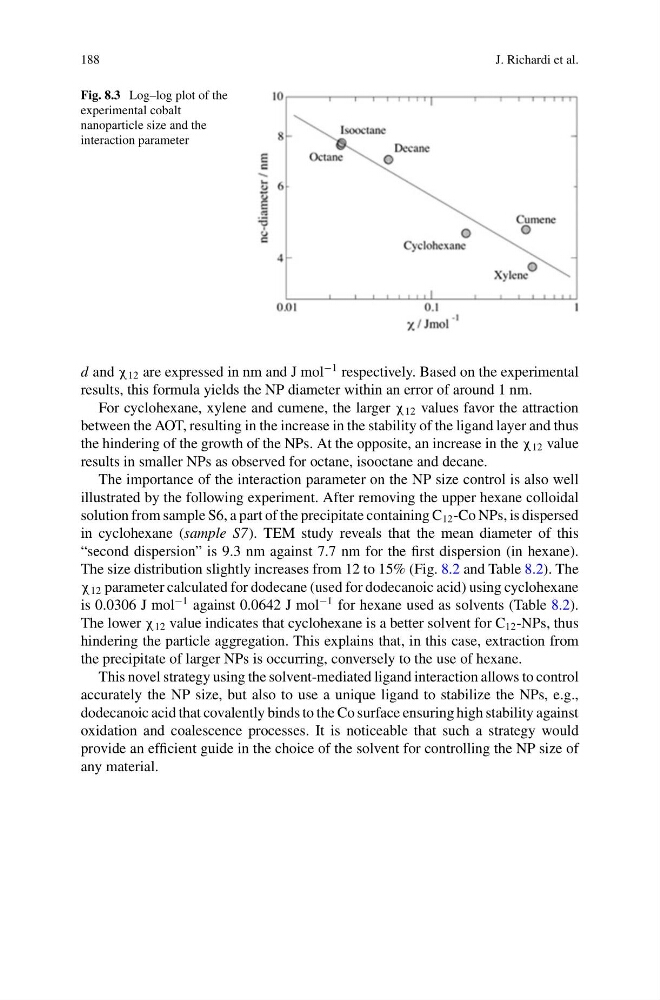
Fig. 8.3 Log–log plot of the
experimental cobalt
nanoparticle size and the
interaction parameter
d and χ 12 are expressed in nm and J mol
−1 respectively. Based on the experimental
results, this formula yields the NP diameter within an error of around 1 nm.
For cyclohexane, xylene and cumene, the larger χ 12 values favor the attraction
between the AOT, resulting in the increase in the stability of the ligand layer and thus
the hindering of the growth of the NPs. At the opposite, an increase in the χ 12 value
results in smaller NPs as observed for octane, isooctane and decane.
The importance of the interaction parameter on the NP size control is also well
illustrated by the following experiment. After removing the upper hexane colloidal
solution from sample S6, a part of the precipitate containing C 12 -Co NPs, is dispersed
in cyclohexane (sample S7). TEM study reveals that the mean diameter of this
“second dispersion” is 9.3 nm against 7.7 nm for the first dispersion (in hexane).
The size distribution slightly increases from 12 to 15% (Fig. 8.2 and Table 8.2). The
χ 12 parameter calculated for dodecane (used for dodecanoic acid) using cyclohexane
is 0.0306 J mol
−1 against 0.0642 J mol
−1 for hexane used as solvents (Table 8.2).
The lower χ 12 value indicates that cyclohexane is a better solvent for C 12 -NPs, thus
hindering the particle aggregation. This explains that, in this case, extraction from
the precipitate of larger NPs is occurring, conversely to the use of hexane.
This novel strategy using the solvent-mediated ligand interaction allows to control
accurately the NP size, but also to use a unique ligand to stabilize the NPs, e.g.,
dodecanoic acid that covalently binds to the Co surface ensuring high stability against
oxidation and coalescence processes. It is noticeable that such a strategy would
provide an efficient guide in the choice of the solvent for controlling the NP size of
any material.
J. Richardi et al.
Fig. 8.3 Log–log plot of the
experimental cobalt
nanoparticle size and the
interaction parameter
d and χ 12 are expressed in nm and J mol
−1 respectively. Based on the experimental
results, this formula yields the NP diameter within an error of around 1 nm.
For cyclohexane, xylene and cumene, the larger χ 12 values favor the attraction
between the AOT, resulting in the increase in the stability of the ligand layer and thus
the hindering of the growth of the NPs. At the opposite, an increase in the χ 12 value
results in smaller NPs as observed for octane, isooctane and decane.
The importance of the interaction parameter on the NP size control is also well
illustrated by the following experiment. After removing the upper hexane colloidal
solution from sample S6, a part of the precipitate containing C 12 -Co NPs, is dispersed
in cyclohexane (sample S7). TEM study reveals that the mean diameter of this
“second dispersion” is 9.3 nm against 7.7 nm for the first dispersion (in hexane).
The size distribution slightly increases from 12 to 15% (Fig. 8.2 and Table 8.2). The
χ 12 parameter calculated for dodecane (used for dodecanoic acid) using cyclohexane
is 0.0306 J mol
−1 against 0.0642 J mol
−1 for hexane used as solvents (Table 8.2).
The lower χ 12 value indicates that cyclohexane is a better solvent for C 12 -NPs, thus
hindering the particle aggregation. This explains that, in this case, extraction from
the precipitate of larger NPs is occurring, conversely to the use of hexane.
This novel strategy using the solvent-mediated ligand interaction allows to control
accurately the NP size, but also to use a unique ligand to stabilize the NPs, e.g.,
dodecanoic acid that covalently binds to the Co surface ensuring high stability against
oxidation and coalescence processes. It is noticeable that such a strategy would
provide an efficient guide in the choice of the solvent for controlling the NP size of
any material.