

186
J. Richardi et al.
Table 8.1 Average diameter of C O nanoparticles D, and size distributions, σ, at various R values
R
0.5
1
2
4
6
8
D (nm)
6
7
7
7
7
8
σ (%)
30
18
13
12
12
8
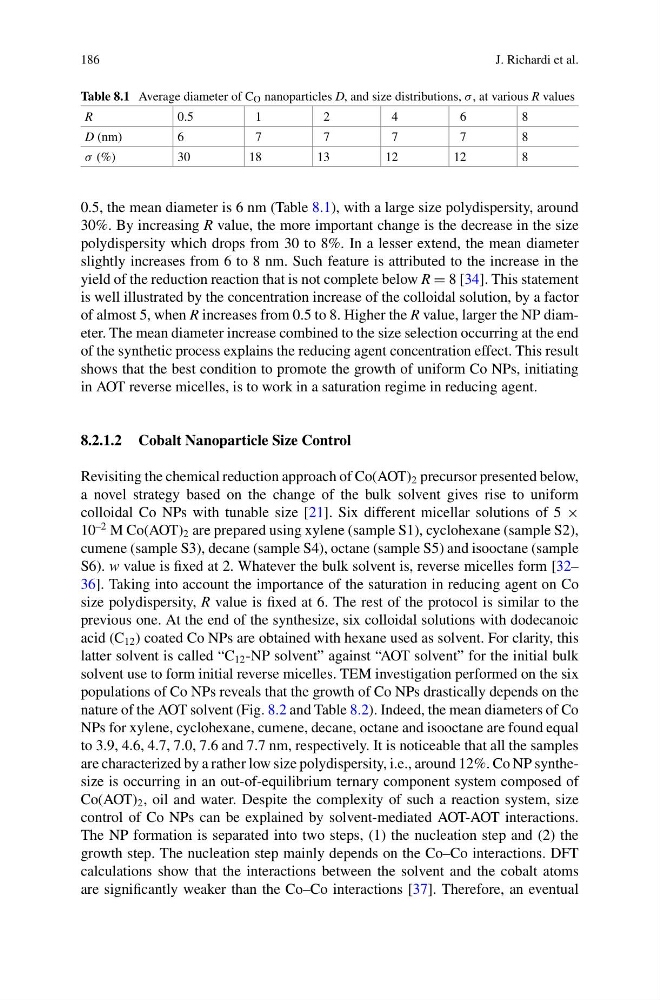
0.5, the mean diameter is 6 nm (Table 8.1), with a large size polydispersity, around
30%. By increasing R value, the more important change is the decrease in the size
polydispersity which drops from 30 to 8%. In a lesser extend, the mean diameter
slightly increases from 6 to 8 nm. Such feature is attributed to the increase in the
yield of the reduction reaction that is not complete below R = 8 [34]. This statement
is well illustrated by the concentration increase of the colloidal solution, by a factor
of almost 5, when R increases from 0.5 to 8. Higher the R value, larger the NP diameter. The mean diameter increase combined to the size selection occurring at the end
of the synthetic process explains the reducing agent concentration effect. This result
shows that the best condition to promote the growth of uniform Co NPs, initiating
in AOT reverse micelles, is to work in a saturation regime in reducing agent.
8.2.1.2 Cobalt Nanoparticle Size Control
Revisiting the chemical reduction approach of Co(AOT) 2 precursor presented below,
a novel strategy based on the change of the bulk solvent gives rise to uniform
colloidal Co NPs with tunable size [21]. Six different micellar solutions of 5 ×
10
–2 M Co(AOT) 2 are prepared using xylene (sample S1), cyclohexane (sample S2),
cumene (sample S3), decane (sample S4), octane (sample S5) and isooctane (sample
S6). w value is fixed at 2. Whatever the bulk solvent is, reverse micelles form [32–
36]. Taking into account the importance of the saturation in reducing agent on Co
size polydispersity, R value is fixed at 6. The rest of the protocol is similar to the
previous one. At the end of the synthesize, six colloidal solutions with dodecanoic
acid (C 12 ) coated Co NPs are obtained with hexane used as solvent. For clarity, this
latter solvent is called “C 12 -NP solvent” against “AOT solvent” for the initial bulk
solvent use to form initial reverse micelles. TEM investigation performed on the six
populations of Co NPs reveals that the growth of Co NPs drastically depends on the
nature of the AOT solvent (Fig. 8.2 and Table 8.2). Indeed, the mean diameters of Co
NPs for xylene, cyclohexane, cumene, decane, octane and isooctane are found equal
to 3.9, 4.6, 4.7, 7.0, 7.6 and 7.7 nm, respectively. It is noticeable that all the samples
are characterized by a rather low size polydispersity, i.e., around 12%. Co NP synthesize is occurring in an out-of-equilibrium ternary component system composed of
Co(AOT) 2 , oil and water. Despite the complexity of such a reaction system, size
control of Co NPs can be explained by solvent-mediated AOT-AOT interactions.
The NP formation is separated into two steps, (1) the nucleation step and (2) the
growth step. The nucleation step mainly depends on the Co–Co interactions. DFT
calculations show that the interactions between the solvent and the cobalt atoms
are significantly weaker than the Co–Co interactions [37]. Therefore, an eventual
J. Richardi et al.
Table 8.1 Average diameter of C O nanoparticles D, and size distributions, σ, at various R values
R
0.5
1
2
4
6
8
D (nm)
6
7
7
7
7
8
σ (%)
30
18
13
12
12
8
0.5, the mean diameter is 6 nm (Table 8.1), with a large size polydispersity, around
30%. By increasing R value, the more important change is the decrease in the size
polydispersity which drops from 30 to 8%. In a lesser extend, the mean diameter
slightly increases from 6 to 8 nm. Such feature is attributed to the increase in the
yield of the reduction reaction that is not complete below R = 8 [34]. This statement
is well illustrated by the concentration increase of the colloidal solution, by a factor
of almost 5, when R increases from 0.5 to 8. Higher the R value, larger the NP diameter. The mean diameter increase combined to the size selection occurring at the end
of the synthetic process explains the reducing agent concentration effect. This result
shows that the best condition to promote the growth of uniform Co NPs, initiating
in AOT reverse micelles, is to work in a saturation regime in reducing agent.
8.2.1.2 Cobalt Nanoparticle Size Control
Revisiting the chemical reduction approach of Co(AOT) 2 precursor presented below,
a novel strategy based on the change of the bulk solvent gives rise to uniform
colloidal Co NPs with tunable size [21]. Six different micellar solutions of 5 ×
10
–2 M Co(AOT) 2 are prepared using xylene (sample S1), cyclohexane (sample S2),
cumene (sample S3), decane (sample S4), octane (sample S5) and isooctane (sample
S6). w value is fixed at 2. Whatever the bulk solvent is, reverse micelles form [32–
36]. Taking into account the importance of the saturation in reducing agent on Co
size polydispersity, R value is fixed at 6. The rest of the protocol is similar to the
previous one. At the end of the synthesize, six colloidal solutions with dodecanoic
acid (C 12 ) coated Co NPs are obtained with hexane used as solvent. For clarity, this
latter solvent is called “C 12 -NP solvent” against “AOT solvent” for the initial bulk
solvent use to form initial reverse micelles. TEM investigation performed on the six
populations of Co NPs reveals that the growth of Co NPs drastically depends on the
nature of the AOT solvent (Fig. 8.2 and Table 8.2). Indeed, the mean diameters of Co
NPs for xylene, cyclohexane, cumene, decane, octane and isooctane are found equal
to 3.9, 4.6, 4.7, 7.0, 7.6 and 7.7 nm, respectively. It is noticeable that all the samples
are characterized by a rather low size polydispersity, i.e., around 12%. Co NP synthesize is occurring in an out-of-equilibrium ternary component system composed of
Co(AOT) 2 , oil and water. Despite the complexity of such a reaction system, size
control of Co NPs can be explained by solvent-mediated AOT-AOT interactions.
The NP formation is separated into two steps, (1) the nucleation step and (2) the
growth step. The nucleation step mainly depends on the Co–Co interactions. DFT
calculations show that the interactions between the solvent and the cobalt atoms
are significantly weaker than the Co–Co interactions [37]. Therefore, an eventual