

7 Nature Driven Magnetic Nanoarchitectures
173
75 kHz
149 kHz
302 kHz
532 kHz
a)
b)
0
20
40
60
80
100
Control
2 h
24 h
Percentage of living cells
***
*
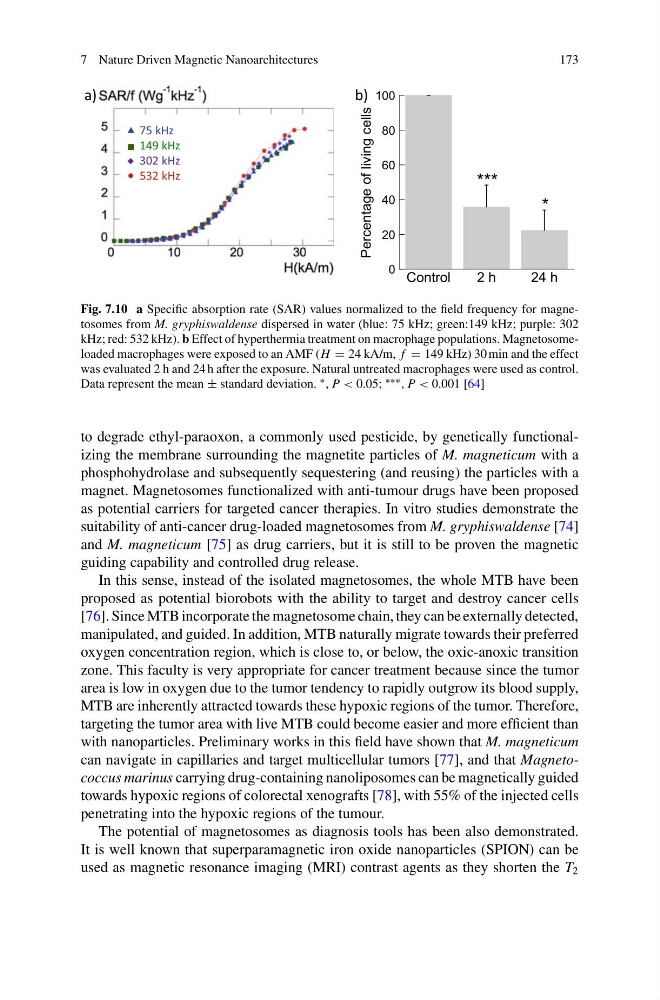
Fig. 7.10 a Specific absorption rate (SAR) values normalized to the field frequency for magnetosomes from M. gryphiswaldense dispersed in water (blue: 75 kHz; green:149 kHz; purple: 302
kHz; red: 532 kHz). b Effect of hyperthermia treatment on macrophage populations. Magnetosomeloaded macrophages were exposed to an AMF (H = 24 kA/m, f = 149 kHz) 30 min and the effect
was evaluated 2 h and 24 h after the exposure. Natural untreated macrophages were used as control.
Data represent the mean ± standard deviation. ∗ , P < 0.05; ∗∗∗ , P < 0.001 [64]
to degrade ethyl-paraoxon, a commonly used pesticide, by genetically functionalizing the membrane surrounding the magnetite particles of M. magneticum with a
phosphohydrolase and subsequently sequestering (and reusing) the particles with a
magnet. Magnetosomes functionalized with anti-tumour drugs have been proposed
as potential carriers for targeted cancer therapies. In vitro studies demonstrate the
suitability of anti-cancer drug-loaded magnetosomes from M. gryphiswaldense [74]
and M. magneticum [75] as drug carriers, but it is still to be proven the magnetic
guiding capability and controlled drug release.
In this sense, instead of the isolated magnetosomes, the whole MTB have been
proposed as potential biorobots with the ability to target and destroy cancer cells
[76]. Since MTB incorporate the magnetosome chain, they can be externally detected,
manipulated, and guided. In addition, MTB naturally migrate towards their preferred
oxygen concentration region, which is close to, or below, the oxic-anoxic transition
zone. This faculty is very appropriate for cancer treatment because since the tumor
area is low in oxygen due to the tumor tendency to rapidly outgrow its blood supply,
MTB are inherently attracted towards these hypoxic regions of the tumor. Therefore,
targeting the tumor area with live MTB could become easier and more efficient than
with nanoparticles. Preliminary works in this field have shown that M. magneticum
can navigate in capillaries and target multicellular tumors [77], and that Magnetococcus marinus carrying drug-containing nanoliposomes can be magnetically guided
towards hypoxic regions of colorectal xenografts [78], with 55% of the injected cells
penetrating into the hypoxic regions of the tumour.
The potential of magnetosomes as diagnosis tools has been also demonstrated.
It is well known that superparamagnetic iron oxide nanoparticles (SPION) can be
used as magnetic resonance imaging (MRI) contrast agents as they shorten the T 2
173
75 kHz
149 kHz
302 kHz
532 kHz
a)
b)
0
20
40
60
80
100
Control
2 h
24 h
Percentage of living cells
***
*
Fig. 7.10 a Specific absorption rate (SAR) values normalized to the field frequency for magnetosomes from M. gryphiswaldense dispersed in water (blue: 75 kHz; green:149 kHz; purple: 302
kHz; red: 532 kHz). b Effect of hyperthermia treatment on macrophage populations. Magnetosomeloaded macrophages were exposed to an AMF (H = 24 kA/m, f = 149 kHz) 30 min and the effect
was evaluated 2 h and 24 h after the exposure. Natural untreated macrophages were used as control.
Data represent the mean ± standard deviation. ∗ , P < 0.05; ∗∗∗ , P < 0.001 [64]
to degrade ethyl-paraoxon, a commonly used pesticide, by genetically functionalizing the membrane surrounding the magnetite particles of M. magneticum with a
phosphohydrolase and subsequently sequestering (and reusing) the particles with a
magnet. Magnetosomes functionalized with anti-tumour drugs have been proposed
as potential carriers for targeted cancer therapies. In vitro studies demonstrate the
suitability of anti-cancer drug-loaded magnetosomes from M. gryphiswaldense [74]
and M. magneticum [75] as drug carriers, but it is still to be proven the magnetic
guiding capability and controlled drug release.
In this sense, instead of the isolated magnetosomes, the whole MTB have been
proposed as potential biorobots with the ability to target and destroy cancer cells
[76]. Since MTB incorporate the magnetosome chain, they can be externally detected,
manipulated, and guided. In addition, MTB naturally migrate towards their preferred
oxygen concentration region, which is close to, or below, the oxic-anoxic transition
zone. This faculty is very appropriate for cancer treatment because since the tumor
area is low in oxygen due to the tumor tendency to rapidly outgrow its blood supply,
MTB are inherently attracted towards these hypoxic regions of the tumor. Therefore,
targeting the tumor area with live MTB could become easier and more efficient than
with nanoparticles. Preliminary works in this field have shown that M. magneticum
can navigate in capillaries and target multicellular tumors [77], and that Magnetococcus marinus carrying drug-containing nanoliposomes can be magnetically guided
towards hypoxic regions of colorectal xenografts [78], with 55% of the injected cells
penetrating into the hypoxic regions of the tumour.
The potential of magnetosomes as diagnosis tools has been also demonstrated.
It is well known that superparamagnetic iron oxide nanoparticles (SPION) can be
used as magnetic resonance imaging (MRI) contrast agents as they shorten the T 2