

7 Nature Driven Magnetic Nanoarchitectures
171
(80º,45º)
[100]
x
y
[010]
[001]
z
(74º,45º)
[001]
z
[100]
x
y
[010]
[
]
[001]
x
y
z
K u
[100]
[010]
-20
0
20
40
0
1 0 0
2 0 0
3 0 0
K uni
K c
Anisotropy constant
(kJ/m
3
)
T (K)
(c)
(b)
(e)
(d)
(a)
300 K
5 K
M
M
M
Chain axis
[111]
[111]
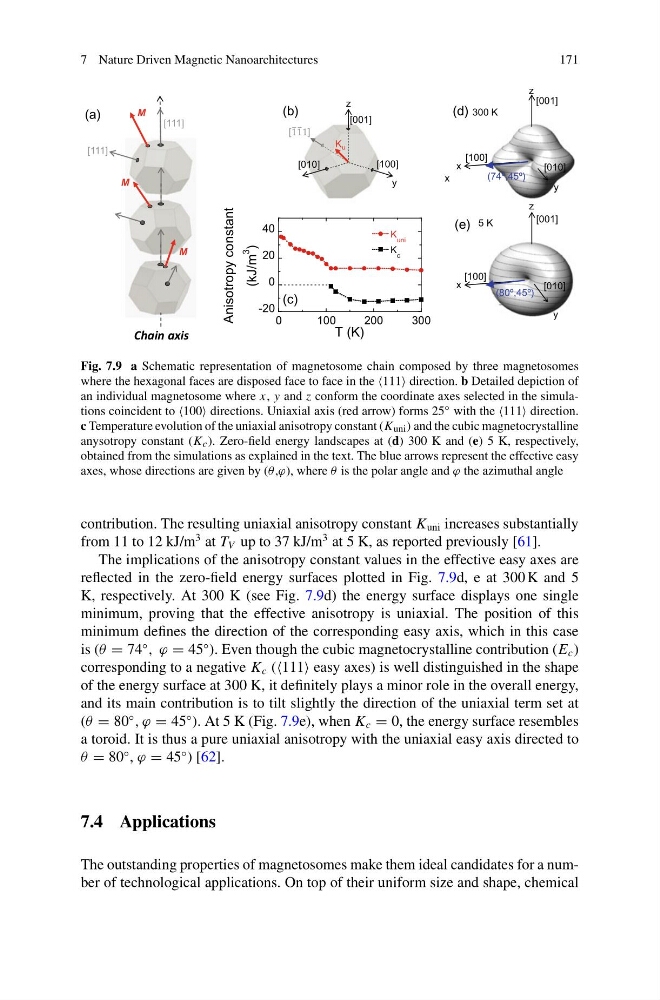
Fig. 7.9 a Schematic representation of magnetosome chain composed by three magnetosomes
where the hexagonal faces are disposed face to face in the 111 direction. b Detailed depiction of
an individual magnetosome where x, y and z conform the coordinate axes selected in the simulations coincident to 100 directions. Uniaxial axis (red arrow) forms 25 ◦ with the 111 direction.
c Temperature evolution of the uniaxial anisotropy constant (K uni ) and the cubic magnetocrystalline
anysotropy constant (K c ). Zero-field energy landscapes at (d) 300 K and (e) 5 K, respectively,
obtained from the simulations as explained in the text. The blue arrows represent the effective easy
axes, whose directions are given by (θ,ϕ), where θ is the polar angle and ϕ the azimuthal angle
contribution. The resulting uniaxial anisotropy constant K uni increases substantially
from 11 to 12 kJ/m
3 at T V up to 37 kJ/m
3 at 5 K, as reported previously [61].
The implications of the anisotropy constant values in the effective easy axes are
reflected in the zero-field energy surfaces plotted in Fig. 7.9d, e at 300 K and 5
K, respectively. At 300 K (see Fig. 7.9d) the energy surface displays one single
minimum, proving that the effective anisotropy is uniaxial. The position of this
minimum defines the direction of the corresponding easy axis, which in this case
is (θ = 74
◦
, ϕ = 45
◦ ). Even though the cubic magnetocrystalline contribution (E c )
corresponding to a negative K c (111 easy axes) is well distinguished in the shape
of the energy surface at 300 K, it definitely plays a minor role in the overall energy,
and its main contribution is to tilt slightly the direction of the uniaxial term set at
(θ = 80
◦
, ϕ = 45
◦ ). At 5 K (Fig. 7.9e), when K c = 0, the energy surface resembles
a toroid. It is thus a pure uniaxial anisotropy with the uniaxial easy axis directed to
θ = 80
◦ , ϕ = 45
◦ ) [62].
7.4 Applications
The outstanding properties of magnetosomes make them ideal candidates for a number of technological applications. On top of their uniform size and shape, chemical
171
(80º,45º)
[100]
x
y
[010]
[001]
z
(74º,45º)
[001]
z
[100]
x
y
[010]
[
]
[001]
x
y
z
K u
[100]
[010]
-20
0
20
40
0
1 0 0
2 0 0
3 0 0
K uni
K c
Anisotropy constant
(kJ/m
3
)
T (K)
(c)
(b)
(e)
(d)
(a)
300 K
5 K
M
M
M
Chain axis
[111]
[111]
Fig. 7.9 a Schematic representation of magnetosome chain composed by three magnetosomes
where the hexagonal faces are disposed face to face in the 111 direction. b Detailed depiction of
an individual magnetosome where x, y and z conform the coordinate axes selected in the simulations coincident to 100 directions. Uniaxial axis (red arrow) forms 25 ◦ with the 111 direction.
c Temperature evolution of the uniaxial anisotropy constant (K uni ) and the cubic magnetocrystalline
anysotropy constant (K c ). Zero-field energy landscapes at (d) 300 K and (e) 5 K, respectively,
obtained from the simulations as explained in the text. The blue arrows represent the effective easy
axes, whose directions are given by (θ,ϕ), where θ is the polar angle and ϕ the azimuthal angle
contribution. The resulting uniaxial anisotropy constant K uni increases substantially
from 11 to 12 kJ/m
3 at T V up to 37 kJ/m
3 at 5 K, as reported previously [61].
The implications of the anisotropy constant values in the effective easy axes are
reflected in the zero-field energy surfaces plotted in Fig. 7.9d, e at 300 K and 5
K, respectively. At 300 K (see Fig. 7.9d) the energy surface displays one single
minimum, proving that the effective anisotropy is uniaxial. The position of this
minimum defines the direction of the corresponding easy axis, which in this case
is (θ = 74
◦
, ϕ = 45
◦ ). Even though the cubic magnetocrystalline contribution (E c )
corresponding to a negative K c (111 easy axes) is well distinguished in the shape
of the energy surface at 300 K, it definitely plays a minor role in the overall energy,
and its main contribution is to tilt slightly the direction of the uniaxial term set at
(θ = 80
◦
, ϕ = 45
◦ ). At 5 K (Fig. 7.9e), when K c = 0, the energy surface resembles
a toroid. It is thus a pure uniaxial anisotropy with the uniaxial easy axis directed to
θ = 80
◦ , ϕ = 45
◦ ) [62].
7.4 Applications
The outstanding properties of magnetosomes make them ideal candidates for a number of technological applications. On top of their uniform size and shape, chemical