

122
C. de Julián Fernández and F. Pineider
ε =
⎛
⎝
ε xx ε xy ε xz
−ε xy ε yy ε yz
−ε xz −ε yz ε zz
⎞
⎠
(5.3)
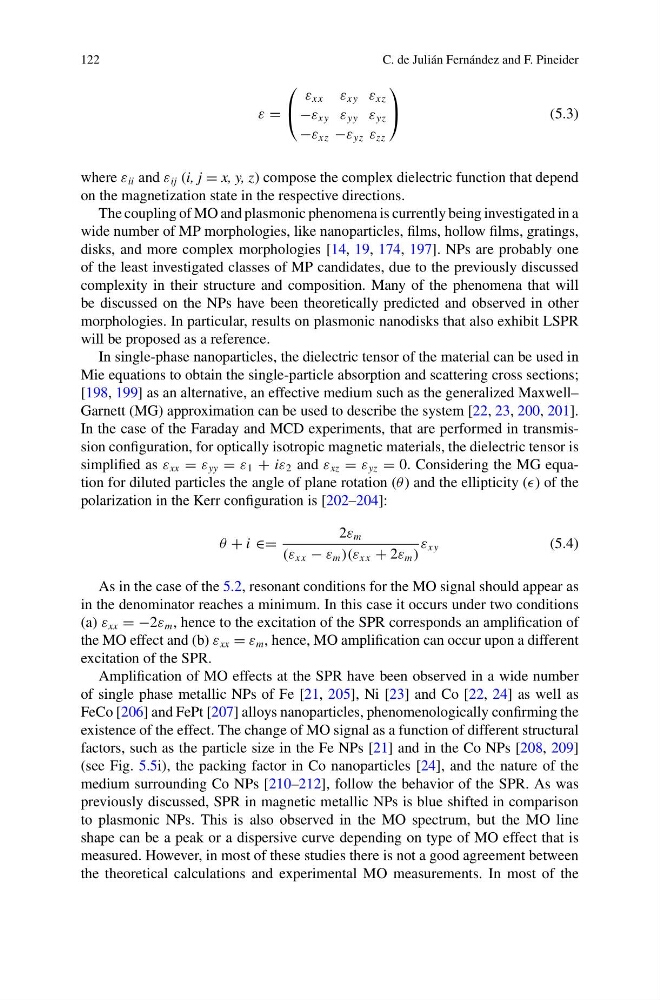
where ε ii and ε ij (i, j = x, y, z) compose the complex dielectric function that depend
on the magnetization state in the respective directions.
The coupling of MO and plasmonic phenomena is currently being investigated in a
wide number of MP morphologies, like nanoparticles, films, hollow films, gratings,
disks, and more complex morphologies [14, 19, 174, 197]. NPs are probably one
of the least investigated classes of MP candidates, due to the previously discussed
complexity in their structure and composition. Many of the phenomena that will
be discussed on the NPs have been theoretically predicted and observed in other
morphologies. In particular, results on plasmonic nanodisks that also exhibit LSPR
will be proposed as a reference.
In single-phase nanoparticles, the dielectric tensor of the material can be used in
Mie equations to obtain the single-particle absorption and scattering cross sections;
[198, 199] as an alternative, an effective medium such as the generalized Maxwell–
Garnett (MG) approximation can be used to describe the system [22, 23, 200, 201].
In the case of the Faraday and MCD experiments, that are performed in transmission configuration, for optically isotropic magnetic materials, the dielectric tensor is
simplified as ε xx = ε yy = ε 1 + iε 2 and ε xz = ε yz = 0. Considering the MG equation for diluted particles the angle of plane rotation (θ ) and the ellipticity () of the
polarization in the Kerr configuration is [202–204]:
θ + i ∈=
2ε m
(ε xx − ε m )(ε xx + 2ε m )
ε xy
(5.4)
As in the case of the 5.2, resonant conditions for the MO signal should appear as
in the denominator reaches a minimum. In this case it occurs under two conditions
(a) ε xx = −2ε m , hence to the excitation of the SPR corresponds an amplification of
the MO effect and (b) ε xx = ε m , hence, MO amplification can occur upon a different
excitation of the SPR.
Amplification of MO effects at the SPR have been observed in a wide number
of single phase metallic NPs of Fe [21, 205], Ni [23] and Co [22, 24] as well as
FeCo [206] and FePt [207] alloys nanoparticles, phenomenologically confirming the
existence of the effect. The change of MO signal as a function of different structural
factors, such as the particle size in the Fe NPs [21] and in the Co NPs [208, 209]
(see Fig. 5.5i), the packing factor in Co nanoparticles [24], and the nature of the
medium surrounding Co NPs [210–212], follow the behavior of the SPR. As was
previously discussed, SPR in magnetic metallic NPs is blue shifted in comparison
to plasmonic NPs. This is also observed in the MO spectrum, but the MO line
shape can be a peak or a dispersive curve depending on type of MO effect that is
measured. However, in most of these studies there is not a good agreement between
the theoretical calculations and experimental MO measurements. In most of the
C. de Julián Fernández and F. Pineider
ε =
⎛
⎝
ε xx ε xy ε xz
−ε xy ε yy ε yz
−ε xz −ε yz ε zz
⎞
⎠
(5.3)
where ε ii and ε ij (i, j = x, y, z) compose the complex dielectric function that depend
on the magnetization state in the respective directions.
The coupling of MO and plasmonic phenomena is currently being investigated in a
wide number of MP morphologies, like nanoparticles, films, hollow films, gratings,
disks, and more complex morphologies [14, 19, 174, 197]. NPs are probably one
of the least investigated classes of MP candidates, due to the previously discussed
complexity in their structure and composition. Many of the phenomena that will
be discussed on the NPs have been theoretically predicted and observed in other
morphologies. In particular, results on plasmonic nanodisks that also exhibit LSPR
will be proposed as a reference.
In single-phase nanoparticles, the dielectric tensor of the material can be used in
Mie equations to obtain the single-particle absorption and scattering cross sections;
[198, 199] as an alternative, an effective medium such as the generalized Maxwell–
Garnett (MG) approximation can be used to describe the system [22, 23, 200, 201].
In the case of the Faraday and MCD experiments, that are performed in transmission configuration, for optically isotropic magnetic materials, the dielectric tensor is
simplified as ε xx = ε yy = ε 1 + iε 2 and ε xz = ε yz = 0. Considering the MG equation for diluted particles the angle of plane rotation (θ ) and the ellipticity () of the
polarization in the Kerr configuration is [202–204]:
θ + i ∈=
2ε m
(ε xx − ε m )(ε xx + 2ε m )
ε xy
(5.4)
As in the case of the 5.2, resonant conditions for the MO signal should appear as
in the denominator reaches a minimum. In this case it occurs under two conditions
(a) ε xx = −2ε m , hence to the excitation of the SPR corresponds an amplification of
the MO effect and (b) ε xx = ε m , hence, MO amplification can occur upon a different
excitation of the SPR.
Amplification of MO effects at the SPR have been observed in a wide number
of single phase metallic NPs of Fe [21, 205], Ni [23] and Co [22, 24] as well as
FeCo [206] and FePt [207] alloys nanoparticles, phenomenologically confirming the
existence of the effect. The change of MO signal as a function of different structural
factors, such as the particle size in the Fe NPs [21] and in the Co NPs [208, 209]
(see Fig. 5.5i), the packing factor in Co nanoparticles [24], and the nature of the
medium surrounding Co NPs [210–212], follow the behavior of the SPR. As was
previously discussed, SPR in magnetic metallic NPs is blue shifted in comparison
to plasmonic NPs. This is also observed in the MO spectrum, but the MO line
shape can be a peak or a dispersive curve depending on type of MO effect that is
measured. However, in most of these studies there is not a good agreement between
the theoretical calculations and experimental MO measurements. In most of the