

5 Magneto-Plasmonic Nanoparticles
113
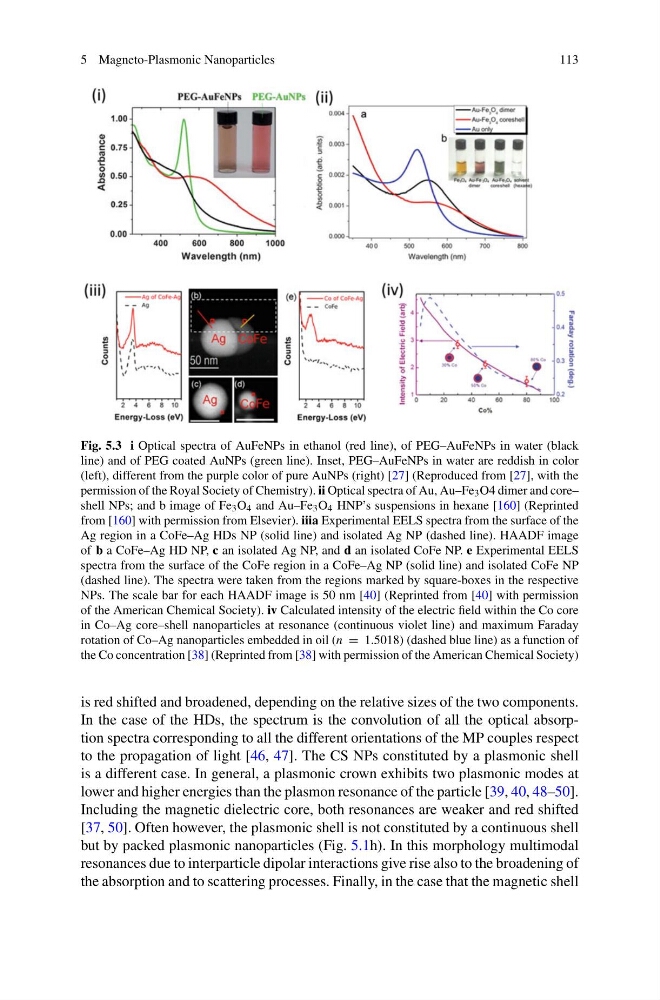
Fig. 5.3 i Optical spectra of AuFeNPs in ethanol (red line), of PEG–AuFeNPs in water (black
line) and of PEG coated AuNPs (green line). Inset, PEG–AuFeNPs in water are reddish in color
(left), different from the purple color of pure AuNPs (right) [27] (Reproduced from [27], with the
permission of the Royal Society of Chemistry). ii Optical spectra of Au, Au–Fe 3 O4 dimer and core–
shell NPs; and b image of Fe 3 O 4 and Au–Fe 3 O 4 HNP’s suspensions in hexane [160] (Reprinted
from [160] with permission from Elsevier). iiia Experimental EELS spectra from the surface of the
Ag region in a CoFe–Ag HDs NP (solid line) and isolated Ag NP (dashed line). HAADF image
of b a CoFe–Ag HD NP, c an isolated Ag NP, and d an isolated CoFe NP. e Experimental EELS
spectra from the surface of the CoFe region in a CoFe–Ag NP (solid line) and isolated CoFe NP
(dashed line). The spectra were taken from the regions marked by square-boxes in the respective
NPs. The scale bar for each HAADF image is 50 nm [40] (Reprinted from [40] with permission
of the American Chemical Society). iv Calculated intensity of the electric field within the Co core
in Co–Ag core–shell nanoparticles at resonance (continuous violet line) and maximum Faraday
rotation of Co–Ag nanoparticles embedded in oil (n = 1.5018) (dashed blue line) as a function of
the Co concentration [38] (Reprinted from [38] with permission of the American Chemical Society)
is red shifted and broadened, depending on the relative sizes of the two components.
In the case of the HDs, the spectrum is the convolution of all the optical absorption spectra corresponding to all the different orientations of the MP couples respect
to the propagation of light [46, 47]. The CS NPs constituted by a plasmonic shell
is a different case. In general, a plasmonic crown exhibits two plasmonic modes at
lower and higher energies than the plasmon resonance of the particle [39, 40, 48–50].
Including the magnetic dielectric core, both resonances are weaker and red shifted
[37, 50]. Often however, the plasmonic shell is not constituted by a continuous shell
but by packed plasmonic nanoparticles (Fig. 5.1h). In this morphology multimodal
resonances due to interparticle dipolar interactions give rise also to the broadening of
the absorption and to scattering processes. Finally, in the case that the magnetic shell
113
Fig. 5.3 i Optical spectra of AuFeNPs in ethanol (red line), of PEG–AuFeNPs in water (black
line) and of PEG coated AuNPs (green line). Inset, PEG–AuFeNPs in water are reddish in color
(left), different from the purple color of pure AuNPs (right) [27] (Reproduced from [27], with the
permission of the Royal Society of Chemistry). ii Optical spectra of Au, Au–Fe 3 O4 dimer and core–
shell NPs; and b image of Fe 3 O 4 and Au–Fe 3 O 4 HNP’s suspensions in hexane [160] (Reprinted
from [160] with permission from Elsevier). iiia Experimental EELS spectra from the surface of the
Ag region in a CoFe–Ag HDs NP (solid line) and isolated Ag NP (dashed line). HAADF image
of b a CoFe–Ag HD NP, c an isolated Ag NP, and d an isolated CoFe NP. e Experimental EELS
spectra from the surface of the CoFe region in a CoFe–Ag NP (solid line) and isolated CoFe NP
(dashed line). The spectra were taken from the regions marked by square-boxes in the respective
NPs. The scale bar for each HAADF image is 50 nm [40] (Reprinted from [40] with permission
of the American Chemical Society). iv Calculated intensity of the electric field within the Co core
in Co–Ag core–shell nanoparticles at resonance (continuous violet line) and maximum Faraday
rotation of Co–Ag nanoparticles embedded in oil (n = 1.5018) (dashed blue line) as a function of
the Co concentration [38] (Reprinted from [38] with permission of the American Chemical Society)
is red shifted and broadened, depending on the relative sizes of the two components.
In the case of the HDs, the spectrum is the convolution of all the optical absorption spectra corresponding to all the different orientations of the MP couples respect
to the propagation of light [46, 47]. The CS NPs constituted by a plasmonic shell
is a different case. In general, a plasmonic crown exhibits two plasmonic modes at
lower and higher energies than the plasmon resonance of the particle [39, 40, 48–50].
Including the magnetic dielectric core, both resonances are weaker and red shifted
[37, 50]. Often however, the plasmonic shell is not constituted by a continuous shell
but by packed plasmonic nanoparticles (Fig. 5.1h). In this morphology multimodal
resonances due to interparticle dipolar interactions give rise also to the broadening of
the absorption and to scattering processes. Finally, in the case that the magnetic shell