

5 Magneto-Plasmonic Nanoparticles
111
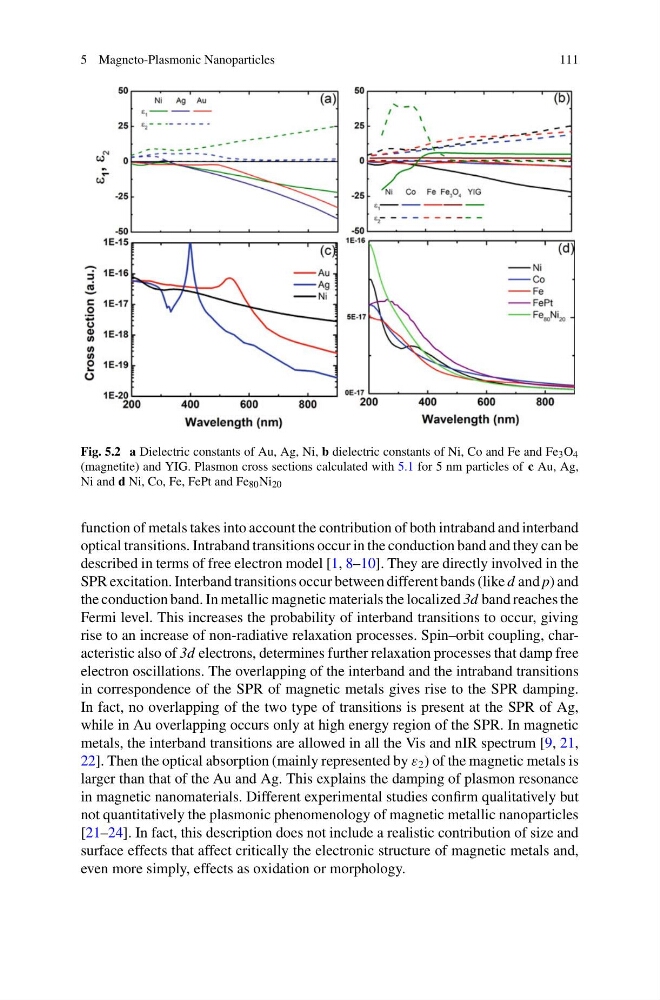
Fig. 5.2 a Dielectric constants of Au, Ag, Ni, b dielectric constants of Ni, Co and Fe and Fe 3 O 4
(magnetite) and YIG. Plasmon cross sections calculated with 5.1 for 5 nm particles of c Au, Ag,
Ni and d Ni, Co, Fe, FePt and Fe 80 Ni 20
function of metals takes into account the contribution of both intraband and interband
optical transitions. Intraband transitions occur in the conduction band and they can be
described in terms of free electron model [1, 8–10]. They are directly involved in the
SPR excitation. Interband transitions occur between different bands (like d and p) and
the conduction band. In metallic magnetic materials the localized 3d band reaches the
Fermi level. This increases the probability of interband transitions to occur, giving
rise to an increase of non-radiative relaxation processes. Spin–orbit coupling, characteristic also of 3d electrons, determines further relaxation processes that damp free
electron oscillations. The overlapping of the interband and the intraband transitions
in correspondence of the SPR of magnetic metals gives rise to the SPR damping.
In fact, no overlapping of the two type of transitions is present at the SPR of Ag,
while in Au overlapping occurs only at high energy region of the SPR. In magnetic
metals, the interband transitions are allowed in all the Vis and nIR spectrum [9, 21,
22]. Then the optical absorption (mainly represented by ε 2 ) of the magnetic metals is
larger than that of the Au and Ag. This explains the damping of plasmon resonance
in magnetic nanomaterials. Different experimental studies confirm qualitatively but
not quantitatively the plasmonic phenomenology of magnetic metallic nanoparticles
[21–24]. In fact, this description does not include a realistic contribution of size and
surface effects that affect critically the electronic structure of magnetic metals and,
even more simply, effects as oxidation or morphology.
111
Fig. 5.2 a Dielectric constants of Au, Ag, Ni, b dielectric constants of Ni, Co and Fe and Fe 3 O 4
(magnetite) and YIG. Plasmon cross sections calculated with 5.1 for 5 nm particles of c Au, Ag,
Ni and d Ni, Co, Fe, FePt and Fe 80 Ni 20
function of metals takes into account the contribution of both intraband and interband
optical transitions. Intraband transitions occur in the conduction band and they can be
described in terms of free electron model [1, 8–10]. They are directly involved in the
SPR excitation. Interband transitions occur between different bands (like d and p) and
the conduction band. In metallic magnetic materials the localized 3d band reaches the
Fermi level. This increases the probability of interband transitions to occur, giving
rise to an increase of non-radiative relaxation processes. Spin–orbit coupling, characteristic also of 3d electrons, determines further relaxation processes that damp free
electron oscillations. The overlapping of the interband and the intraband transitions
in correspondence of the SPR of magnetic metals gives rise to the SPR damping.
In fact, no overlapping of the two type of transitions is present at the SPR of Ag,
while in Au overlapping occurs only at high energy region of the SPR. In magnetic
metals, the interband transitions are allowed in all the Vis and nIR spectrum [9, 21,
22]. Then the optical absorption (mainly represented by ε 2 ) of the magnetic metals is
larger than that of the Au and Ag. This explains the damping of plasmon resonance
in magnetic nanomaterials. Different experimental studies confirm qualitatively but
not quantitatively the plasmonic phenomenology of magnetic metallic nanoparticles
[21–24]. In fact, this description does not include a realistic contribution of size and
surface effects that affect critically the electronic structure of magnetic metals and,
even more simply, effects as oxidation or morphology.