

5 Magneto-Plasmonic Nanoparticles
109
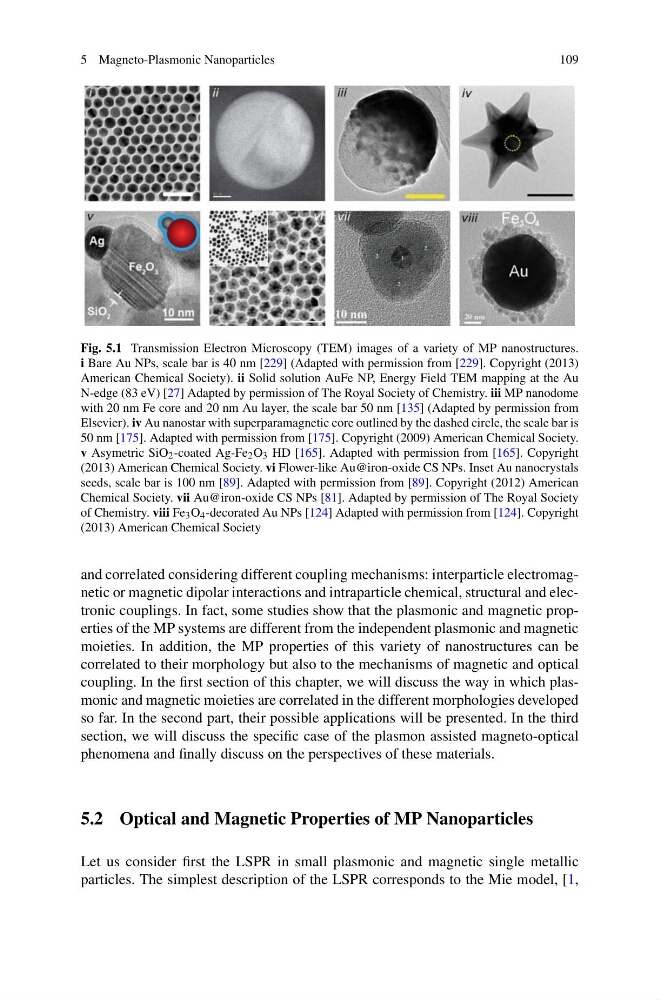
Fig. 5.1 Transmission Electron Microscopy (TEM) images of a variety of MP nanostructures.
i Bare Au NPs, scale bar is 40 nm [229] (Adapted with permission from [229]. Copyright (2013)
American Chemical Society). ii Solid solution AuFe NP, Energy Field TEM mapping at the Au
N-edge (83 eV) [27] Adapted by permission of The Royal Society of Chemistry. iii MP nanodome
with 20 nm Fe core and 20 nm Au layer, the scale bar 50 nm [135] (Adapted by permission from
Elsevier). iv Au nanostar with superparamagnetic core outlined by the dashed circle, the scale bar is
50 nm [175]. Adapted with permission from [175]. Copyright (2009) American Chemical Society.
v Asymetric SiO 2 -coated Ag-Fe 2 O 3 HD [165]. Adapted with permission from [165]. Copyright
(2013) American Chemical Society. vi Flower-like Au@iron-oxide CS NPs. Inset Au nanocrystals
seeds, scale bar is 100 nm [89]. Adapted with permission from [89]. Copyright (2012) American
Chemical Society. vii Au@iron-oxide CS NPs [81]. Adapted by permission of The Royal Society
of Chemistry. viii Fe 3 O 4 -decorated Au NPs [124] Adapted with permission from [124]. Copyright
(2013) American Chemical Society
and correlated considering different coupling mechanisms: interparticle electromagnetic or magnetic dipolar interactions and intraparticle chemical, structural and electronic couplings. In fact, some studies show that the plasmonic and magnetic properties of the MP systems are different from the independent plasmonic and magnetic
moieties. In addition, the MP properties of this variety of nanostructures can be
correlated to their morphology but also to the mechanisms of magnetic and optical
coupling. In the first section of this chapter, we will discuss the way in which plasmonic and magnetic moieties are correlated in the different morphologies developed
so far. In the second part, their possible applications will be presented. In the third
section, we will discuss the specific case of the plasmon assisted magneto-optical
phenomena and finally discuss on the perspectives of these materials.
5.2 Optical and Magnetic Properties of MP Nanoparticles
Let us consider first the LSPR in small plasmonic and magnetic single metallic
particles. The simplest description of the LSPR corresponds to the Mie model, [1,
109
Fig. 5.1 Transmission Electron Microscopy (TEM) images of a variety of MP nanostructures.
i Bare Au NPs, scale bar is 40 nm [229] (Adapted with permission from [229]. Copyright (2013)
American Chemical Society). ii Solid solution AuFe NP, Energy Field TEM mapping at the Au
N-edge (83 eV) [27] Adapted by permission of The Royal Society of Chemistry. iii MP nanodome
with 20 nm Fe core and 20 nm Au layer, the scale bar 50 nm [135] (Adapted by permission from
Elsevier). iv Au nanostar with superparamagnetic core outlined by the dashed circle, the scale bar is
50 nm [175]. Adapted with permission from [175]. Copyright (2009) American Chemical Society.
v Asymetric SiO 2 -coated Ag-Fe 2 O 3 HD [165]. Adapted with permission from [165]. Copyright
(2013) American Chemical Society. vi Flower-like Au@iron-oxide CS NPs. Inset Au nanocrystals
seeds, scale bar is 100 nm [89]. Adapted with permission from [89]. Copyright (2012) American
Chemical Society. vii Au@iron-oxide CS NPs [81]. Adapted by permission of The Royal Society
of Chemistry. viii Fe 3 O 4 -decorated Au NPs [124] Adapted with permission from [124]. Copyright
(2013) American Chemical Society
and correlated considering different coupling mechanisms: interparticle electromagnetic or magnetic dipolar interactions and intraparticle chemical, structural and electronic couplings. In fact, some studies show that the plasmonic and magnetic properties of the MP systems are different from the independent plasmonic and magnetic
moieties. In addition, the MP properties of this variety of nanostructures can be
correlated to their morphology but also to the mechanisms of magnetic and optical
coupling. In the first section of this chapter, we will discuss the way in which plasmonic and magnetic moieties are correlated in the different morphologies developed
so far. In the second part, their possible applications will be presented. In the third
section, we will discuss the specific case of the plasmon assisted magneto-optical
phenomena and finally discuss on the perspectives of these materials.
5.2 Optical and Magnetic Properties of MP Nanoparticles
Let us consider first the LSPR in small plasmonic and magnetic single metallic
particles. The simplest description of the LSPR corresponds to the Mie model, [1,