

1.4 Consumption Behaviours and Yerba Mate Products. One …
13
imposes some reflection when speaking of authenticity and traceability issues: the
global commerce can be an advantage, but adulteration phenomena may occur at
the same time (Chap. 8). Consequently, a deep analysis of the current market and
new marketing perspectives should be recommended. Moreover, the cultural heritage
of yerba mate is a notable key factor explaining partially the success of this plant
worldwide.
The extreme variability of yerba mate-related products may be challenging
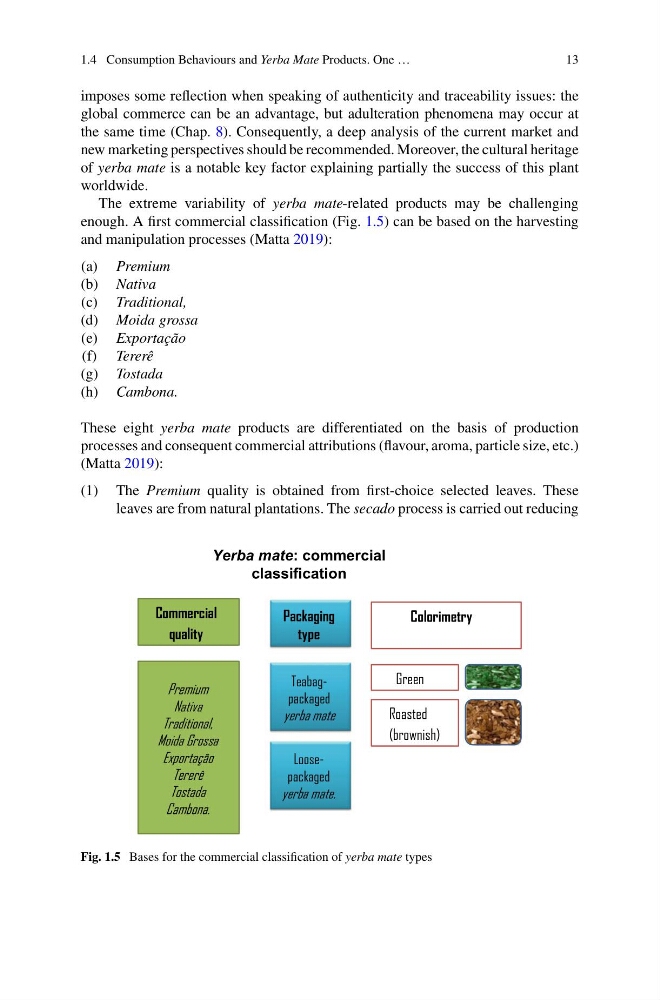
enough. A first commercial classification (Fig. 1.5) can be based on the harvesting
and manipulation processes (Matta 2019):
(a) Premium
(b) Nativa
(c) Traditional,
(d) Moida grossa
(e) Exportação
(f) Tererê
(g) Tostada
(h) Cambona.
These eight yerba mate products are differentiated on the basis of production
processes and consequent commercial attributions (flavour, aroma, particle size, etc.)
(Matta 2019):
(1) The Premium quality is obtained from first-choice selected leaves. These
leaves are from natural plantations. The secado process is carried out reducing
Yerba mate: commercial
classification
Premium
Nativa
Traditional,
Moida Grossa
Exportação
Tererê
Tostada
Cambona.
Commercial
quality
Teabagpackaged
yerba mate
Packaging
type
Green
Colorimetry
Loosepackaged
yerba mate.
Roasted
(brownish)
Fig. 1.5 Bases for the commercial classification of yerba mate types
13
imposes some reflection when speaking of authenticity and traceability issues: the
global commerce can be an advantage, but adulteration phenomena may occur at
the same time (Chap. 8). Consequently, a deep analysis of the current market and
new marketing perspectives should be recommended. Moreover, the cultural heritage
of yerba mate is a notable key factor explaining partially the success of this plant
worldwide.
The extreme variability of yerba mate-related products may be challenging
enough. A first commercial classification (Fig. 1.5) can be based on the harvesting
and manipulation processes (Matta 2019):
(a) Premium
(b) Nativa
(c) Traditional,
(d) Moida grossa
(e) Exportação
(f) Tererê
(g) Tostada
(h) Cambona.
These eight yerba mate products are differentiated on the basis of production
processes and consequent commercial attributions (flavour, aroma, particle size, etc.)
(Matta 2019):
(1) The Premium quality is obtained from first-choice selected leaves. These
leaves are from natural plantations. The secado process is carried out reducing
Yerba mate: commercial
classification
Premium
Nativa
Traditional,
Moida Grossa
Exportação
Tererê
Tostada
Cambona.
Commercial
quality
Teabagpackaged
yerba mate
Packaging
type
Green
Colorimetry
Loosepackaged
yerba mate.
Roasted
(brownish)
Fig. 1.5 Bases for the commercial classification of yerba mate types