

1.3 Ilex Paraguariensis, a Peculiar Plant, and Yerba Mate
9
1.3.3 Native Versus Cultivated Yerba Mate. Harvesting
and Cultivation Procedures, and National Differences
The basic differences between Brazilian and Argentinean yerba mate strongly depend
on their production methods. Actually, the most correct definition should be ‘cultivation & harvesting’; on the other hand, the simple harvesting in natural forests is
still carried out, with the obvious elimination of plantation procedures.
1.3.3.1 Native Yerba Mate. Production Steps
With exclusive reference to ‘native’ yerba mate, the following production steps have
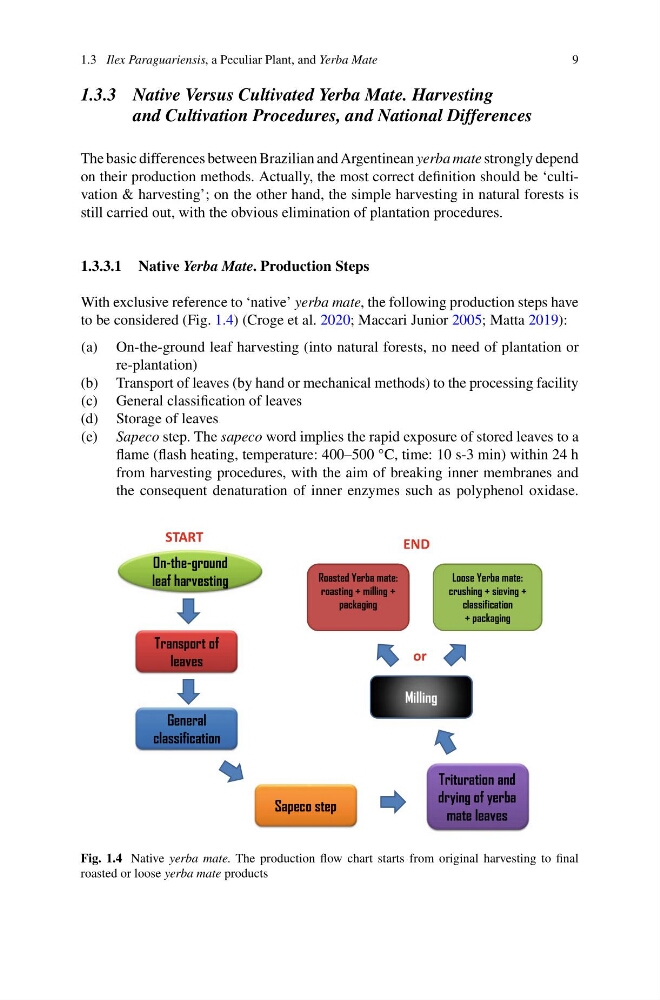
to be considered (Fig. 1.4) (Croge et al. 2020; Maccari Junior 2005; Matta 2019):
(a) On-the-ground leaf harvesting (into natural forests, no need of plantation or
re-plantation)
(b) Transport of leaves (by hand or mechanical methods) to the processing facility
(c) General classification of leaves
(d) Storage of leaves
(e) Sapeco step. The sapeco word implies the rapid exposure of stored leaves to a
flame (flash heating, temperature: 400–500 °C, time: 10 s-3 min) within 24 h
from harvesting procedures, with the aim of breaking inner membranes and
the consequent denaturation of inner enzymes such as polyphenol oxidase.
On-the-ground
leaf harvesting
Transport of
leaves
General
classification
Sapeco step
Trituration and
drying of yerba
mate leaves
Milling
Roasted Yerba mate:
roasting + milling +
packaging
Loose Yerba mate:
crushing + sieving +
classification
+ packaging
START
END
or
Fig. 1.4 Native yerba mate. The production flow chart starts from original harvesting to final
roasted or loose yerba mate products
9
1.3.3 Native Versus Cultivated Yerba Mate. Harvesting
and Cultivation Procedures, and National Differences
The basic differences between Brazilian and Argentinean yerba mate strongly depend
on their production methods. Actually, the most correct definition should be ‘cultivation & harvesting’; on the other hand, the simple harvesting in natural forests is
still carried out, with the obvious elimination of plantation procedures.
1.3.3.1 Native Yerba Mate. Production Steps
With exclusive reference to ‘native’ yerba mate, the following production steps have
to be considered (Fig. 1.4) (Croge et al. 2020; Maccari Junior 2005; Matta 2019):
(a) On-the-ground leaf harvesting (into natural forests, no need of plantation or
re-plantation)
(b) Transport of leaves (by hand or mechanical methods) to the processing facility
(c) General classification of leaves
(d) Storage of leaves
(e) Sapeco step. The sapeco word implies the rapid exposure of stored leaves to a
flame (flash heating, temperature: 400–500 °C, time: 10 s-3 min) within 24 h
from harvesting procedures, with the aim of breaking inner membranes and
the consequent denaturation of inner enzymes such as polyphenol oxidase.
On-the-ground
leaf harvesting
Transport of
leaves
General
classification
Sapeco step
Trituration and
drying of yerba
mate leaves
Milling
Roasted Yerba mate:
roasting + milling +
packaging
Loose Yerba mate:
crushing + sieving +
classification
+ packaging
START
END
or
Fig. 1.4 Native yerba mate. The production flow chart starts from original harvesting to final
roasted or loose yerba mate products