

1.3 Ilex Paraguariensis, a Peculiar Plant, and Yerba Mate
7
and Brazil (Southern region). This plant has been and is still used for centuries
because of different claimed properties, in form of beverage (infusion of yerba mate
leaves), under the following names: mate, chimarrão, and tererê.
The commercial and scientific interest in these plants and related infusions depend
on their global diffusion, while the origin of I. paraguariensis is in the South American area only. Differently from coffee, and similarly to açaí berries, it can be assumed
that I. paraguariensis is really a specific plant of the South American continent,
explaining how certain products are the most concrete expression of biodiversity.
This plant needs subtropical environments (average temperatures: 21–22 °C, with
tolerated minimum temperature of 6 °C), and 1,200 mm of yearly (and possibly
constant) rainfall: it flourishes from October to November, and related fruits (dark-tored drupes, estimated length: 4–6 mm) are produced in the March–June period (Matta
2019). Consequently, snowfalls may be tolerated enough, and this aspect is important
because cultivated and native regions include mountainous also (Heck and Mejia
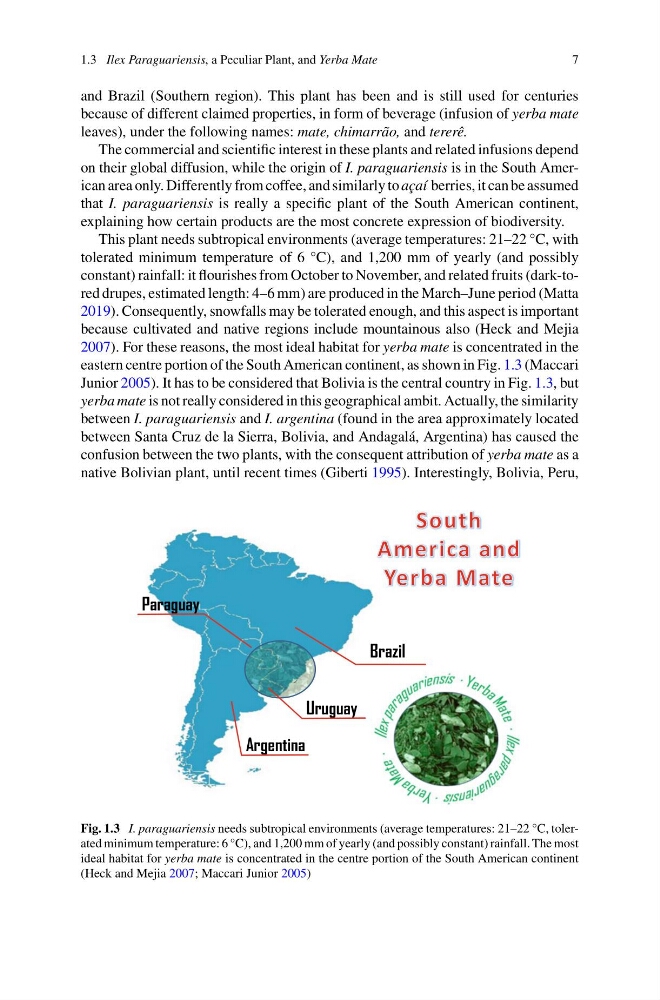
2007). For these reasons, the most ideal habitat for yerba mate is concentrated in the
eastern centre portion of the South American continent, as shown in Fig. 1.3 (Maccari
Junior 2005). It has to be considered that Bolivia is the central country in Fig. 1.3, but
yerba mate is not really considered in this geographical ambit. Actually, the similarity
between I. paraguariensis and I. argentina (found in the area approximately located
between Santa Cruz de la Sierra, Bolivia, and Andagalá, Argentina) has caused the
confusion between the two plants, with the consequent attribution of yerba mate as a
native Bolivian plant, until recent times (Giberti 1995). Interestingly, Bolivia, Peru,
Brazil
Argentina
Paraguay
Uruguay
Fig. 1.3 I. paraguariensis needs subtropical environments (average temperatures: 21–22 °C, tolerated minimum temperature: 6 °C), and 1,200 mm of yearly (and possibly constant) rainfall. The most
ideal habitat for yerba mate is concentrated in the centre portion of the South American continent
(Heck and Mejia 2007; Maccari Junior 2005)
7
and Brazil (Southern region). This plant has been and is still used for centuries
because of different claimed properties, in form of beverage (infusion of yerba mate
leaves), under the following names: mate, chimarrão, and tererê.
The commercial and scientific interest in these plants and related infusions depend
on their global diffusion, while the origin of I. paraguariensis is in the South American area only. Differently from coffee, and similarly to açaí berries, it can be assumed
that I. paraguariensis is really a specific plant of the South American continent,
explaining how certain products are the most concrete expression of biodiversity.
This plant needs subtropical environments (average temperatures: 21–22 °C, with
tolerated minimum temperature of 6 °C), and 1,200 mm of yearly (and possibly
constant) rainfall: it flourishes from October to November, and related fruits (dark-tored drupes, estimated length: 4–6 mm) are produced in the March–June period (Matta
2019). Consequently, snowfalls may be tolerated enough, and this aspect is important
because cultivated and native regions include mountainous also (Heck and Mejia
2007). For these reasons, the most ideal habitat for yerba mate is concentrated in the
eastern centre portion of the South American continent, as shown in Fig. 1.3 (Maccari
Junior 2005). It has to be considered that Bolivia is the central country in Fig. 1.3, but
yerba mate is not really considered in this geographical ambit. Actually, the similarity
between I. paraguariensis and I. argentina (found in the area approximately located
between Santa Cruz de la Sierra, Bolivia, and Andagalá, Argentina) has caused the
confusion between the two plants, with the consequent attribution of yerba mate as a
native Bolivian plant, until recent times (Giberti 1995). Interestingly, Bolivia, Peru,
Brazil
Argentina
Paraguay
Uruguay
Fig. 1.3 I. paraguariensis needs subtropical environments (average temperatures: 21–22 °C, tolerated minimum temperature: 6 °C), and 1,200 mm of yearly (and possibly constant) rainfall. The most
ideal habitat for yerba mate is concentrated in the centre portion of the South American continent
(Heck and Mejia 2007; Maccari Junior 2005)