

72
2 Critical Mass, Efficiency, and Yield
The second way of using (2.46) is to specify R tamp , and then solve for R thresh , the
radius of a core which would just be critical for the specified tamper outer radius.
This can be a handy calculation if the size of your bomb is limited in advance by
some condition such as the diameter of a missile tube.
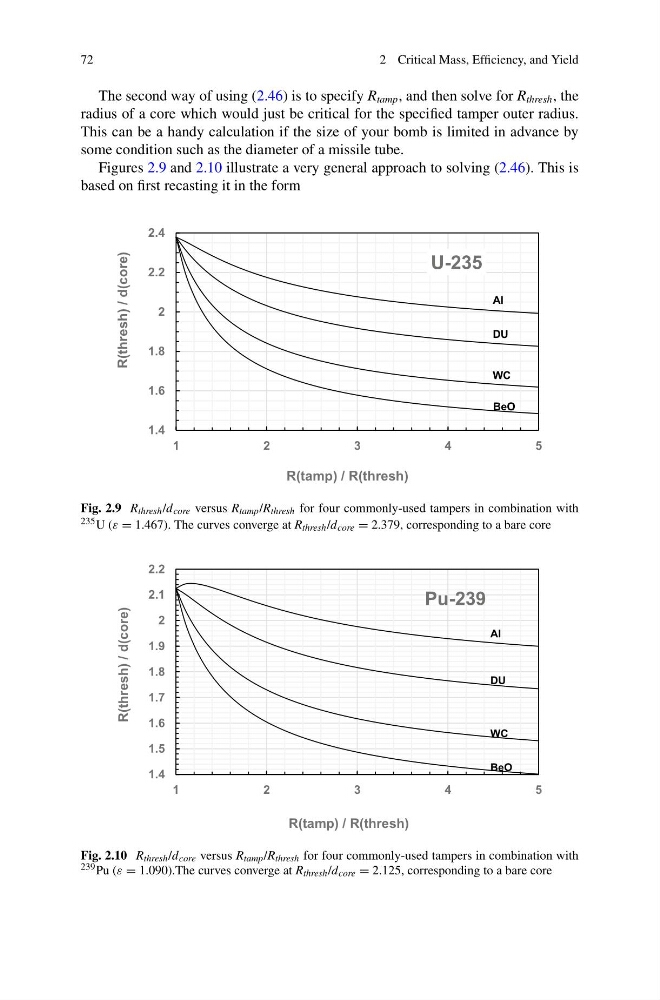
Figures 2.9 and 2.10 illustrate a very general approach to solving (2.46). This is
based on first recasting it in the form
1.4
1.6
1.8
2
2.2
2.4
1
2
3
4
5
R(thresh) / d(core)
R(tamp) / R(thresh)
U-235
WC
BeO
DU
Al
Fig. 2.9 R thresh /d core versus R tamp /R thresh for four commonly-used tampers in combination with
235 U (ε = 1.467). The curves converge at R thresh /d core = 2.379, corresponding to a bare core
1.4
1.5
1.6
1.7
1.8
1.9
2
2.1
2.2
1
2
3
4
5
R(thresh) / d(core)
R(tamp) / R(thresh)
Pu-239
WC
BeO
DU
Al
Fig. 2.10 R thresh /d core versus R tamp /R thresh for four commonly-used tampers in combination with
239 Pu (ε = 1.090).The curves converge at R thresh /d core = 2.125, corresponding to a bare core
2 Critical Mass, Efficiency, and Yield
The second way of using (2.46) is to specify R tamp , and then solve for R thresh , the
radius of a core which would just be critical for the specified tamper outer radius.
This can be a handy calculation if the size of your bomb is limited in advance by
some condition such as the diameter of a missile tube.
Figures 2.9 and 2.10 illustrate a very general approach to solving (2.46). This is
based on first recasting it in the form
1.4
1.6
1.8
2
2.2
2.4
1
2
3
4
5
R(thresh) / d(core)
R(tamp) / R(thresh)
U-235
WC
BeO
DU
Al
Fig. 2.9 R thresh /d core versus R tamp /R thresh for four commonly-used tampers in combination with
235 U (ε = 1.467). The curves converge at R thresh /d core = 2.379, corresponding to a bare core
1.4
1.5
1.6
1.7
1.8
1.9
2
2.1
2.2
1
2
3
4
5
R(thresh) / d(core)
R(tamp) / R(thresh)
Pu-239
WC
BeO
DU
Al
Fig. 2.10 R thresh /d core versus R tamp /R thresh for four commonly-used tampers in combination with
239 Pu (ε = 1.090).The curves converge at R thresh /d core = 2.125, corresponding to a bare core