

I hope that readers will discover, as I did, that studying nuclear weapons is not only
fascinating in its own right, but is an excellent vehicle for reinforcing understanding
of many foundational areas of physics such as energy, electromagnetism, dynamics,
statistical mechanics, modern physics, and, of course, nuclear physics—as well as
their attendant mathematical techniques.
This book is neither a conventional text nor a work of history. I assume that
readers are already familiar with the basic history of some of the physics that led to
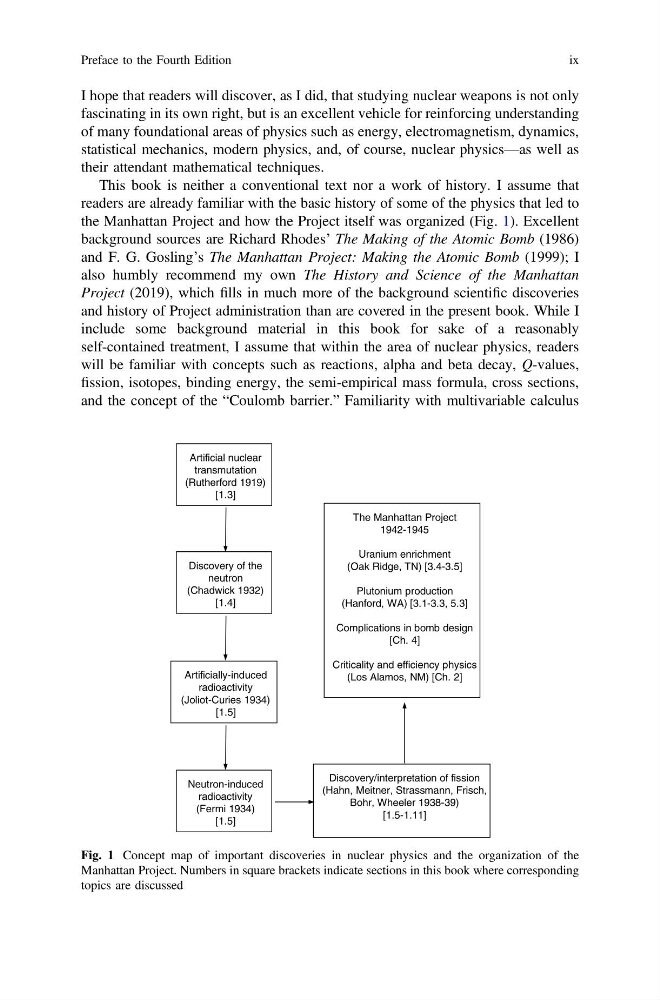
the Manhattan Project and how the Project itself was organized (Fig. 1). Excellent
background sources are Richard Rhodes’ The Making of the Atomic Bomb (1986)
and F. G. Gosling’s The Manhattan Project: Making the Atomic Bomb (1999); I
also humbly recommend my own The History and Science of the Manhattan
Project (2019), which fills in much more of the background scientific discoveries
and history of Project administration than are covered in the present book. While I
include some background material in this book for sake of a reasonably
self-contained treatment, I assume that within the area of nuclear physics, readers
will be familiar with concepts such as reactions, alpha and beta decay, Q-values,
fission, isotopes, binding energy, the semi-empirical mass formula, cross sections,
and the concept of the “Coulomb barrier.” Familiarity with multivariable calculus
Artificial nuclear
transmutation
(Rutherford 1919)
[1.3]
Discovery of the
neutron
(Chadwick 1932)
[1.4]
Artificially-induced
radioactivity
(Joliot-Curies 1934)
[1.5]
Neutron-induced
radioactivity
(Fermi 1934)
[1.5]
Discovery/interpretation of fission
(Hahn, Meitner, Strassmann, Frisch,
Bohr, Wheeler 1938-39)
[1.5-1.11]
The Manhattan Project
1942-1945
Uranium enrichment
(Oak Ridge, TN) [3.4-3.5]
Plutonium production
(Hanford, WA) [3.1-3.3, 5.3]
Complications in bomb design
[Ch. 4]
Criticality and efficiency physics
(Los Alamos, NM) [Ch. 2]
Fig. 1 Concept map of important discoveries in nuclear physics and the organization of the
Manhattan Project. Numbers in square brackets indicate sections in this book where corresponding
topics are discussed
Preface to the Fourth Edition
ix
fascinating in its own right, but is an excellent vehicle for reinforcing understanding
of many foundational areas of physics such as energy, electromagnetism, dynamics,
statistical mechanics, modern physics, and, of course, nuclear physics—as well as
their attendant mathematical techniques.
This book is neither a conventional text nor a work of history. I assume that
readers are already familiar with the basic history of some of the physics that led to
the Manhattan Project and how the Project itself was organized (Fig. 1). Excellent
background sources are Richard Rhodes’ The Making of the Atomic Bomb (1986)
and F. G. Gosling’s The Manhattan Project: Making the Atomic Bomb (1999); I
also humbly recommend my own The History and Science of the Manhattan
Project (2019), which fills in much more of the background scientific discoveries
and history of Project administration than are covered in the present book. While I
include some background material in this book for sake of a reasonably
self-contained treatment, I assume that within the area of nuclear physics, readers
will be familiar with concepts such as reactions, alpha and beta decay, Q-values,
fission, isotopes, binding energy, the semi-empirical mass formula, cross sections,
and the concept of the “Coulomb barrier.” Familiarity with multivariable calculus
Artificial nuclear
transmutation
(Rutherford 1919)
[1.3]
Discovery of the
neutron
(Chadwick 1932)
[1.4]
Artificially-induced
radioactivity
(Joliot-Curies 1934)
[1.5]
Neutron-induced
radioactivity
(Fermi 1934)
[1.5]
Discovery/interpretation of fission
(Hahn, Meitner, Strassmann, Frisch,
Bohr, Wheeler 1938-39)
[1.5-1.11]
The Manhattan Project
1942-1945
Uranium enrichment
(Oak Ridge, TN) [3.4-3.5]
Plutonium production
(Hanford, WA) [3.1-3.3, 5.3]
Complications in bomb design
[Ch. 4]
Criticality and efficiency physics
(Los Alamos, NM) [Ch. 2]
Fig. 1 Concept map of important discoveries in nuclear physics and the organization of the
Manhattan Project. Numbers in square brackets indicate sections in this book where corresponding
topics are discussed
Preface to the Fourth Edition
ix