

2.1 Cross-Sections, Mean Free Path, and the Diffusion Equation
55
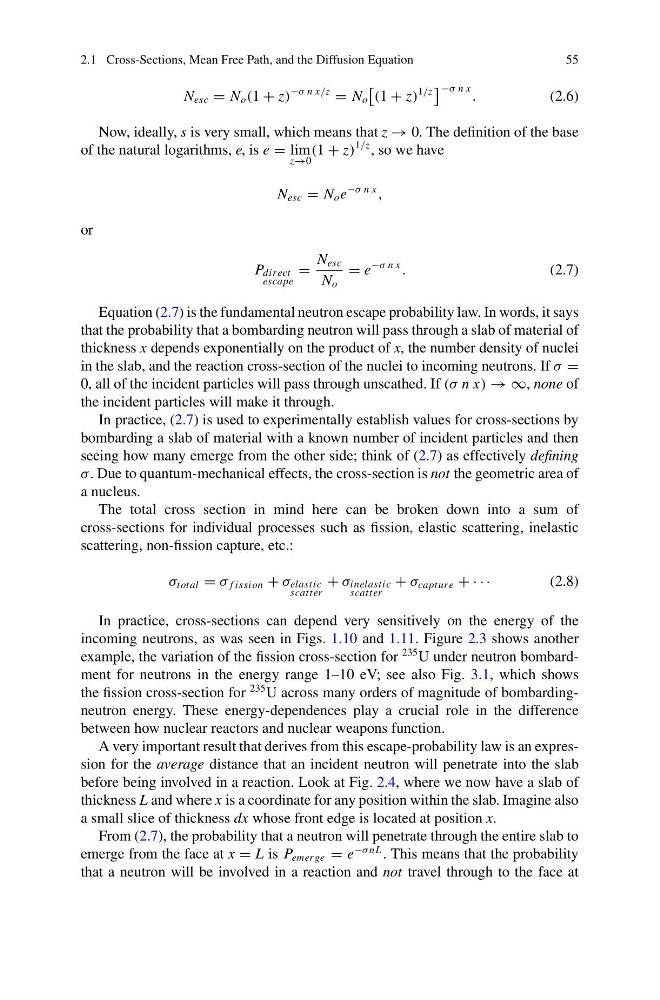
N esc = N o (1 + z)
−σ n x/z
= N o
(1 + z)
1/z
−σ n x .
(2.6)
Now, ideally, s is very small, which means that z → 0. The definition of the base
of the natural logarithms, e, is e = lim
z→0
(1 + z)
1/z , so we have
N esc = N o e
−σ n x
,
or
P direct
escape
=
N esc
N o
= e
−σ n x
.
(2.7)
Equation (2.7) is the fundamental neutron escape probability law. In words, it says
that the probability that a bombarding neutron will pass through a slab of material of
thickness x depends exponentially on the product of x, the number density of nuclei
in the slab, and the reaction cross-section of the nuclei to incoming neutrons. If σ =
0, all of the incident particles will pass through unscathed. If (σ n x) → ∞, none of
the incident particles will make it through.
In practice, (2.7) is used to experimentally establish values for cross-sections by
bombarding a slab of material with a known number of incident particles and then
seeing how many emerge from the other side; think of (2.7) as effectively defining
σ. Due to quantum-mechanical effects, the cross-section is not the geometric area of
a nucleus.
The total cross section in mind here can be broken down into a sum of
cross-sections for individual processes such as fission, elastic scattering, inelastic
scattering, non-fission capture, etc.:
σ total = σ f ission + σ elastic
scatter
+ σ inelastic
scatter
+ σ capture + · · ·
(2.8)
In practice, cross-sections can depend very sensitively on the energy of the
incoming neutrons, as was seen in Figs. 1.10 and 1.11. Figure 2.3 shows another
example, the variation of the fission cross-section for
235 U under neutron bombardment for neutrons in the energy range 1–10 eV; see also Fig. 3.1, which shows
the fission cross-section for
235 U across many orders of magnitude of bombardingneutron energy. These energy-dependences play a crucial role in the difference
between how nuclear reactors and nuclear weapons function.
A very important result that derives from this escape-probability law is an expression for the average distance that an incident neutron will penetrate into the slab
before being involved in a reaction. Look at Fig. 2.4, where we now have a slab of
thickness L and where x is a coordinate for any position within the slab. Imagine also
a small slice of thickness dx whose front edge is located at position x.
From (2.7), the probability that a neutron will penetrate through the entire slab to
emerge from the face at x = L is P emerge = e
−σ nL . This means that the probability
that a neutron will be involved in a reaction and not travel through to the face at
55
N esc = N o (1 + z)
−σ n x/z
= N o
(1 + z)
1/z
−σ n x .
(2.6)
Now, ideally, s is very small, which means that z → 0. The definition of the base
of the natural logarithms, e, is e = lim
z→0
(1 + z)
1/z , so we have
N esc = N o e
−σ n x
,
or
P direct
escape
=
N esc
N o
= e
−σ n x
.
(2.7)
Equation (2.7) is the fundamental neutron escape probability law. In words, it says
that the probability that a bombarding neutron will pass through a slab of material of
thickness x depends exponentially on the product of x, the number density of nuclei
in the slab, and the reaction cross-section of the nuclei to incoming neutrons. If σ =
0, all of the incident particles will pass through unscathed. If (σ n x) → ∞, none of
the incident particles will make it through.
In practice, (2.7) is used to experimentally establish values for cross-sections by
bombarding a slab of material with a known number of incident particles and then
seeing how many emerge from the other side; think of (2.7) as effectively defining
σ. Due to quantum-mechanical effects, the cross-section is not the geometric area of
a nucleus.
The total cross section in mind here can be broken down into a sum of
cross-sections for individual processes such as fission, elastic scattering, inelastic
scattering, non-fission capture, etc.:
σ total = σ f ission + σ elastic
scatter
+ σ inelastic
scatter
+ σ capture + · · ·
(2.8)
In practice, cross-sections can depend very sensitively on the energy of the
incoming neutrons, as was seen in Figs. 1.10 and 1.11. Figure 2.3 shows another
example, the variation of the fission cross-section for
235 U under neutron bombardment for neutrons in the energy range 1–10 eV; see also Fig. 3.1, which shows
the fission cross-section for
235 U across many orders of magnitude of bombardingneutron energy. These energy-dependences play a crucial role in the difference
between how nuclear reactors and nuclear weapons function.
A very important result that derives from this escape-probability law is an expression for the average distance that an incident neutron will penetrate into the slab
before being involved in a reaction. Look at Fig. 2.4, where we now have a slab of
thickness L and where x is a coordinate for any position within the slab. Imagine also
a small slice of thickness dx whose front edge is located at position x.
From (2.7), the probability that a neutron will penetrate through the entire slab to
emerge from the face at x = L is P emerge = e
−σ nL . This means that the probability
that a neutron will be involved in a reaction and not travel through to the face at