

2.1 Cross-Sections, Mean Free Path, and the Diffusion Equation
53
nuclear number
density n
s
surface
area
bombardment rate
Ro neutrons
per m 2 per second
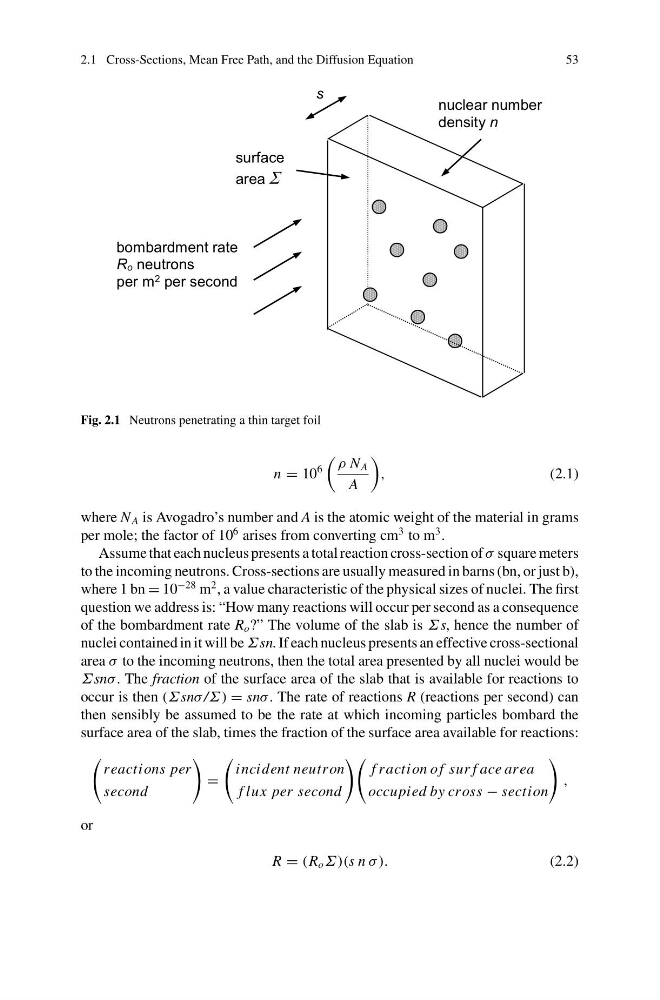
Fig. 2.1 Neutrons penetrating a thin target foil
n = 10
6
ρ N A
A
,
(2.1)
where N A is Avogadro’s number and A is the atomic weight of the material in grams
per mole; the factor of 10
6 arises from converting cm
3 to m
3 .
Assume that each nucleus presents a total reaction cross-section of σ square meters
to the incoming neutrons. Cross-sections are usually measured in barns (bn, or just b),
where 1 bn = 10
−28 m
2 , a value characteristic of the physical sizes of nuclei. The first
question we address is: “How many reactions will occur per second as a consequence
of the bombardment rate R o ?” The volume of the slab is Σs, hence the number of
nuclei contained in it will be Σsn. If each nucleus presents an effective cross-sectional
area σ to the incoming neutrons, then the total area presented by all nuclei would be
Σsnσ. The fraction of the surface area of the slab that is available for reactions to
occur is then (Σsnσ /Σ) = snσ. The rate of reactions R (reactions per second) can
then sensibly be assumed to be the rate at which incoming particles bombard the
surface area of the slab, times the fraction of the surface area available for reactions:
reactions per
second
=
incident neutron
f lux per second
f raction o f sur f ace area
occupied by cross − section
,
or
R = (R o Σ)(s n σ ).
(2.2)
53
nuclear number
density n
s
surface
area
bombardment rate
Ro neutrons
per m 2 per second
Fig. 2.1 Neutrons penetrating a thin target foil
n = 10
6
ρ N A
A
,
(2.1)
where N A is Avogadro’s number and A is the atomic weight of the material in grams
per mole; the factor of 10
6 arises from converting cm
3 to m
3 .
Assume that each nucleus presents a total reaction cross-section of σ square meters
to the incoming neutrons. Cross-sections are usually measured in barns (bn, or just b),
where 1 bn = 10
−28 m
2 , a value characteristic of the physical sizes of nuclei. The first
question we address is: “How many reactions will occur per second as a consequence
of the bombardment rate R o ?” The volume of the slab is Σs, hence the number of
nuclei contained in it will be Σsn. If each nucleus presents an effective cross-sectional
area σ to the incoming neutrons, then the total area presented by all nuclei would be
Σsnσ. The fraction of the surface area of the slab that is available for reactions to
occur is then (Σsnσ /Σ) = snσ. The rate of reactions R (reactions per second) can
then sensibly be assumed to be the rate at which incoming particles bombard the
surface area of the slab, times the fraction of the surface area available for reactions:
reactions per
second
=
incident neutron
f lux per second
f raction o f sur f ace area
occupied by cross − section
,
or
R = (R o Σ)(s n σ ).
(2.2)