

36
1 Energy Release in Nuclear Reactions, Neutrons, Fission, and Characteristics …
α =
f
2/3
+ 1
(1 + f )
2/3
,
(1.79)
β =
f
5/3
+ 1
(1 + f )
5/3
,
(1.80)
and
γ =
(5/3) f
(1 + f )
5/3
f 1/3 + 1
.
(1.81)
The difference in energy between the fissioned and original configurations is given
by
E = U
f iss
E
− U
orig
E
= a S A
2/3
(α − 1) + a C
Z
2
A 1/3
(β + γ − 1).
(1.82)
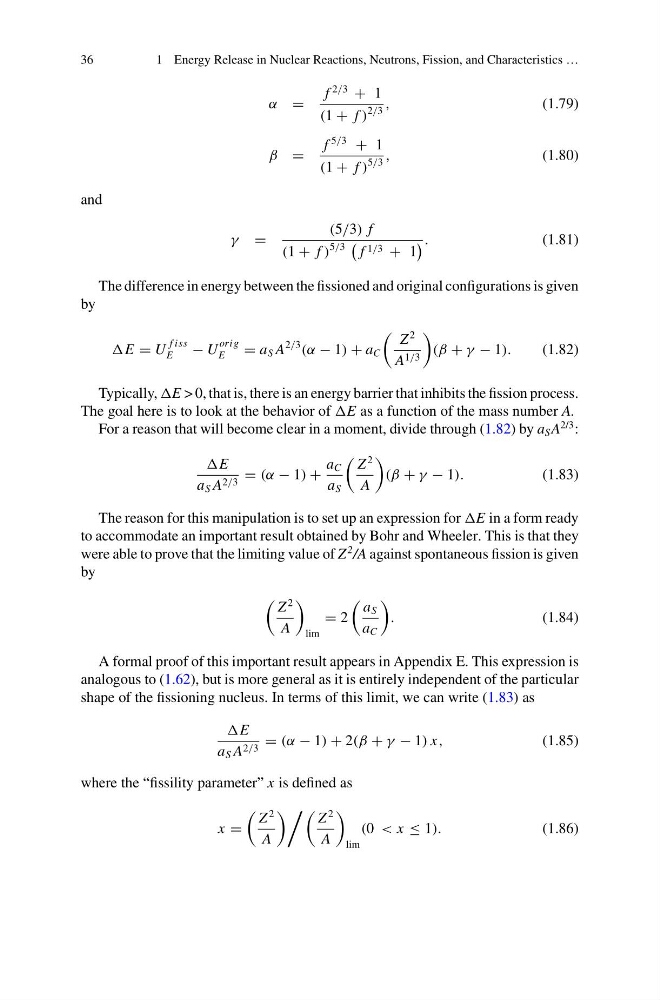
Typically, E > 0, that is, there is an energy barrier that inhibits the fission process.
The goal here is to look at the behavior of E as a function of the mass number A.
For a reason that will become clear in a moment, divide through (1.82) by a S A
2/3 :
E
a S A 2/3 = (α − 1) +
a C
a S
Z
2
A
(β + γ − 1).
(1.83)
The reason for this manipulation is to set up an expression for E in a form ready
to accommodate an important result obtained by Bohr and Wheeler. This is that they
were able to prove that the limiting value of Z
2 /A against spontaneous fission is given
by
Z
2
A
lim
= 2
a S
a C
.
(1.84)
A formal proof of this important result appears in Appendix E. This expression is
analogous to (1.62), but is more general as it is entirely independent of the particular
shape of the fissioning nucleus. In terms of this limit, we can write (1.83) as
E
a S A 2/3 = (α − 1) + 2(β + γ − 1) x,
(1.85)
where the “fissility parameter” x is defined as
x =
Z
2
A
Z
2
A
lim
(0 < x ≤ 1).
(1.86)
1 Energy Release in Nuclear Reactions, Neutrons, Fission, and Characteristics …
α =
f
2/3
+ 1
(1 + f )
2/3
,
(1.79)
β =
f
5/3
+ 1
(1 + f )
5/3
,
(1.80)
and
γ =
(5/3) f
(1 + f )
5/3
f 1/3 + 1
.
(1.81)
The difference in energy between the fissioned and original configurations is given
by
E = U
f iss
E
− U
orig
E
= a S A
2/3
(α − 1) + a C
Z
2
A 1/3
(β + γ − 1).
(1.82)
Typically, E > 0, that is, there is an energy barrier that inhibits the fission process.
The goal here is to look at the behavior of E as a function of the mass number A.
For a reason that will become clear in a moment, divide through (1.82) by a S A
2/3 :
E
a S A 2/3 = (α − 1) +
a C
a S
Z
2
A
(β + γ − 1).
(1.83)
The reason for this manipulation is to set up an expression for E in a form ready
to accommodate an important result obtained by Bohr and Wheeler. This is that they
were able to prove that the limiting value of Z
2 /A against spontaneous fission is given
by
Z
2
A
lim
= 2
a S
a C
.
(1.84)
A formal proof of this important result appears in Appendix E. This expression is
analogous to (1.62), but is more general as it is entirely independent of the particular
shape of the fissioning nucleus. In terms of this limit, we can write (1.83) as
E
a S A 2/3 = (α − 1) + 2(β + γ − 1) x,
(1.85)
where the “fissility parameter” x is defined as
x =
Z
2
A
Z
2
A
lim
(0 < x ≤ 1).
(1.86)