

26
1 Energy Release in Nuclear Reactions, Neutrons, Fission, and Characteristics …
0
1
2
3
4
5
6
0
1
2
3
4
5
ln (A)
ln (Z)
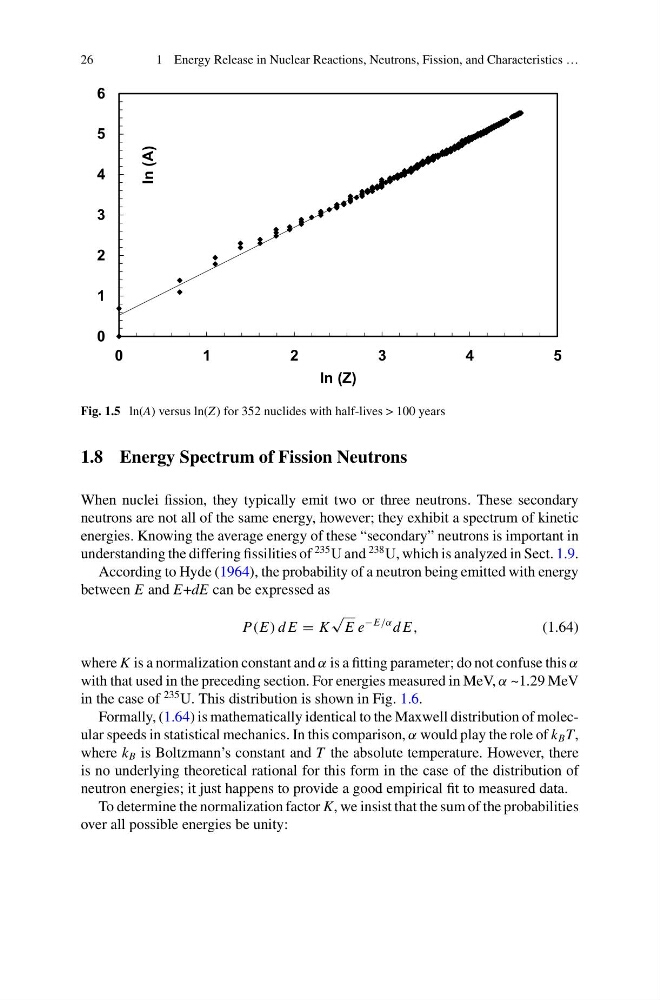
Fig. 1.5 ln(A) versus ln(Z) for 352 nuclides with half-lives > 100 years
1.8 Energy Spectrum of Fission Neutrons
When nuclei fission, they typically emit two or three neutrons. These secondary
neutrons are not all of the same energy, however; they exhibit a spectrum of kinetic
energies. Knowing the average energy of these “secondary” neutrons is important in
understanding the differing fissilities of
235 U and
238 U, which is analyzed in Sect. 1.9.
According to Hyde (1964), the probability of a neutron being emitted with energy
between E and E+dE can be expressed as
P(E) d E = K
√
E e
−E/α d E,
(1.64)
where K is a normalization constant and α is a fitting parameter; do not confuse this α
with that used in the preceding section. For energies measured in MeV, α ~1.29 MeV
in the case of
235 U. This distribution is shown in Fig. 1.6.
Formally, (1.64) is mathematically identical to the Maxwell distribution of molecular speeds in statistical mechanics. In this comparison, α would play the role of k B T,
where k B is Boltzmann’s constant and T the absolute temperature. However, there
is no underlying theoretical rational for this form in the case of the distribution of
neutron energies; it just happens to provide a good empirical fit to measured data.
To determine the normalization factor K, we insist that the sum of the probabilities
over all possible energies be unity:
1 Energy Release in Nuclear Reactions, Neutrons, Fission, and Characteristics …
0
1
2
3
4
5
6
0
1
2
3
4
5
ln (A)
ln (Z)
Fig. 1.5 ln(A) versus ln(Z) for 352 nuclides with half-lives > 100 years
1.8 Energy Spectrum of Fission Neutrons
When nuclei fission, they typically emit two or three neutrons. These secondary
neutrons are not all of the same energy, however; they exhibit a spectrum of kinetic
energies. Knowing the average energy of these “secondary” neutrons is important in
understanding the differing fissilities of
235 U and
238 U, which is analyzed in Sect. 1.9.
According to Hyde (1964), the probability of a neutron being emitted with energy
between E and E+dE can be expressed as
P(E) d E = K
√
E e
−E/α d E,
(1.64)
where K is a normalization constant and α is a fitting parameter; do not confuse this α
with that used in the preceding section. For energies measured in MeV, α ~1.29 MeV
in the case of
235 U. This distribution is shown in Fig. 1.6.
Formally, (1.64) is mathematically identical to the Maxwell distribution of molecular speeds in statistical mechanics. In this comparison, α would play the role of k B T,
where k B is Boltzmann’s constant and T the absolute temperature. However, there
is no underlying theoretical rational for this form in the case of the distribution of
neutron energies; it just happens to provide a good empirical fit to measured data.
To determine the normalization factor K, we insist that the sum of the probabilities
over all possible energies be unity: