

1.7 The Bohr-Wheeler Theory of Fission …
23
U
sel f
C
=
4 π ρ
2
15 ε o
r
5
,
(1.51)
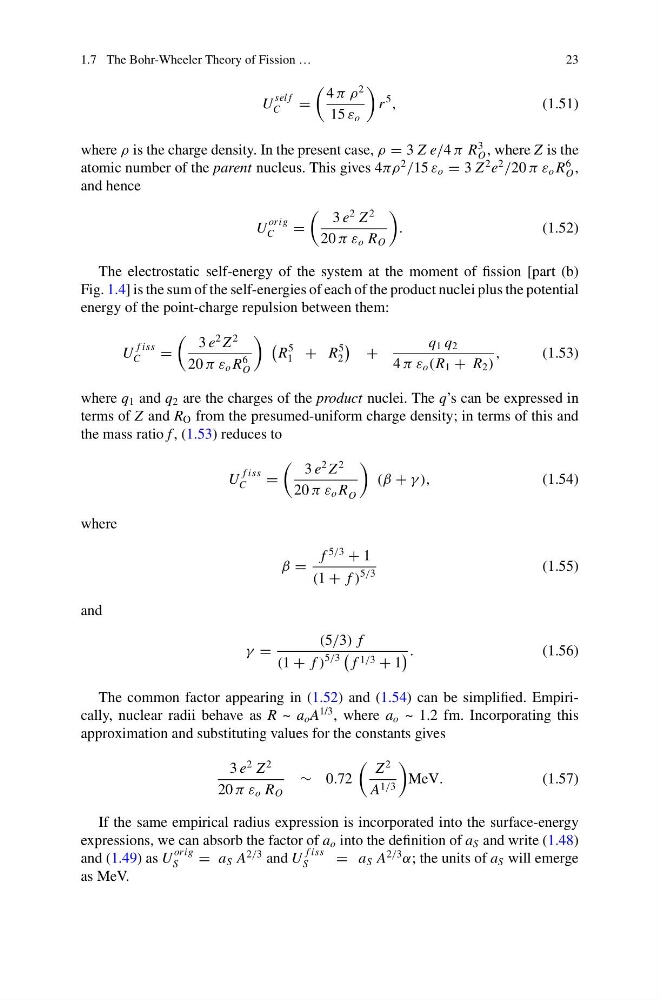
where ρ is the charge density. In the present case, ρ = 3 Z e/4 π R
3
O , where Z is the
atomic number of the parent nucleus. This gives 4πρ
2
/15 ε o = 3 Z
2 e
2
/20 π ε o R
6
O ,
and hence
U
orig
C
=
3 e
2 Z
2
20 π ε o R O
.
(1.52)
The electrostatic self-energy of the system at the moment of fission [part (b)
Fig. 1.4] is the sum of the self-energies of each of the product nuclei plus the potential
energy of the point-charge repulsion between them:
U
f iss
C
=
3 e
2 Z
2
20 π ε o R
6
O
R
5
1 + R
5
2
+
q 1 q 2
4 π ε o (R 1 + R 2 )
,
(1.53)
where q 1 and q 2 are the charges of the product nuclei. The q’s can be expressed in
terms of Z and R O from the presumed-uniform charge density; in terms of this and
the mass ratio f , (1.53) reduces to
U
f iss
C
=
3 e
2 Z
2
20 π ε o R O
(β + γ ),
(1.54)
where
β =
f
5/3
+ 1
(1 + f )
5/3
(1.55)
and
γ =
(5/3) f
(1 + f )
5/3
f 1/3 + 1
.
(1.56)
The common factor appearing in (1.52) and (1.54) can be simplified. Empirically, nuclear radii behave as R ~ a o A
1/3 , where a o ~ 1.2 fm. Incorporating this
approximation and substituting values for the constants gives
3 e
2 Z
2
20 π ε o R O
∼ 0.72
Z
2
A 1/3
MeV.
(1.57)
If the same empirical radius expression is incorporated into the surface-energy
expressions, we can absorb the factor of a o into the definition of a S and write (1.48)
and (1.49) as U
orig
S
= a S A
2/3 and U
f iss
S
= a S A
2/3
α; the units of a S will emerge
as MeV.
23
U
sel f
C
=
4 π ρ
2
15 ε o
r
5
,
(1.51)
where ρ is the charge density. In the present case, ρ = 3 Z e/4 π R
3
O , where Z is the
atomic number of the parent nucleus. This gives 4πρ
2
/15 ε o = 3 Z
2 e
2
/20 π ε o R
6
O ,
and hence
U
orig
C
=
3 e
2 Z
2
20 π ε o R O
.
(1.52)
The electrostatic self-energy of the system at the moment of fission [part (b)
Fig. 1.4] is the sum of the self-energies of each of the product nuclei plus the potential
energy of the point-charge repulsion between them:
U
f iss
C
=
3 e
2 Z
2
20 π ε o R
6
O
R
5
1 + R
5
2
+
q 1 q 2
4 π ε o (R 1 + R 2 )
,
(1.53)
where q 1 and q 2 are the charges of the product nuclei. The q’s can be expressed in
terms of Z and R O from the presumed-uniform charge density; in terms of this and
the mass ratio f , (1.53) reduces to
U
f iss
C
=
3 e
2 Z
2
20 π ε o R O
(β + γ ),
(1.54)
where
β =
f
5/3
+ 1
(1 + f )
5/3
(1.55)
and
γ =
(5/3) f
(1 + f )
5/3
f 1/3 + 1
.
(1.56)
The common factor appearing in (1.52) and (1.54) can be simplified. Empirically, nuclear radii behave as R ~ a o A
1/3 , where a o ~ 1.2 fm. Incorporating this
approximation and substituting values for the constants gives
3 e
2 Z
2
20 π ε o R O
∼ 0.72
Z
2
A 1/3
MeV.
(1.57)
If the same empirical radius expression is incorporated into the surface-energy
expressions, we can absorb the factor of a o into the definition of a S and write (1.48)
and (1.49) as U
orig
S
= a S A
2/3 and U
f iss
S
= a S A
2/3
α; the units of a S will emerge
as MeV.