

1.7 The Bohr-Wheeler Theory of Fission …
21
spontaneous fission. Section 1.1.8 examines the energetics of neutrons emitted in the
fission process. These two sections set stage for an examination of the fission barrier
in Sect. 1.9, which explains why
235 U and
238 U behave so differently under neutron
bombardment. Further analysis of the fission barrier follows in Sect. 1.10, and a
numerical simulation of the fission process is examined in Sect. 1.11. A detailed
formal treatment of the Bohr and Wheeler analysis is presented in Appendix E.
Bohr and Wheeler modeled nuclei as deformable “liquid drops” whose shapes can
be described by a sum of Legendre polynomials configured to conserve volume as
they deform. They then considered the total energy of the nucleus to be the sum of two
contributions. These are a “surface” energy U S proportional to the surface area S of
the nucleus, and an electrostatic contribution U C corresponding to its Coulomb selfpotential. If a nucleus finds itself deformed from its original spherical shape, U S will
increase due to the consequent increase in surface area, while U C will decrease as the
nuclear charge becomes more spread out. If (U S + U C ) deformed < (U S + U C ) original ,
then the nucleus will be unstable against further deformation and potentially eventual
fission. The surface-energy term originates in the fact that nucleons near the surface
of the nucleus are less strongly bound than those inside, while the Coulomb term
arises from mutual repulsion of protons.
The usual textbook approach to establishing the Z
2 /A limit is to quote expressions
for the surface and Coulomb energies of nuclei modeled as ellipsoids, and then
compute the difference in energy between a spherical nucleus and an ellipsoid of the
same volume (Fermi 1950). We can obtain an approximate treatment, however, by
modeling nuclei as spheres.
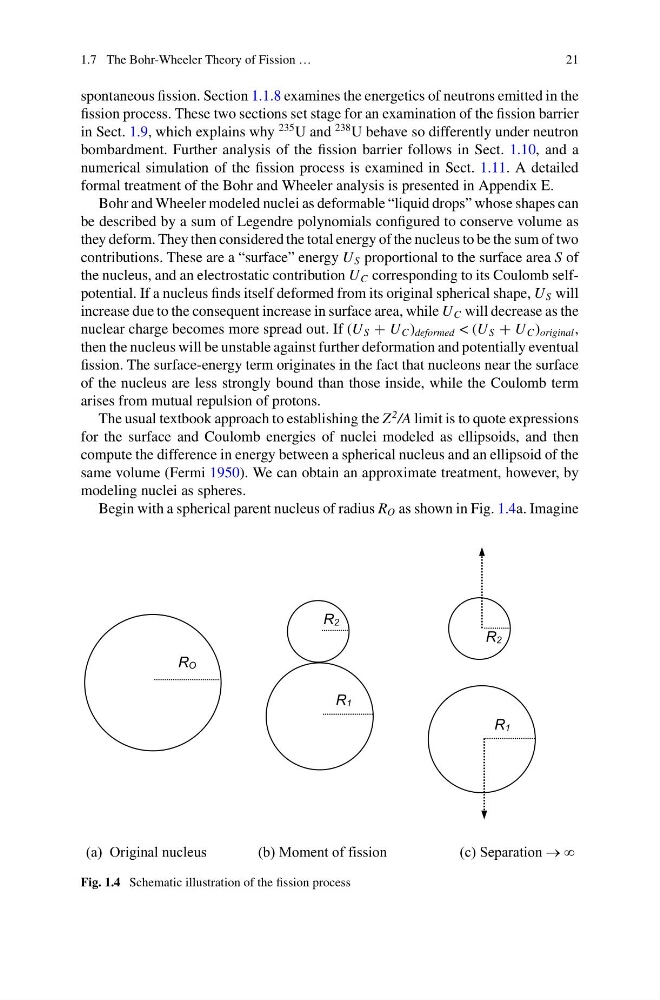
Begin with a spherical parent nucleus of radius R O as shown in Fig. 1.4a. Imagine
RO
R1
R2
R1
R2
Fig. 1.4 Schematic illustration of the fission process
21
spontaneous fission. Section 1.1.8 examines the energetics of neutrons emitted in the
fission process. These two sections set stage for an examination of the fission barrier
in Sect. 1.9, which explains why
235 U and
238 U behave so differently under neutron
bombardment. Further analysis of the fission barrier follows in Sect. 1.10, and a
numerical simulation of the fission process is examined in Sect. 1.11. A detailed
formal treatment of the Bohr and Wheeler analysis is presented in Appendix E.
Bohr and Wheeler modeled nuclei as deformable “liquid drops” whose shapes can
be described by a sum of Legendre polynomials configured to conserve volume as
they deform. They then considered the total energy of the nucleus to be the sum of two
contributions. These are a “surface” energy U S proportional to the surface area S of
the nucleus, and an electrostatic contribution U C corresponding to its Coulomb selfpotential. If a nucleus finds itself deformed from its original spherical shape, U S will
increase due to the consequent increase in surface area, while U C will decrease as the
nuclear charge becomes more spread out. If (U S + U C ) deformed < (U S + U C ) original ,
then the nucleus will be unstable against further deformation and potentially eventual
fission. The surface-energy term originates in the fact that nucleons near the surface
of the nucleus are less strongly bound than those inside, while the Coulomb term
arises from mutual repulsion of protons.
The usual textbook approach to establishing the Z
2 /A limit is to quote expressions
for the surface and Coulomb energies of nuclei modeled as ellipsoids, and then
compute the difference in energy between a spherical nucleus and an ellipsoid of the
same volume (Fermi 1950). We can obtain an approximate treatment, however, by
modeling nuclei as spheres.
Begin with a spherical parent nucleus of radius R O as shown in Fig. 1.4a. Imagine
RO
R1
R2
R1
R2
Fig. 1.4 Schematic illustration of the fission process