

1.4 Discovery of the Neutron
11
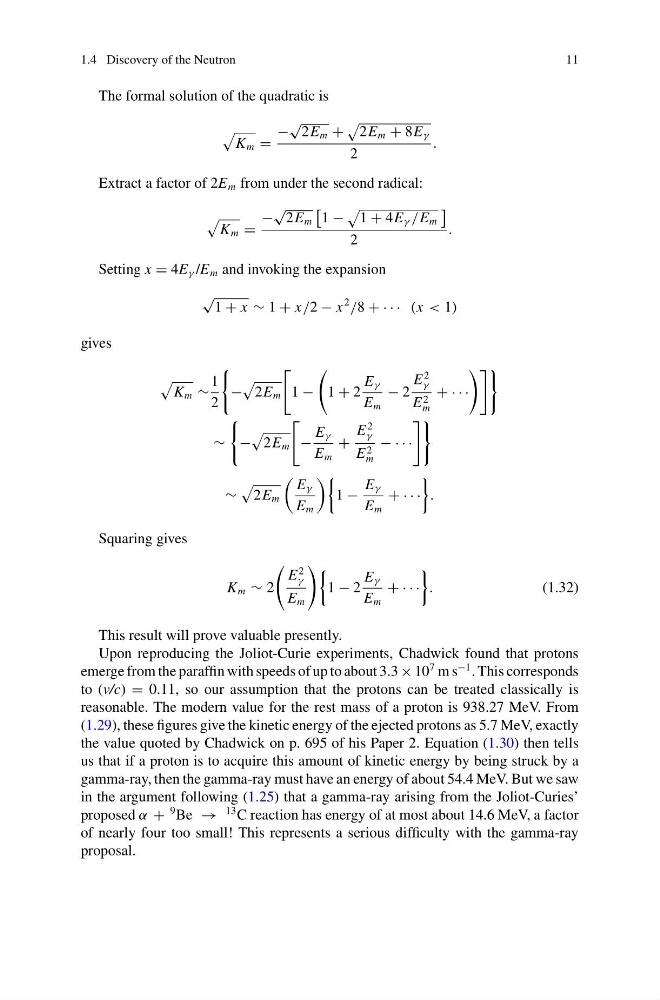
The formal solution of the quadratic is
K m =
−
√
2E m +
2E m + 8E γ
2
.
Extract a factor of 2E m from under the second radical:
K m =
−
√
2E m
1 −
1 + 4E γ /E m
2
.
Setting x = 4E γ /E m and invoking the expansion
√
1 + x ∼ 1 + x/2 − x
2
/8 + · · · (x < 1)
gives
K m ∼
1
2
−
2E m
1 −
1 + 2
E γ
E m
− 2
E
2
γ
E 2
m
+ · · ·
∼
−
2E m
−
E γ
E m
+
E
2
γ
E 2
m
− · · ·
∼
2E m
E γ
E m
1 −
E γ
E m
+ · · ·
.
Squaring gives
K m ∼ 2
E
2
γ
E m
1 − 2
E γ
E m
+ · · ·
.
(1.32)
This result will prove valuable presently.
Upon reproducing the Joliot-Curie experiments, Chadwick found that protons
emerge from the paraffin with speeds of up to about 3.3 × 10
7 m s
−1 . This corresponds
to (v/c) = 0.11, so our assumption that the protons can be treated classically is
reasonable. The modern value for the rest mass of a proton is 938.27 MeV. From
(1.29), these figures give the kinetic energy of the ejected protons as 5.7 MeV, exactly
the value quoted by Chadwick on p. 695 of his Paper 2. Equation (1.30) then tells
us that if a proton is to acquire this amount of kinetic energy by being struck by a
gamma-ray, then the gamma-ray must have an energy of about 54.4 MeV. But we saw
in the argument following (1.25) that a gamma-ray arising from the Joliot-Curies’
proposed α +
9 Be →
13 C reaction has energy of at most about 14.6 MeV, a factor
of nearly four too small! This represents a serious difficulty with the gamma-ray
proposal.
11
The formal solution of the quadratic is
K m =
−
√
2E m +
2E m + 8E γ
2
.
Extract a factor of 2E m from under the second radical:
K m =
−
√
2E m
1 −
1 + 4E γ /E m
2
.
Setting x = 4E γ /E m and invoking the expansion
√
1 + x ∼ 1 + x/2 − x
2
/8 + · · · (x < 1)
gives
K m ∼
1
2
−
2E m
1 −
1 + 2
E γ
E m
− 2
E
2
γ
E 2
m
+ · · ·
∼
−
2E m
−
E γ
E m
+
E
2
γ
E 2
m
− · · ·
∼
2E m
E γ
E m
1 −
E γ
E m
+ · · ·
.
Squaring gives
K m ∼ 2
E
2
γ
E m
1 − 2
E γ
E m
+ · · ·
.
(1.32)
This result will prove valuable presently.
Upon reproducing the Joliot-Curie experiments, Chadwick found that protons
emerge from the paraffin with speeds of up to about 3.3 × 10
7 m s
−1 . This corresponds
to (v/c) = 0.11, so our assumption that the protons can be treated classically is
reasonable. The modern value for the rest mass of a proton is 938.27 MeV. From
(1.29), these figures give the kinetic energy of the ejected protons as 5.7 MeV, exactly
the value quoted by Chadwick on p. 695 of his Paper 2. Equation (1.30) then tells
us that if a proton is to acquire this amount of kinetic energy by being struck by a
gamma-ray, then the gamma-ray must have an energy of about 54.4 MeV. But we saw
in the argument following (1.25) that a gamma-ray arising from the Joliot-Curies’
proposed α +
9 Be →
13 C reaction has energy of at most about 14.6 MeV, a factor
of nearly four too small! This represents a serious difficulty with the gamma-ray
proposal.