

1.4 Discovery of the Neutron
9
Table 1.1 -Values and Rest
Energies for the Joliot-Curie
γ -Reaction
Nucleus
A
E (MeV)
He
4
2.425
3728.40228
Be
9
11.348
8394.79688
C
13
3.125
12112.55116
where E He , E Be and E C represent the mc
2 rest energies (in MeV) of the alphaparticle, Be nucleus, and carbon nucleus, respectively, and where K He is the kinetic
energy of the incoming alpha-particle. These rest energies can be calculated from the
corresponding nucleon numbers and -values as E = εA + as in Sect. 1.1.
The relevant numbers appear in Table 1.1.
These numbers give (with K He = 5.3 MeV) α = 4.12795 × 10
−5 MeV
−1 , ε =
0.983587, and δ = –14.316590 MeV. Solving the quadratic gives E γ = 14.55 MeV;
this is a little less than the approximately 16 MeV estimated on the basis of the Qvalue alone as the carbon nucleus carries off some momentum. This solution takes
the upper sign (+) in the solution of the quadratic; choosing the lower sign leads
to a negative value for the kinetic energy of the carbon nucleus, which would be
unphysical.
Spreadsheet TwoBodyGamma.xls allows a user to investigate head-on reactions
of the general form A + B → C + γ . As with TwoBody.xls, the user inputs nucleon
numbers and -values for nuclides A, B, and C, along with the input kinetic energy
for A; B is presumed to be stationary when struck head-on by A. The spreadsheet
computes and displays the possible solutions for the energy of the γ -ray and the
kinetic energy and momentum of product C.
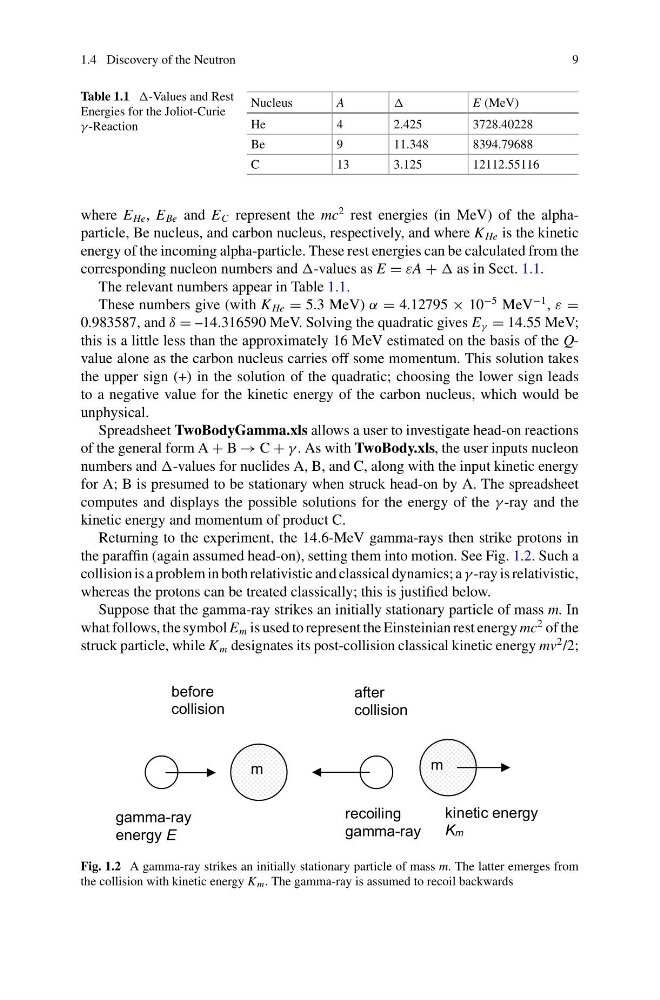
Returning to the experiment, the 14.6-MeV gamma-rays then strike protons in
the paraffin (again assumed head-on), setting them into motion. See Fig. 1.2. Such a
collision is a problem in both relativistic and classical dynamics; a γ -ray is relativistic,
whereas the protons can be treated classically; this is justified below.
Suppose that the gamma-ray strikes an initially stationary particle of mass m. In
what follows, the symbol E m is used to represent the Einsteinian rest energy mc
2 of the
struck particle, while K m designates its post-collision classical kinetic energy mv
2 /2;
gamma-ray
energy E
before
collision
m
recoiling
gamma-ray
kinetic energy
Km
after
collision
m
Fig. 1.2 A gamma-ray strikes an initially stationary particle of mass m. The latter emerges from
the collision with kinetic energy K m . The gamma-ray is assumed to recoil backwards
9
Table 1.1 -Values and Rest
Energies for the Joliot-Curie
γ -Reaction
Nucleus
A
E (MeV)
He
4
2.425
3728.40228
Be
9
11.348
8394.79688
C
13
3.125
12112.55116
where E He , E Be and E C represent the mc
2 rest energies (in MeV) of the alphaparticle, Be nucleus, and carbon nucleus, respectively, and where K He is the kinetic
energy of the incoming alpha-particle. These rest energies can be calculated from the
corresponding nucleon numbers and -values as E = εA + as in Sect. 1.1.
The relevant numbers appear in Table 1.1.
These numbers give (with K He = 5.3 MeV) α = 4.12795 × 10
−5 MeV
−1 , ε =
0.983587, and δ = –14.316590 MeV. Solving the quadratic gives E γ = 14.55 MeV;
this is a little less than the approximately 16 MeV estimated on the basis of the Qvalue alone as the carbon nucleus carries off some momentum. This solution takes
the upper sign (+) in the solution of the quadratic; choosing the lower sign leads
to a negative value for the kinetic energy of the carbon nucleus, which would be
unphysical.
Spreadsheet TwoBodyGamma.xls allows a user to investigate head-on reactions
of the general form A + B → C + γ . As with TwoBody.xls, the user inputs nucleon
numbers and -values for nuclides A, B, and C, along with the input kinetic energy
for A; B is presumed to be stationary when struck head-on by A. The spreadsheet
computes and displays the possible solutions for the energy of the γ -ray and the
kinetic energy and momentum of product C.
Returning to the experiment, the 14.6-MeV gamma-rays then strike protons in
the paraffin (again assumed head-on), setting them into motion. See Fig. 1.2. Such a
collision is a problem in both relativistic and classical dynamics; a γ -ray is relativistic,
whereas the protons can be treated classically; this is justified below.
Suppose that the gamma-ray strikes an initially stationary particle of mass m. In
what follows, the symbol E m is used to represent the Einsteinian rest energy mc
2 of the
struck particle, while K m designates its post-collision classical kinetic energy mv
2 /2;
gamma-ray
energy E
before
collision
m
recoiling
gamma-ray
kinetic energy
Km
after
collision
m
Fig. 1.2 A gamma-ray strikes an initially stationary particle of mass m. The latter emerges from
the collision with kinetic energy K m . The gamma-ray is assumed to recoil backwards