

6.5 Appendix E: Formal Derivation of the Bohr-Wheeler Spontaneous Fission Limit
209
U 21 =
4πr
2
1
3
P 0(1) .
(6.53)
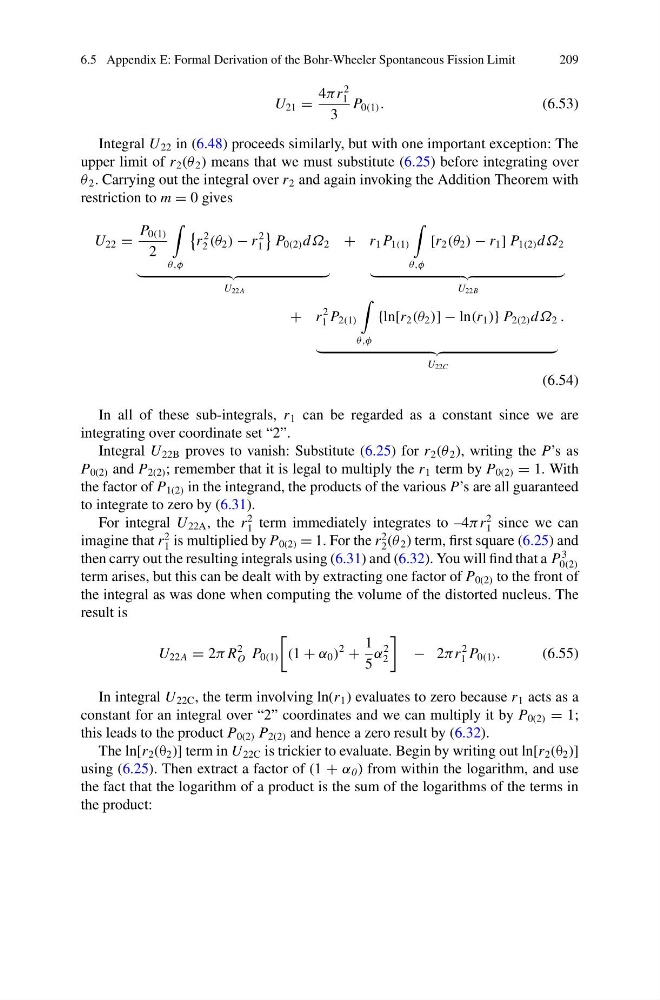
Integral U 22 in (6.48) proceeds similarly, but with one important exception: The
upper limit of r 2 (θ 2 ) means that we must substitute (6.25) before integrating over
θ 2 . Carrying out the integral over r 2 and again invoking the Addition Theorem with
restriction to m = 0 gives
U 22 =
P 0(1)
2
θ,φ
r
2
2 (θ 2 ) − r
2
1
P 0(2) dΩ 2
U 22 A
+ r 1 P 1(1)
θ,φ
[r 2 (θ 2 ) − r 1 ] P 1(2) dΩ 2
U 22B
+ r
2
1 P 2(1)
θ,φ
{ln[r 2 (θ 2 )] − ln(r 1 )} P 2(2) dΩ 2
U 22C
.
(6.54)
In all of these sub-integrals, r 1 can be regarded as a constant since we are
integrating over coordinate set “2”.
Integral U 22B proves to vanish: Substitute (6.25) for r 2 (θ 2 ), writing the P’s as
P 0(2) and P 2(2) ; remember that it is legal to multiply the r 1 term by P 0(2) = 1. With
the factor of P 1(2) in the integrand, the products of the various P’s are all guaranteed
to integrate to zero by (6.31).
For integral U 22A , the r
2
1 term immediately integrates to –4π r
2
1 since we can
imagine that r
2
1 is multiplied by P 0(2) = 1. For the r
2
2 (θ 2 ) term, first square (6.25) and
then carry out the resulting integrals using (6.31) and (6.32). You will find that a P
3
0(2)
term arises, but this can be dealt with by extracting one factor of P 0(2) to the front of
the integral as was done when computing the volume of the distorted nucleus. The
result is
U 22 A = 2π R
2
O P 0(1)
(1 + α 0 )
2
+
1
5
α
2
2
− 2πr
2
1 P 0(1) .
(6.55)
In integral U 22C , the term involving ln(r 1 ) evaluates to zero because r 1 acts as a
constant for an integral over “2” coordinates and we can multiply it by P 0(2) = 1;
this leads to the product P 0(2) P 2(2) and hence a zero result by (6.32).
The ln[r 2 (θ 2 )] term in U 22C is trickier to evaluate. Begin by writing out ln[r 2 (θ 2 )]
using (6.25). Then extract a factor of (1 + α 0 ) from within the logarithm, and use
the fact that the logarithm of a product is the sum of the logarithms of the terms in
the product:
209
U 21 =
4πr
2
1
3
P 0(1) .
(6.53)
Integral U 22 in (6.48) proceeds similarly, but with one important exception: The
upper limit of r 2 (θ 2 ) means that we must substitute (6.25) before integrating over
θ 2 . Carrying out the integral over r 2 and again invoking the Addition Theorem with
restriction to m = 0 gives
U 22 =
P 0(1)
2
θ,φ
r
2
2 (θ 2 ) − r
2
1
P 0(2) dΩ 2
U 22 A
+ r 1 P 1(1)
θ,φ
[r 2 (θ 2 ) − r 1 ] P 1(2) dΩ 2
U 22B
+ r
2
1 P 2(1)
θ,φ
{ln[r 2 (θ 2 )] − ln(r 1 )} P 2(2) dΩ 2
U 22C
.
(6.54)
In all of these sub-integrals, r 1 can be regarded as a constant since we are
integrating over coordinate set “2”.
Integral U 22B proves to vanish: Substitute (6.25) for r 2 (θ 2 ), writing the P’s as
P 0(2) and P 2(2) ; remember that it is legal to multiply the r 1 term by P 0(2) = 1. With
the factor of P 1(2) in the integrand, the products of the various P’s are all guaranteed
to integrate to zero by (6.31).
For integral U 22A , the r
2
1 term immediately integrates to –4π r
2
1 since we can
imagine that r
2
1 is multiplied by P 0(2) = 1. For the r
2
2 (θ 2 ) term, first square (6.25) and
then carry out the resulting integrals using (6.31) and (6.32). You will find that a P
3
0(2)
term arises, but this can be dealt with by extracting one factor of P 0(2) to the front of
the integral as was done when computing the volume of the distorted nucleus. The
result is
U 22 A = 2π R
2
O P 0(1)
(1 + α 0 )
2
+
1
5
α
2
2
− 2πr
2
1 P 0(1) .
(6.55)
In integral U 22C , the term involving ln(r 1 ) evaluates to zero because r 1 acts as a
constant for an integral over “2” coordinates and we can multiply it by P 0(2) = 1;
this leads to the product P 0(2) P 2(2) and hence a zero result by (6.32).
The ln[r 2 (θ 2 )] term in U 22C is trickier to evaluate. Begin by writing out ln[r 2 (θ 2 )]
using (6.25). Then extract a factor of (1 + α 0 ) from within the logarithm, and use
the fact that the logarithm of a product is the sum of the logarithms of the terms in
the product: