

198
6 Appendices
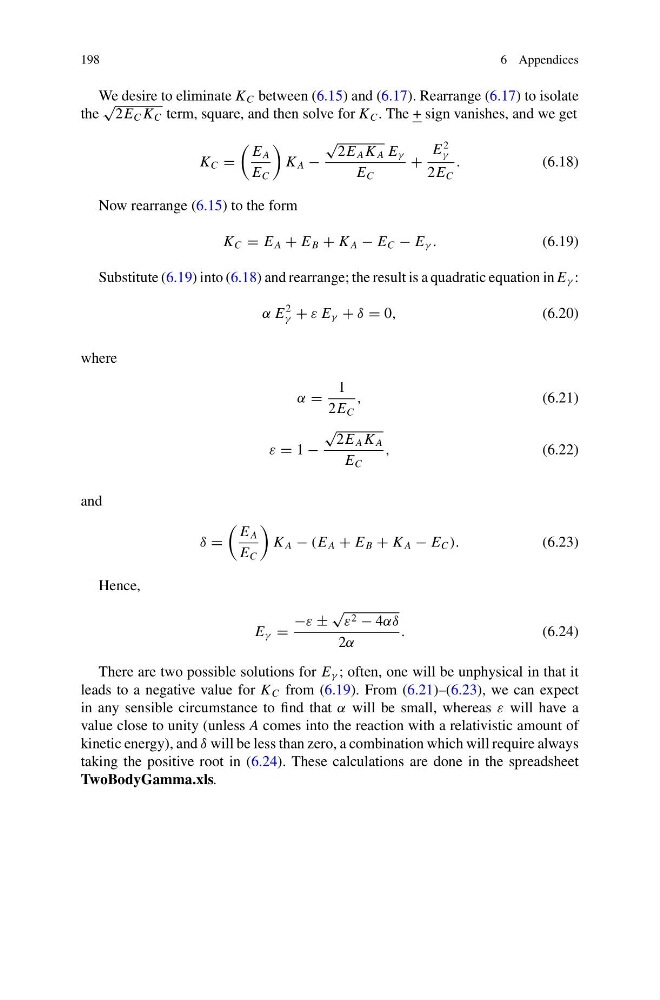
We desire to eliminate K C between (6.15) and (6.17). Rearrange (6.17) to isolate
the
√
2E C K C term, square, and then solve for K C . The + sign vanishes, and we get
K C =
E A
E C
K A −
√
2E A K A E γ
E C
+
E
2
γ
2E C
.
(6.18)
Now rearrange (6.15) to the form
K C = E A + E B + K A − E C − E γ .
(6.19)
Substitute (6.19) into (6.18) and rearrange; the result is a quadratic equation in E γ :
α E
2
γ + ε E γ + δ = 0,
(6.20)
where
α =
1
2E C
,
(6.21)
ε = 1 −
√
2E A K A
E C
,
(6.22)
and
δ =
E A
E C
K A − (E A + E B + K A − E C ).
(6.23)
Hence,
E γ =
−ε ±
√
ε 2 − 4αδ
2α
.
(6.24)
There are two possible solutions for E γ ; often, one will be unphysical in that it
leads to a negative value for K C from (6.19). From (6.21)–(6.23), we can expect
in any sensible circumstance to find that α will be small, whereas ε will have a
value close to unity (unless A comes into the reaction with a relativistic amount of
kinetic energy), and δ will be less than zero, a combination which will require always
taking the positive root in (6.24). These calculations are done in the spreadsheet
TwoBodyGamma.xls.
6 Appendices
We desire to eliminate K C between (6.15) and (6.17). Rearrange (6.17) to isolate
the
√
2E C K C term, square, and then solve for K C . The + sign vanishes, and we get
K C =
E A
E C
K A −
√
2E A K A E γ
E C
+
E
2
γ
2E C
.
(6.18)
Now rearrange (6.15) to the form
K C = E A + E B + K A − E C − E γ .
(6.19)
Substitute (6.19) into (6.18) and rearrange; the result is a quadratic equation in E γ :
α E
2
γ + ε E γ + δ = 0,
(6.20)
where
α =
1
2E C
,
(6.21)
ε = 1 −
√
2E A K A
E C
,
(6.22)
and
δ =
E A
E C
K A − (E A + E B + K A − E C ).
(6.23)
Hence,
E γ =
−ε ±
√
ε 2 − 4αδ
2α
.
(6.24)
There are two possible solutions for E γ ; often, one will be unphysical in that it
leads to a negative value for K C from (6.19). From (6.21)–(6.23), we can expect
in any sensible circumstance to find that α will be small, whereas ε will have a
value close to unity (unless A comes into the reaction with a relativistic amount of
kinetic energy), and δ will be less than zero, a combination which will require always
taking the positive root in (6.24). These calculations are done in the spreadsheet
TwoBodyGamma.xls.