

5.3 A Model for Trace Isotope Production in a Reactor
185
f issions per t days = R t.
(5.13)
As in Sect. 3.3, let ν be the number of neutrons released per fission. As described
below, a consistency requirement demands that ν be a function of time in the
simulation. The number of neutrons released over time t will then be
neutrons released per t days = ν R t.
(5.14)
The simulation operates by tracking the fractional abundances of isotopes as a
function of time. For a given isotope i, let F
i
(t) be the fractional abundance of that
isotope in the fuel at time t. F is used here for fractional abundance as opposed to the
f of Sect. 4.1, as the latter is used here to represent fission. If N is the total number of
atoms of fuel loaded into the reactor, then the number of atoms of isotope i at time t
will be N
i
(t) = N F
i
(t).
Now consider some process p that a nucleus can suffer under neutron bombardment; this will be either fission (f ) by or capture (c) of the neutron. No other processes
are allowed to occur, and all free neutrons are assumed to either cause a fission
or to be captured during a given timestep. The total cross-section available for all
processes over all isotopes at any time is given by the abundance-weighted sums of
all individual-process cross-sections in play:
σ total (t) =
i, p
σ
i
p N
i
(t)
= N
F
235
σ
235
f
+ σ
235
c
+ F
238
σ
238
c
+ F
239
σ
239
f
+ σ
239
c
+F
240
σ
240
c
+ F
241
σ
241
f
+ σ
241
c
+ F
Prod−1
σ
Prod−1
c
.
(5.15)
The total fission cross-section at any time will be
σ f iss (t) = N
F
235
σ
235
f
+ F
239
σ
239
f
+ F
241
σ
241
f
.
(5.16)
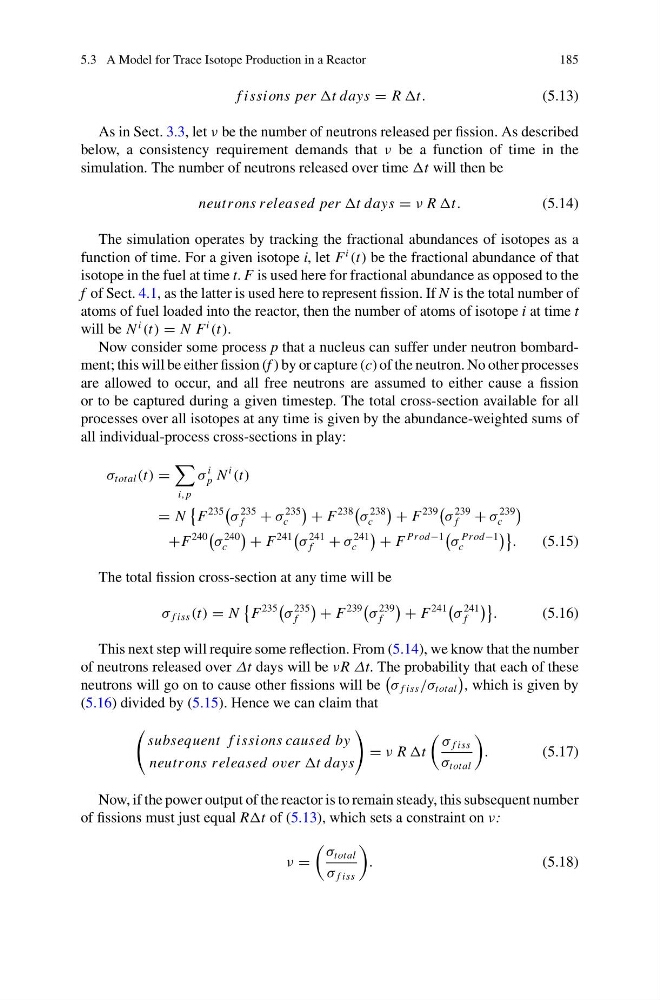
This next step will require some reflection. From (5.14), we know that the number
of neutrons released over Δt days will be νR Δt. The probability that each of these
neutrons will go on to cause other fissions will be
σ f iss /σ total
, which is given by
(5.16) divided by (5.15). Hence we can claim that
subsequent f issions caused by
neutrons released over t days
= ν R t
σ f iss
σ total
.
(5.17)
Now, if the power output of the reactor is to remain steady, this subsequent number
of fissions must just equal Rt of (5.13), which sets a constraint on ν:
ν =
σ total
σ f iss
.
(5.18)
185
f issions per t days = R t.
(5.13)
As in Sect. 3.3, let ν be the number of neutrons released per fission. As described
below, a consistency requirement demands that ν be a function of time in the
simulation. The number of neutrons released over time t will then be
neutrons released per t days = ν R t.
(5.14)
The simulation operates by tracking the fractional abundances of isotopes as a
function of time. For a given isotope i, let F
i
(t) be the fractional abundance of that
isotope in the fuel at time t. F is used here for fractional abundance as opposed to the
f of Sect. 4.1, as the latter is used here to represent fission. If N is the total number of
atoms of fuel loaded into the reactor, then the number of atoms of isotope i at time t
will be N
i
(t) = N F
i
(t).
Now consider some process p that a nucleus can suffer under neutron bombardment; this will be either fission (f ) by or capture (c) of the neutron. No other processes
are allowed to occur, and all free neutrons are assumed to either cause a fission
or to be captured during a given timestep. The total cross-section available for all
processes over all isotopes at any time is given by the abundance-weighted sums of
all individual-process cross-sections in play:
σ total (t) =
i, p
σ
i
p N
i
(t)
= N
F
235
σ
235
f
+ σ
235
c
+ F
238
σ
238
c
+ F
239
σ
239
f
+ σ
239
c
+F
240
σ
240
c
+ F
241
σ
241
f
+ σ
241
c
+ F
Prod−1
σ
Prod−1
c
.
(5.15)
The total fission cross-section at any time will be
σ f iss (t) = N
F
235
σ
235
f
+ F
239
σ
239
f
+ F
241
σ
241
f
.
(5.16)
This next step will require some reflection. From (5.14), we know that the number
of neutrons released over Δt days will be νR Δt. The probability that each of these
neutrons will go on to cause other fissions will be
σ f iss /σ total
, which is given by
(5.16) divided by (5.15). Hence we can claim that
subsequent f issions caused by
neutrons released over t days
= ν R t
σ f iss
σ total
.
(5.17)
Now, if the power output of the reactor is to remain steady, this subsequent number
of fissions must just equal Rt of (5.13), which sets a constraint on ν:
ν =
σ total
σ f iss
.
(5.18)