

5.2 Brightness of the Trinity Explosion
181
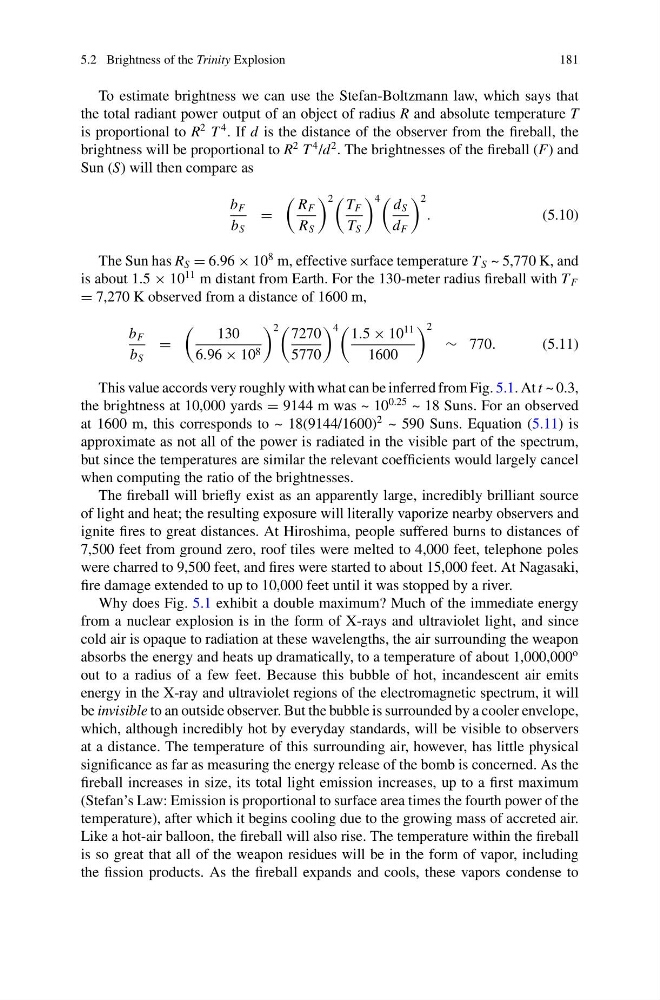
To estimate brightness we can use the Stefan-Boltzmann law, which says that
the total radiant power output of an object of radius R and absolute temperature T
is proportional to R
2 T
4 . If d is the distance of the observer from the fireball, the
brightness will be proportional to R
2 T
4 /d
2 . The brightnesses of the fireball (F) and
Sun (S) will then compare as
b F
b S
=
R F
R S
2
T F
T S
4
d S
d F
2
.
(5.10)
The Sun has R S = 6.96 × 10
8 m, effective surface temperature T S ~ 5,770 K, and
is about 1.5 × 10
11 m distant from Earth. For the 130-meter radius fireball with T F
= 7,270 K observed from a distance of 1600 m,
b F
b S
=
130
6.96 × 10 8
2
7270
5770
4
1.5 × 10
11
1600
2
∼ 770.
(5.11)
This value accords very roughly with what can be inferred from Fig. 5.1. At t ~ 0.3,
the brightness at 10,000 yards = 9144 m was ~ 10
0.25 ~ 18 Suns. For an observed
at 1600 m, this corresponds to ~ 18(9144/1600)
2 ~ 590 Suns. Equation (5.11) is
approximate as not all of the power is radiated in the visible part of the spectrum,
but since the temperatures are similar the relevant coefficients would largely cancel
when computing the ratio of the brightnesses.
The fireball will briefly exist as an apparently large, incredibly brilliant source
of light and heat; the resulting exposure will literally vaporize nearby observers and
ignite fires to great distances. At Hiroshima, people suffered burns to distances of
7,500 feet from ground zero, roof tiles were melted to 4,000 feet, telephone poles
were charred to 9,500 feet, and fires were started to about 15,000 feet. At Nagasaki,
fire damage extended to up to 10,000 feet until it was stopped by a river.
Why does Fig. 5.1 exhibit a double maximum? Much of the immediate energy
from a nuclear explosion is in the form of X-rays and ultraviolet light, and since
cold air is opaque to radiation at these wavelengths, the air surrounding the weapon
absorbs the energy and heats up dramatically, to a temperature of about 1,000,000
o
out to a radius of a few feet. Because this bubble of hot, incandescent air emits
energy in the X-ray and ultraviolet regions of the electromagnetic spectrum, it will
be invisible to an outside observer. But the bubble is surrounded by a cooler envelope,
which, although incredibly hot by everyday standards, will be visible to observers
at a distance. The temperature of this surrounding air, however, has little physical
significance as far as measuring the energy release of the bomb is concerned. As the
fireball increases in size, its total light emission increases, up to a first maximum
(Stefan’s Law: Emission is proportional to surface area times the fourth power of the
temperature), after which it begins cooling due to the growing mass of accreted air.
Like a hot-air balloon, the fireball will also rise. The temperature within the fireball
is so great that all of the weapon residues will be in the form of vapor, including
the fission products. As the fireball expands and cools, these vapors condense to
181
To estimate brightness we can use the Stefan-Boltzmann law, which says that
the total radiant power output of an object of radius R and absolute temperature T
is proportional to R
2 T
4 . If d is the distance of the observer from the fireball, the
brightness will be proportional to R
2 T
4 /d
2 . The brightnesses of the fireball (F) and
Sun (S) will then compare as
b F
b S
=
R F
R S
2
T F
T S
4
d S
d F
2
.
(5.10)
The Sun has R S = 6.96 × 10
8 m, effective surface temperature T S ~ 5,770 K, and
is about 1.5 × 10
11 m distant from Earth. For the 130-meter radius fireball with T F
= 7,270 K observed from a distance of 1600 m,
b F
b S
=
130
6.96 × 10 8
2
7270
5770
4
1.5 × 10
11
1600
2
∼ 770.
(5.11)
This value accords very roughly with what can be inferred from Fig. 5.1. At t ~ 0.3,
the brightness at 10,000 yards = 9144 m was ~ 10
0.25 ~ 18 Suns. For an observed
at 1600 m, this corresponds to ~ 18(9144/1600)
2 ~ 590 Suns. Equation (5.11) is
approximate as not all of the power is radiated in the visible part of the spectrum,
but since the temperatures are similar the relevant coefficients would largely cancel
when computing the ratio of the brightnesses.
The fireball will briefly exist as an apparently large, incredibly brilliant source
of light and heat; the resulting exposure will literally vaporize nearby observers and
ignite fires to great distances. At Hiroshima, people suffered burns to distances of
7,500 feet from ground zero, roof tiles were melted to 4,000 feet, telephone poles
were charred to 9,500 feet, and fires were started to about 15,000 feet. At Nagasaki,
fire damage extended to up to 10,000 feet until it was stopped by a river.
Why does Fig. 5.1 exhibit a double maximum? Much of the immediate energy
from a nuclear explosion is in the form of X-rays and ultraviolet light, and since
cold air is opaque to radiation at these wavelengths, the air surrounding the weapon
absorbs the energy and heats up dramatically, to a temperature of about 1,000,000
o
out to a radius of a few feet. Because this bubble of hot, incandescent air emits
energy in the X-ray and ultraviolet regions of the electromagnetic spectrum, it will
be invisible to an outside observer. But the bubble is surrounded by a cooler envelope,
which, although incredibly hot by everyday standards, will be visible to observers
at a distance. The temperature of this surrounding air, however, has little physical
significance as far as measuring the energy release of the bomb is concerned. As the
fireball increases in size, its total light emission increases, up to a first maximum
(Stefan’s Law: Emission is proportional to surface area times the fourth power of the
temperature), after which it begins cooling due to the growing mass of accreted air.
Like a hot-air balloon, the fireball will also rise. The temperature within the fireball
is so great that all of the weapon residues will be in the form of vapor, including
the fission products. As the fireball expands and cools, these vapors condense to