

162
4 Complicating Factors
0
20
40
60
80
100
0
1
2
3
4
5
6
7
8
9
10
Probability and yield fraction (%)
time of initiation of chain reaction
following first criticality (microsec)
6 kg Pu-239 core
6% Pu-240
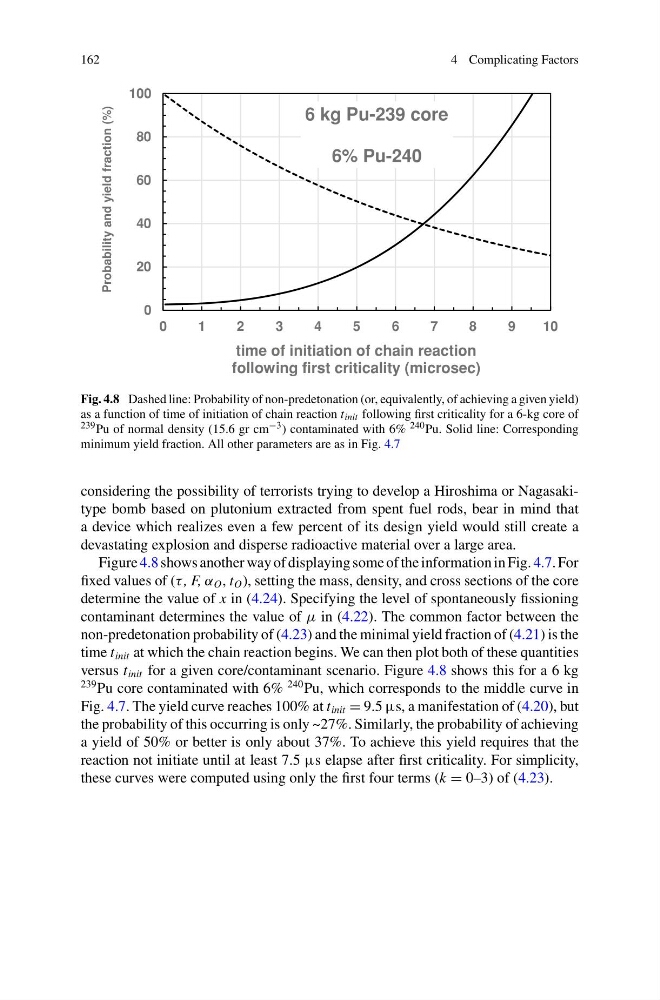
Fig. 4.8 Dashed line: Probability of non-predetonation (or, equivalently, of achieving a given yield)
as a function of time of initiation of chain reaction t init following first criticality for a 6-kg core of
239 Pu of normal density (15.6 gr cm −3 ) contaminated with 6% 240 Pu. Solid line: Corresponding
minimum yield fraction. All other parameters are as in Fig. 4.7
considering the possibility of terrorists trying to develop a Hiroshima or Nagasakitype bomb based on plutonium extracted from spent fuel rods, bear in mind that
a device which realizes even a few percent of its design yield would still create a
devastating explosion and disperse radioactive material over a large area.
Figure 4.8 shows another way of displaying some of the information in Fig. 4.7. For
fixed values of (τ , F, α O , t O ), setting the mass, density, and cross sections of the core
determine the value of x in (4.24). Specifying the level of spontaneously fissioning
contaminant determines the value of μ in (4.22). The common factor between the
non-predetonation probability of (4.23) and the minimal yield fraction of (4.21) is the
time t init at which the chain reaction begins. We can then plot both of these quantities
versus t init for a given core/contaminant scenario. Figure 4.8 shows this for a 6 kg
239 Pu core contaminated with 6%
240 Pu, which corresponds to the middle curve in
Fig. 4.7. The yield curve reaches 100% at t init = 9.5 μs, a manifestation of (4.20), but
the probability of this occurring is only ~27%. Similarly, the probability of achieving
a yield of 50% or better is only about 37%. To achieve this yield requires that the
reaction not initiate until at least 7.5 μs elapse after first criticality. For simplicity,
these curves were computed using only the first four terms (k = 0–3) of (4.23).
4 Complicating Factors
0
20
40
60
80
100
0
1
2
3
4
5
6
7
8
9
10
Probability and yield fraction (%)
time of initiation of chain reaction
following first criticality (microsec)
6 kg Pu-239 core
6% Pu-240
Fig. 4.8 Dashed line: Probability of non-predetonation (or, equivalently, of achieving a given yield)
as a function of time of initiation of chain reaction t init following first criticality for a 6-kg core of
239 Pu of normal density (15.6 gr cm −3 ) contaminated with 6% 240 Pu. Solid line: Corresponding
minimum yield fraction. All other parameters are as in Fig. 4.7
considering the possibility of terrorists trying to develop a Hiroshima or Nagasakitype bomb based on plutonium extracted from spent fuel rods, bear in mind that
a device which realizes even a few percent of its design yield would still create a
devastating explosion and disperse radioactive material over a large area.
Figure 4.8 shows another way of displaying some of the information in Fig. 4.7. For
fixed values of (τ , F, α O , t O ), setting the mass, density, and cross sections of the core
determine the value of x in (4.24). Specifying the level of spontaneously fissioning
contaminant determines the value of μ in (4.22). The common factor between the
non-predetonation probability of (4.23) and the minimal yield fraction of (4.21) is the
time t init at which the chain reaction begins. We can then plot both of these quantities
versus t init for a given core/contaminant scenario. Figure 4.8 shows this for a 6 kg
239 Pu core contaminated with 6%
240 Pu, which corresponds to the middle curve in
Fig. 4.7. The yield curve reaches 100% at t init = 9.5 μs, a manifestation of (4.20), but
the probability of this occurring is only ~27%. Similarly, the probability of achieving
a yield of 50% or better is only about 37%. To achieve this yield requires that the
reaction not initiate until at least 7.5 μs elapse after first criticality. For simplicity,
these curves were computed using only the first four terms (k = 0–3) of (4.23).