

4.3 Predetonation Yield
159
1580
1620
1660
1700
1740
1780
0
0.1
0.2
0.3
0.4
0.5
<
ρ r > (kg m -2
)
α
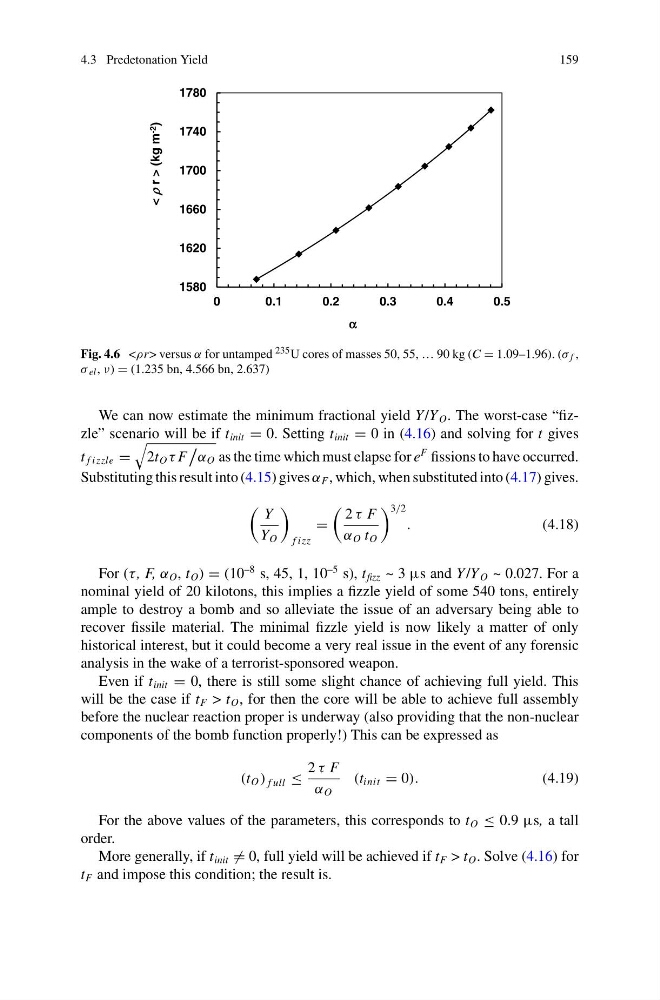
Fig. 4.6 <ρr> versus α for untamped 235 U cores of masses 50, 55, … 90 kg (C = 1.09–1.96). (σ f ,
σ el , ν) = (1.235 bn, 4.566 bn, 2.637)
We can now estimate the minimum fractional yield Y /Y O . The worst-case “fizzle” scenario will be if t init = 0. Setting t init = 0 in (4.16) and solving for t gives
t f izzle =
2t O τ F
α O as the time which must elapse for e
F fissions to have occurred.
Substituting this result into (4.15) gives α F , which, when substituted into (4.17) gives.
Y
Y O
f izz
=
2 τ F
α O t O
3/2
.
(4.18)
For (τ , F, α O , t O ) = (10
–8 s, 45, 1, 10
–5 s), t fizz ~ 3 μs and Y /Y O ~ 0.027. For a
nominal yield of 20 kilotons, this implies a fizzle yield of some 540 tons, entirely
ample to destroy a bomb and so alleviate the issue of an adversary being able to
recover fissile material. The minimal fizzle yield is now likely a matter of only
historical interest, but it could become a very real issue in the event of any forensic
analysis in the wake of a terrorist-sponsored weapon.
Even if t init = 0, there is still some slight chance of achieving full yield. This
will be the case if t F > t O , for then the core will be able to achieve full assembly
before the nuclear reaction proper is underway (also providing that the non-nuclear
components of the bomb function properly!) This can be expressed as
(t O ) f ull ≤
2 τ F
α O
(t init = 0).
(4.19)
For the above values of the parameters, this corresponds to t O ≤ 0.9 μs, a tall
order.
More generally, if t init = 0, full yield will be achieved if t F > t O . Solve (4.16) for
t F and impose this condition; the result is.
159
1580
1620
1660
1700
1740
1780
0
0.1
0.2
0.3
0.4
0.5
<
ρ r > (kg m -2
)
α
Fig. 4.6 <ρr> versus α for untamped 235 U cores of masses 50, 55, … 90 kg (C = 1.09–1.96). (σ f ,
σ el , ν) = (1.235 bn, 4.566 bn, 2.637)
We can now estimate the minimum fractional yield Y /Y O . The worst-case “fizzle” scenario will be if t init = 0. Setting t init = 0 in (4.16) and solving for t gives
t f izzle =
2t O τ F
α O as the time which must elapse for e
F fissions to have occurred.
Substituting this result into (4.15) gives α F , which, when substituted into (4.17) gives.
Y
Y O
f izz
=
2 τ F
α O t O
3/2
.
(4.18)
For (τ , F, α O , t O ) = (10
–8 s, 45, 1, 10
–5 s), t fizz ~ 3 μs and Y /Y O ~ 0.027. For a
nominal yield of 20 kilotons, this implies a fizzle yield of some 540 tons, entirely
ample to destroy a bomb and so alleviate the issue of an adversary being able to
recover fissile material. The minimal fizzle yield is now likely a matter of only
historical interest, but it could become a very real issue in the event of any forensic
analysis in the wake of a terrorist-sponsored weapon.
Even if t init = 0, there is still some slight chance of achieving full yield. This
will be the case if t F > t O , for then the core will be able to achieve full assembly
before the nuclear reaction proper is underway (also providing that the non-nuclear
components of the bomb function properly!) This can be expressed as
(t O ) f ull ≤
2 τ F
α O
(t init = 0).
(4.19)
For the above values of the parameters, this corresponds to t O ≤ 0.9 μs, a tall
order.
More generally, if t init = 0, full yield will be achieved if t F > t O . Solve (4.16) for
t F and impose this condition; the result is.