

4.2 Spontaneous Fission of 240 Pu, Predetonation, and Implosion
153
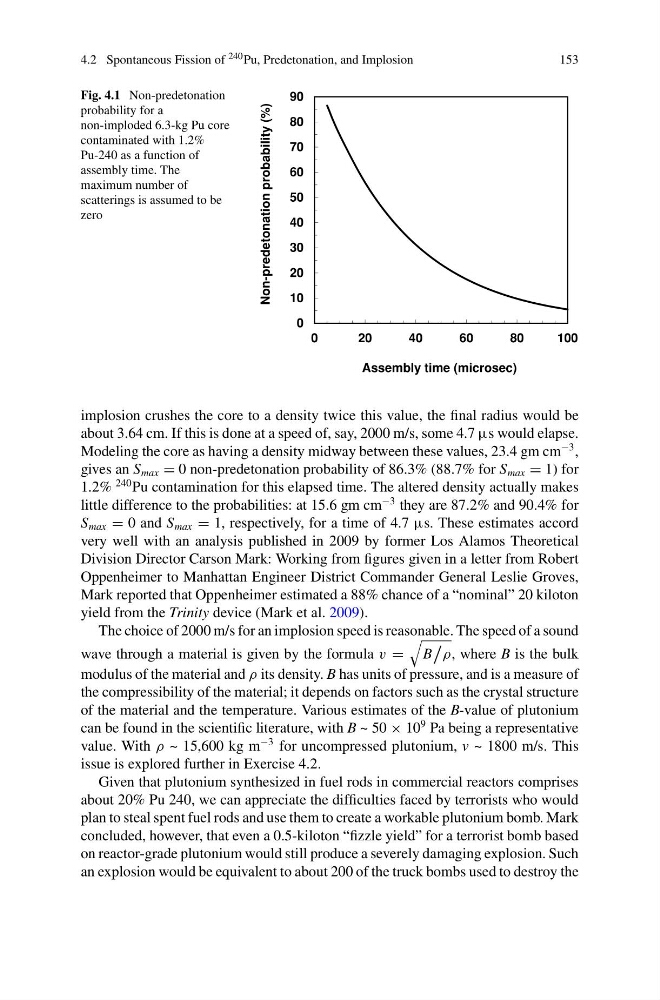
Fig. 4.1 Non-predetonation
probability for a
non-imploded 6.3-kg Pu core
contaminated with 1.2%
Pu-240 as a function of
assembly time. The
maximum number of
scatterings is assumed to be
zero
0
10
20
30
40
50
60
70
80
90
0
2 0
4 0
6 0
8 0
1 0 0
Non-predetonation probability (%)
Assembly time (microsec)
implosion crushes the core to a density twice this value, the final radius would be
about 3.64 cm. If this is done at a speed of, say, 2000 m/s, some 4.7 μs would elapse.
Modeling the core as having a density midway between these values, 23.4 gm cm
−3 ,
gives an S max = 0 non-predetonation probability of 86.3% (88.7% for S max = 1) for
1.2%
240 Pu contamination for this elapsed time. The altered density actually makes
little difference to the probabilities: at 15.6 gm cm
−3 they are 87.2% and 90.4% for
S max = 0 and S max = 1, respectively, for a time of 4.7 μs. These estimates accord
very well with an analysis published in 2009 by former Los Alamos Theoretical
Division Director Carson Mark: Working from figures given in a letter from Robert
Oppenheimer to Manhattan Engineer District Commander General Leslie Groves,
Mark reported that Oppenheimer estimated a 88% chance of a “nominal” 20 kiloton
yield from the Trinity device (Mark et al. 2009).
The choice of 2000 m/s for an implosion speed is reasonable. The speed of a sound
wave through a material is given by the formula v =
B
ρ, where B is the bulk
modulus of the material and ρ its density. B has units of pressure, and is a measure of
the compressibility of the material; it depends on factors such as the crystal structure
of the material and the temperature. Various estimates of the B-value of plutonium
can be found in the scientific literature, with B ~ 50 × 10
9 Pa being a representative
value. With ρ ~ 15,600 kg m
−3 for uncompressed plutonium, v ~ 1800 m/s. This
issue is explored further in Exercise 4.2.
Given that plutonium synthesized in fuel rods in commercial reactors comprises
about 20% Pu 240, we can appreciate the difficulties faced by terrorists who would
plan to steal spent fuel rods and use them to create a workable plutonium bomb. Mark
concluded, however, that even a 0.5-kiloton “fizzle yield” for a terrorist bomb based
on reactor-grade plutonium would still produce a severely damaging explosion. Such
an explosion would be equivalent to about 200 of the truck bombs used to destroy the
153
Fig. 4.1 Non-predetonation
probability for a
non-imploded 6.3-kg Pu core
contaminated with 1.2%
Pu-240 as a function of
assembly time. The
maximum number of
scatterings is assumed to be
zero
0
10
20
30
40
50
60
70
80
90
0
2 0
4 0
6 0
8 0
1 0 0
Non-predetonation probability (%)
Assembly time (microsec)
implosion crushes the core to a density twice this value, the final radius would be
about 3.64 cm. If this is done at a speed of, say, 2000 m/s, some 4.7 μs would elapse.
Modeling the core as having a density midway between these values, 23.4 gm cm
−3 ,
gives an S max = 0 non-predetonation probability of 86.3% (88.7% for S max = 1) for
1.2%
240 Pu contamination for this elapsed time. The altered density actually makes
little difference to the probabilities: at 15.6 gm cm
−3 they are 87.2% and 90.4% for
S max = 0 and S max = 1, respectively, for a time of 4.7 μs. These estimates accord
very well with an analysis published in 2009 by former Los Alamos Theoretical
Division Director Carson Mark: Working from figures given in a letter from Robert
Oppenheimer to Manhattan Engineer District Commander General Leslie Groves,
Mark reported that Oppenheimer estimated a 88% chance of a “nominal” 20 kiloton
yield from the Trinity device (Mark et al. 2009).
The choice of 2000 m/s for an implosion speed is reasonable. The speed of a sound
wave through a material is given by the formula v =
B
ρ, where B is the bulk
modulus of the material and ρ its density. B has units of pressure, and is a measure of
the compressibility of the material; it depends on factors such as the crystal structure
of the material and the temperature. Various estimates of the B-value of plutonium
can be found in the scientific literature, with B ~ 50 × 10
9 Pa being a representative
value. With ρ ~ 15,600 kg m
−3 for uncompressed plutonium, v ~ 1800 m/s. This
issue is explored further in Exercise 4.2.
Given that plutonium synthesized in fuel rods in commercial reactors comprises
about 20% Pu 240, we can appreciate the difficulties faced by terrorists who would
plan to steal spent fuel rods and use them to create a workable plutonium bomb. Mark
concluded, however, that even a 0.5-kiloton “fizzle yield” for a terrorist bomb based
on reactor-grade plutonium would still produce a severely damaging explosion. Such
an explosion would be equivalent to about 200 of the truck bombs used to destroy the