

140
3 Producing Fissile Material
N esc (t) =
ρ N S v (t)
4π
π/2
0
sin θ cos θ dθ
2π
0
dφ.
(3.53)
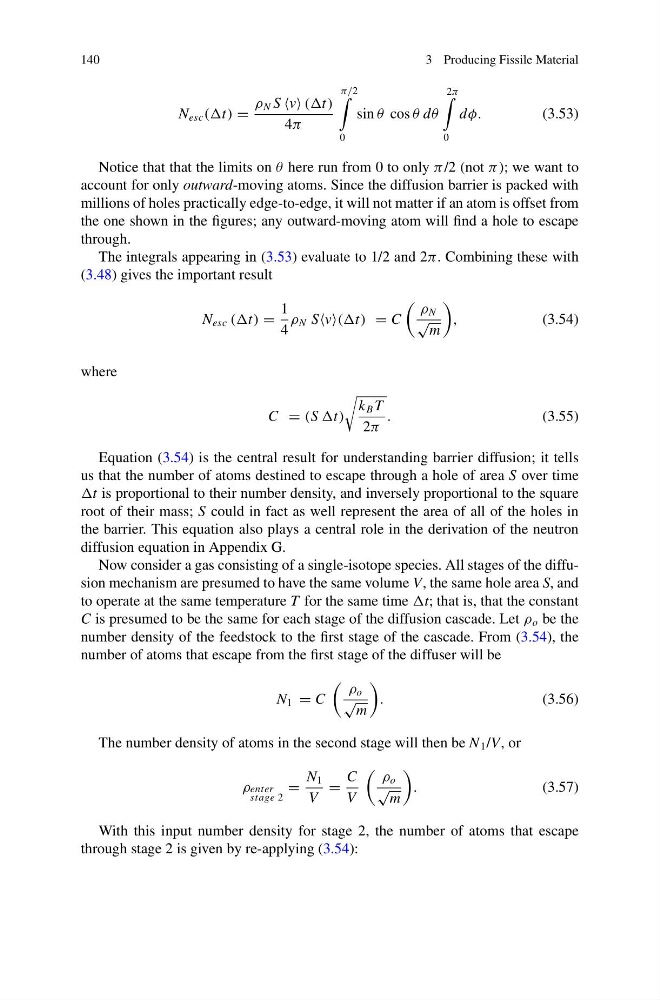
Notice that that the limits on θ here run from 0 to only π /2 (not π ); we want to
account for only outward-moving atoms. Since the diffusion barrier is packed with
millions of holes practically edge-to-edge, it will not matter if an atom is offset from
the one shown in the figures; any outward-moving atom will find a hole to escape
through.
The integrals appearing in (3.53) evaluate to 1/2 and 2π. Combining these with
(3.48) gives the important result
N esc (t) =
1
4
ρ N Sv(t) = C
ρ N
√
m
,
(3.54)
where
C = (S t)
k B T
2π
.
(3.55)
Equation (3.54) is the central result for understanding barrier diffusion; it tells
us that the number of atoms destined to escape through a hole of area S over time
t is proportional to their number density, and inversely proportional to the square
root of their mass; S could in fact as well represent the area of all of the holes in
the barrier. This equation also plays a central role in the derivation of the neutron
diffusion equation in Appendix G.
Now consider a gas consisting of a single-isotope species. All stages of the diffusion mechanism are presumed to have the same volume V, the same hole area S, and
to operate at the same temperature T for the same time t; that is, that the constant
C is presumed to be the same for each stage of the diffusion cascade. Let ρ o be the
number density of the feedstock to the first stage of the cascade. From (3.54), the
number of atoms that escape from the first stage of the diffuser will be
N 1 = C
ρ o
√
m
.
(3.56)
The number density of atoms in the second stage will then be N 1 /V, or
ρenter
stage 2
=
N 1
V
=
C
V
ρ o
√
m
.
(3.57)
With this input number density for stage 2, the number of atoms that escape
through stage 2 is given by re-applying (3.54):
3 Producing Fissile Material
N esc (t) =
ρ N S v (t)
4π
π/2
0
sin θ cos θ dθ
2π
0
dφ.
(3.53)
Notice that that the limits on θ here run from 0 to only π /2 (not π ); we want to
account for only outward-moving atoms. Since the diffusion barrier is packed with
millions of holes practically edge-to-edge, it will not matter if an atom is offset from
the one shown in the figures; any outward-moving atom will find a hole to escape
through.
The integrals appearing in (3.53) evaluate to 1/2 and 2π. Combining these with
(3.48) gives the important result
N esc (t) =
1
4
ρ N Sv(t) = C
ρ N
√
m
,
(3.54)
where
C = (S t)
k B T
2π
.
(3.55)
Equation (3.54) is the central result for understanding barrier diffusion; it tells
us that the number of atoms destined to escape through a hole of area S over time
t is proportional to their number density, and inversely proportional to the square
root of their mass; S could in fact as well represent the area of all of the holes in
the barrier. This equation also plays a central role in the derivation of the neutron
diffusion equation in Appendix G.
Now consider a gas consisting of a single-isotope species. All stages of the diffusion mechanism are presumed to have the same volume V, the same hole area S, and
to operate at the same temperature T for the same time t; that is, that the constant
C is presumed to be the same for each stage of the diffusion cascade. Let ρ o be the
number density of the feedstock to the first stage of the cascade. From (3.54), the
number of atoms that escape from the first stage of the diffuser will be
N 1 = C
ρ o
√
m
.
(3.56)
The number density of atoms in the second stage will then be N 1 /V, or
ρenter
stage 2
=
N 1
V
=
C
V
ρ o
√
m
.
(3.57)
With this input number density for stage 2, the number of atoms that escape
through stage 2 is given by re-applying (3.54):