

138
3 Producing Fissile Material
191
vy
vx
vz
v
θ
φ
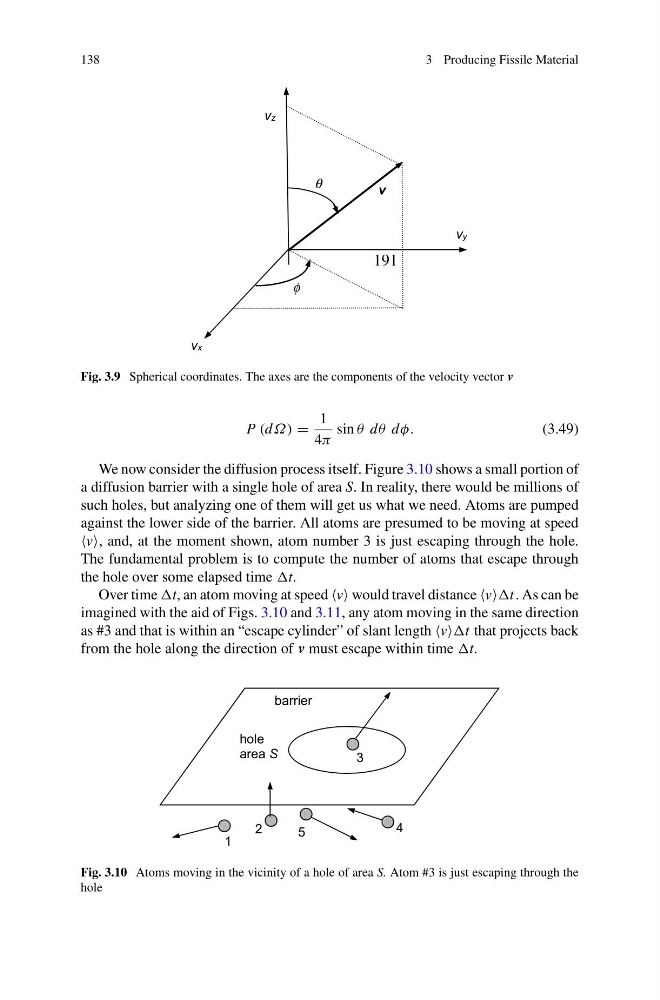
Fig. 3.9 Spherical coordinates. The axes are the components of the velocity vector v
P (dΩ) =
1
4π
sin θ dθ dφ.
(3.49)
We now consider the diffusion process itself. Figure 3.10 shows a small portion of
a diffusion barrier with a single hole of area S. In reality, there would be millions of
such holes, but analyzing one of them will get us what we need. Atoms are pumped
against the lower side of the barrier. All atoms are presumed to be moving at speed
v, and, at the moment shown, atom number 3 is just escaping through the hole.
The fundamental problem is to compute the number of atoms that escape through
the hole over some elapsed time
Over time an atom moving at speed v would travel distance v As can be
imagined with the aid of Figs. 3.10 and 3.11, any atom moving in the same direction
as #3 and that is within an “escape cylinder” of slant length v that projects back
from the hole along the direction of v must escape within time
1
barrier
hole
area S
2
3
4
5
Fig. 3.10 Atoms moving in the vicinity of a hole of area S. Atom #3 is just escaping through the
hole
3 Producing Fissile Material
191
vy
vx
vz
v
θ
φ
Fig. 3.9 Spherical coordinates. The axes are the components of the velocity vector v
P (dΩ) =
1
4π
sin θ dθ dφ.
(3.49)
We now consider the diffusion process itself. Figure 3.10 shows a small portion of
a diffusion barrier with a single hole of area S. In reality, there would be millions of
such holes, but analyzing one of them will get us what we need. Atoms are pumped
against the lower side of the barrier. All atoms are presumed to be moving at speed
v, and, at the moment shown, atom number 3 is just escaping through the hole.
The fundamental problem is to compute the number of atoms that escape through
the hole over some elapsed time
Over time an atom moving at speed v would travel distance v As can be
imagined with the aid of Figs. 3.10 and 3.11, any atom moving in the same direction
as #3 and that is within an “escape cylinder” of slant length v that projects back
from the hole along the direction of v must escape within time
1
barrier
hole
area S
2
3
4
5
Fig. 3.10 Atoms moving in the vicinity of a hole of area S. Atom #3 is just escaping through the
hole