

136
3 Producing Fissile Material
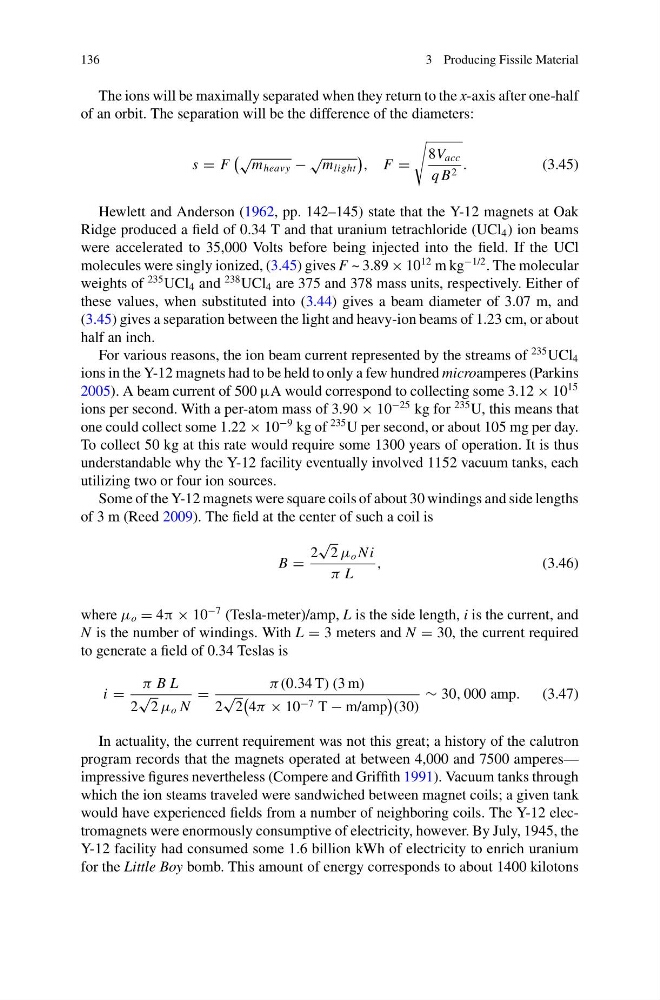
The ions will be maximally separated when they return to the x-axis after one-half
of an orbit. The separation will be the difference of the diameters:
s = F
√ m heavy −
√
m light
, F =
8V acc
q B 2 .
(3.45)
Hewlett and Anderson (1962, pp. 142–145) state that the Y-12 magnets at Oak
Ridge produced a field of 0.34 T and that uranium tetrachloride (UCl 4 ) ion beams
were accelerated to 35,000 Volts before being injected into the field. If the UCl
molecules were singly ionized, (3.45) gives F ~ 3.89 × 10
12 m kg
−1/2 . The molecular
weights of
235 UCl 4 and
238 UCl 4 are 375 and 378 mass units, respectively. Either of
these values, when substituted into (3.44) gives a beam diameter of 3.07 m, and
(3.45) gives a separation between the light and heavy-ion beams of 1.23 cm, or about
half an inch.
For various reasons, the ion beam current represented by the streams of
235 UCl 4
ions in the Y-12 magnets had to be held to only a few hundred microamperes (Parkins
2005). A beam current of 500 μA would correspond to collecting some 3.12 × 10
15
ions per second. With a per-atom mass of 3.90 × 10
−25 kg for
235 U, this means that
one could collect some 1.22 × 10
−9 kg of
235 U per second, or about 105 mg per day.
To collect 50 kg at this rate would require some 1300 years of operation. It is thus
understandable why the Y-12 facility eventually involved 1152 vacuum tanks, each
utilizing two or four ion sources.
Some of the Y-12 magnets were square coils of about 30 windings and side lengths
of 3 m (Reed 2009). The field at the center of such a coil is
B =
2
√
2 μ o Ni
π L
,
(3.46)
where μ o = 4π × 10
−7 (Tesla-meter)/amp, L is the side length, i is the current, and
N is the number of windings. With L = 3 meters and N = 30, the current required
to generate a field of 0.34 Teslas is
i =
π B L
2
√
2 μ o N
=
π (0.34 T) (3 m)
2
√
2
4π × 10 −7 T − m/amp
(30)
∼ 30, 000 amp.
(3.47)
In actuality, the current requirement was not this great; a history of the calutron
program records that the magnets operated at between 4,000 and 7500 amperes—
impressive figures nevertheless (Compere and Griffith 1991). Vacuum tanks through
which the ion steams traveled were sandwiched between magnet coils; a given tank
would have experienced fields from a number of neighboring coils. The Y-12 electromagnets were enormously consumptive of electricity, however. By July, 1945, the
Y-12 facility had consumed some 1.6 billion kWh of electricity to enrich uranium
for the Little Boy bomb. This amount of energy corresponds to about 1400 kilotons
3 Producing Fissile Material
The ions will be maximally separated when they return to the x-axis after one-half
of an orbit. The separation will be the difference of the diameters:
s = F
√ m heavy −
√
m light
, F =
8V acc
q B 2 .
(3.45)
Hewlett and Anderson (1962, pp. 142–145) state that the Y-12 magnets at Oak
Ridge produced a field of 0.34 T and that uranium tetrachloride (UCl 4 ) ion beams
were accelerated to 35,000 Volts before being injected into the field. If the UCl
molecules were singly ionized, (3.45) gives F ~ 3.89 × 10
12 m kg
−1/2 . The molecular
weights of
235 UCl 4 and
238 UCl 4 are 375 and 378 mass units, respectively. Either of
these values, when substituted into (3.44) gives a beam diameter of 3.07 m, and
(3.45) gives a separation between the light and heavy-ion beams of 1.23 cm, or about
half an inch.
For various reasons, the ion beam current represented by the streams of
235 UCl 4
ions in the Y-12 magnets had to be held to only a few hundred microamperes (Parkins
2005). A beam current of 500 μA would correspond to collecting some 3.12 × 10
15
ions per second. With a per-atom mass of 3.90 × 10
−25 kg for
235 U, this means that
one could collect some 1.22 × 10
−9 kg of
235 U per second, or about 105 mg per day.
To collect 50 kg at this rate would require some 1300 years of operation. It is thus
understandable why the Y-12 facility eventually involved 1152 vacuum tanks, each
utilizing two or four ion sources.
Some of the Y-12 magnets were square coils of about 30 windings and side lengths
of 3 m (Reed 2009). The field at the center of such a coil is
B =
2
√
2 μ o Ni
π L
,
(3.46)
where μ o = 4π × 10
−7 (Tesla-meter)/amp, L is the side length, i is the current, and
N is the number of windings. With L = 3 meters and N = 30, the current required
to generate a field of 0.34 Teslas is
i =
π B L
2
√
2 μ o N
=
π (0.34 T) (3 m)
2
√
2
4π × 10 −7 T − m/amp
(30)
∼ 30, 000 amp.
(3.47)
In actuality, the current requirement was not this great; a history of the calutron
program records that the magnets operated at between 4,000 and 7500 amperes—
impressive figures nevertheless (Compere and Griffith 1991). Vacuum tanks through
which the ion steams traveled were sandwiched between magnet coils; a given tank
would have experienced fields from a number of neighboring coils. The Y-12 electromagnets were enormously consumptive of electricity, however. By July, 1945, the
Y-12 facility had consumed some 1.6 billion kWh of electricity to enrich uranium
for the Little Boy bomb. This amount of energy corresponds to about 1400 kilotons