

110
2 Critical Mass, Efficiency, and Yield
2.9 Critical Mass of a Cylindrical Core (Optional)
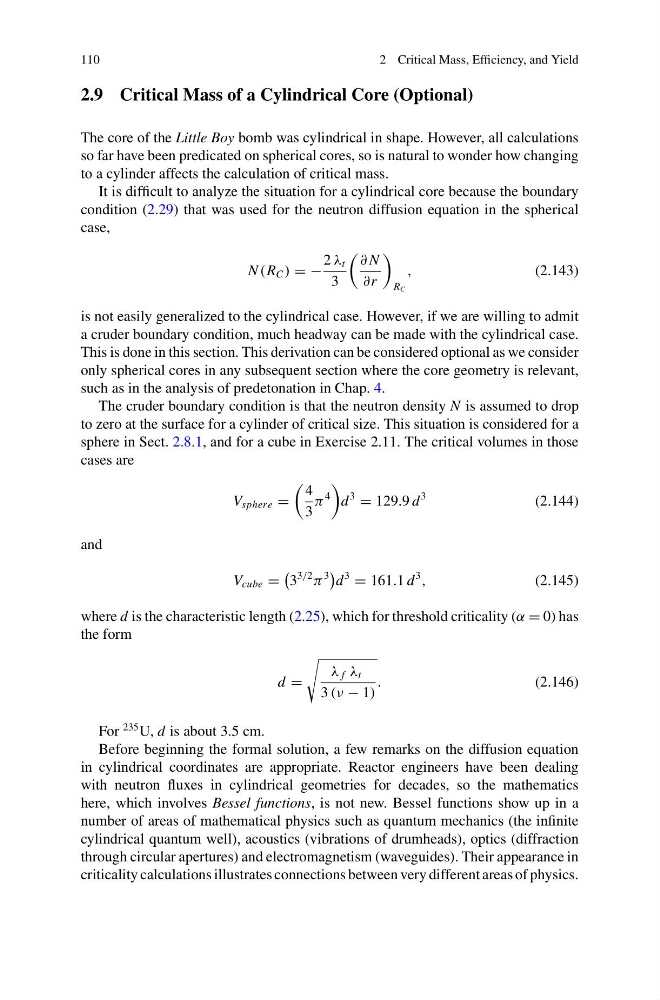
The core of the Little Boy bomb was cylindrical in shape. However, all calculations
so far have been predicated on spherical cores, so is natural to wonder how changing
to a cylinder affects the calculation of critical mass.
It is difficult to analyze the situation for a cylindrical core because the boundary
condition (2.29) that was used for the neutron diffusion equation in the spherical
case,
N (R C ) = −
2 λ t
3
∂ N
∂r
R C
,
(2.143)
is not easily generalized to the cylindrical case. However, if we are willing to admit
a cruder boundary condition, much headway can be made with the cylindrical case.
This is done in this section. This derivation can be considered optional as we consider
only spherical cores in any subsequent section where the core geometry is relevant,
such as in the analysis of predetonation in Chap. 4.
The cruder boundary condition is that the neutron density N is assumed to drop
to zero at the surface for a cylinder of critical size. This situation is considered for a
sphere in Sect. 2.8.1, and for a cube in Exercise 2.11. The critical volumes in those
cases are
V sphere =
4
3
π
4
d
3
= 129.9 d
3
(2.144)
and
V cube =
3
3/2
π
3
d
3
= 161.1 d
3
,
(2.145)
where d is the characteristic length (2.25), which for threshold criticality (α = 0) has
the form
d =
λ f λ t
3 (ν − 1)
.
(2.146)
For
235 U, d is about 3.5 cm.
Before beginning the formal solution, a few remarks on the diffusion equation
in cylindrical coordinates are appropriate. Reactor engineers have been dealing
with neutron fluxes in cylindrical geometries for decades, so the mathematics
here, which involves Bessel functions, is not new. Bessel functions show up in a
number of areas of mathematical physics such as quantum mechanics (the infinite
cylindrical quantum well), acoustics (vibrations of drumheads), optics (diffraction
through circular apertures) and electromagnetism (waveguides). Their appearance in
criticality calculations illustrates connections between very different areas of physics.
2 Critical Mass, Efficiency, and Yield
2.9 Critical Mass of a Cylindrical Core (Optional)
The core of the Little Boy bomb was cylindrical in shape. However, all calculations
so far have been predicated on spherical cores, so is natural to wonder how changing
to a cylinder affects the calculation of critical mass.
It is difficult to analyze the situation for a cylindrical core because the boundary
condition (2.29) that was used for the neutron diffusion equation in the spherical
case,
N (R C ) = −
2 λ t
3
∂ N
∂r
R C
,
(2.143)
is not easily generalized to the cylindrical case. However, if we are willing to admit
a cruder boundary condition, much headway can be made with the cylindrical case.
This is done in this section. This derivation can be considered optional as we consider
only spherical cores in any subsequent section where the core geometry is relevant,
such as in the analysis of predetonation in Chap. 4.
The cruder boundary condition is that the neutron density N is assumed to drop
to zero at the surface for a cylinder of critical size. This situation is considered for a
sphere in Sect. 2.8.1, and for a cube in Exercise 2.11. The critical volumes in those
cases are
V sphere =
4
3
π
4
d
3
= 129.9 d
3
(2.144)
and
V cube =
3
3/2
π
3
d
3
= 161.1 d
3
,
(2.145)
where d is the characteristic length (2.25), which for threshold criticality (α = 0) has
the form
d =
λ f λ t
3 (ν − 1)
.
(2.146)
For
235 U, d is about 3.5 cm.
Before beginning the formal solution, a few remarks on the diffusion equation
in cylindrical coordinates are appropriate. Reactor engineers have been dealing
with neutron fluxes in cylindrical geometries for decades, so the mathematics
here, which involves Bessel functions, is not new. Bessel functions show up in a
number of areas of mathematical physics such as quantum mechanics (the infinite
cylindrical quantum well), acoustics (vibrations of drumheads), optics (diffraction
through circular apertures) and electromagnetism (waveguides). Their appearance in
criticality calculations illustrates connections between very different areas of physics.