

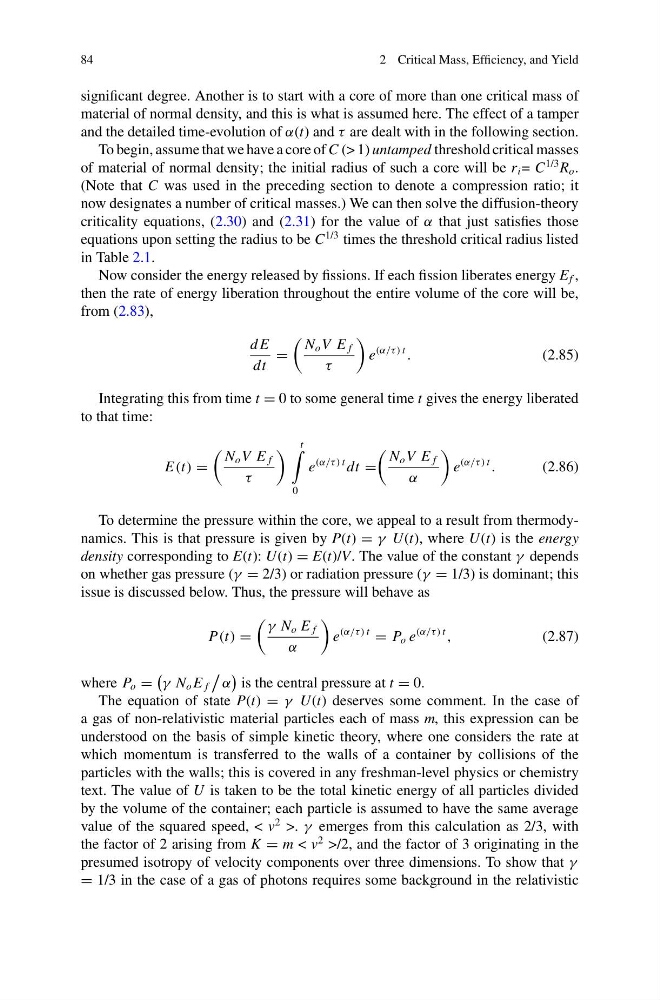
84
2 Critical Mass, Efficiency, and Yield
significant degree. Another is to start with a core of more than one critical mass of
material of normal density, and this is what is assumed here. The effect of a tamper
and the detailed time-evolution of α(t) and τ are dealt with in the following section.
To begin, assume that we have a core of C (> 1) untamped threshold critical masses
of material of normal density; the initial radius of such a core will be r i = C
1/3 R o .
(Note that C was used in the preceding section to denote a compression ratio; it
now designates a number of critical masses.) We can then solve the diffusion-theory
criticality equations, (2.30) and (2.31) for the value of α that just satisfies those
equations upon setting the radius to be C
1/3 times the threshold critical radius listed
in Table 2.1.
Now consider the energy released by fissions. If each fission liberates energy E f ,
then the rate of energy liberation throughout the entire volume of the core will be,
from (2.83),
d E
dt
=
N o V E f
τ
e
(α/τ ) t
.
(2.85)
Integrating this from time t = 0 to some general time t gives the energy liberated
to that time:
E(t) =
N o V E f
τ
t
0
e
(α/τ ) t dt =
N o V E f
α
e
(α/τ ) t
.
(2.86)
To determine the pressure within the core, we appeal to a result from thermodynamics. This is that pressure is given by P(t) = γ U(t), where U(t) is the energy
density corresponding to E(t): U(t) = E(t)/V. The value of the constant γ depends
on whether gas pressure (γ = 2/3) or radiation pressure (γ = 1/3) is dominant; this
issue is discussed below. Thus, the pressure will behave as
P(t) =
γ N o E f
α
e
(α/τ ) t
= P o e
(α/τ ) t
,
(2.87)
where P o =
γ N o E f
α
is the central pressure at t = 0.
The equation of state P(t) = γ U(t) deserves some comment. In the case of
a gas of non-relativistic material particles each of mass m, this expression can be
understood on the basis of simple kinetic theory, where one considers the rate at
which momentum is transferred to the walls of a container by collisions of the
particles with the walls; this is covered in any freshman-level physics or chemistry
text. The value of U is taken to be the total kinetic energy of all particles divided
by the volume of the container; each particle is assumed to have the same average
value of the squared speed, < v
2 >. γ emerges from this calculation as 2/3, with
the factor of 2 arising from K = m < v
2 >/2, and the factor of 3 originating in the
presumed isotropy of velocity components over three dimensions. To show that γ
= 1/3 in the case of a gas of photons requires some background in the relativistic
2 Critical Mass, Efficiency, and Yield
significant degree. Another is to start with a core of more than one critical mass of
material of normal density, and this is what is assumed here. The effect of a tamper
and the detailed time-evolution of α(t) and τ are dealt with in the following section.
To begin, assume that we have a core of C (> 1) untamped threshold critical masses
of material of normal density; the initial radius of such a core will be r i = C
1/3 R o .
(Note that C was used in the preceding section to denote a compression ratio; it
now designates a number of critical masses.) We can then solve the diffusion-theory
criticality equations, (2.30) and (2.31) for the value of α that just satisfies those
equations upon setting the radius to be C
1/3 times the threshold critical radius listed
in Table 2.1.
Now consider the energy released by fissions. If each fission liberates energy E f ,
then the rate of energy liberation throughout the entire volume of the core will be,
from (2.83),
d E
dt
=
N o V E f
τ
e
(α/τ ) t
.
(2.85)
Integrating this from time t = 0 to some general time t gives the energy liberated
to that time:
E(t) =
N o V E f
τ
t
0
e
(α/τ ) t dt =
N o V E f
α
e
(α/τ ) t
.
(2.86)
To determine the pressure within the core, we appeal to a result from thermodynamics. This is that pressure is given by P(t) = γ U(t), where U(t) is the energy
density corresponding to E(t): U(t) = E(t)/V. The value of the constant γ depends
on whether gas pressure (γ = 2/3) or radiation pressure (γ = 1/3) is dominant; this
issue is discussed below. Thus, the pressure will behave as
P(t) =
γ N o E f
α
e
(α/τ ) t
= P o e
(α/τ ) t
,
(2.87)
where P o =
γ N o E f
α
is the central pressure at t = 0.
The equation of state P(t) = γ U(t) deserves some comment. In the case of
a gas of non-relativistic material particles each of mass m, this expression can be
understood on the basis of simple kinetic theory, where one considers the rate at
which momentum is transferred to the walls of a container by collisions of the
particles with the walls; this is covered in any freshman-level physics or chemistry
text. The value of U is taken to be the total kinetic energy of all particles divided
by the volume of the container; each particle is assumed to have the same average
value of the squared speed, < v
2 >. γ emerges from this calculation as 2/3, with
the factor of 2 arising from K = m < v
2 >/2, and the factor of 3 originating in the
presumed isotropy of velocity components over three dimensions. To show that γ
= 1/3 in the case of a gas of photons requires some background in the relativistic