

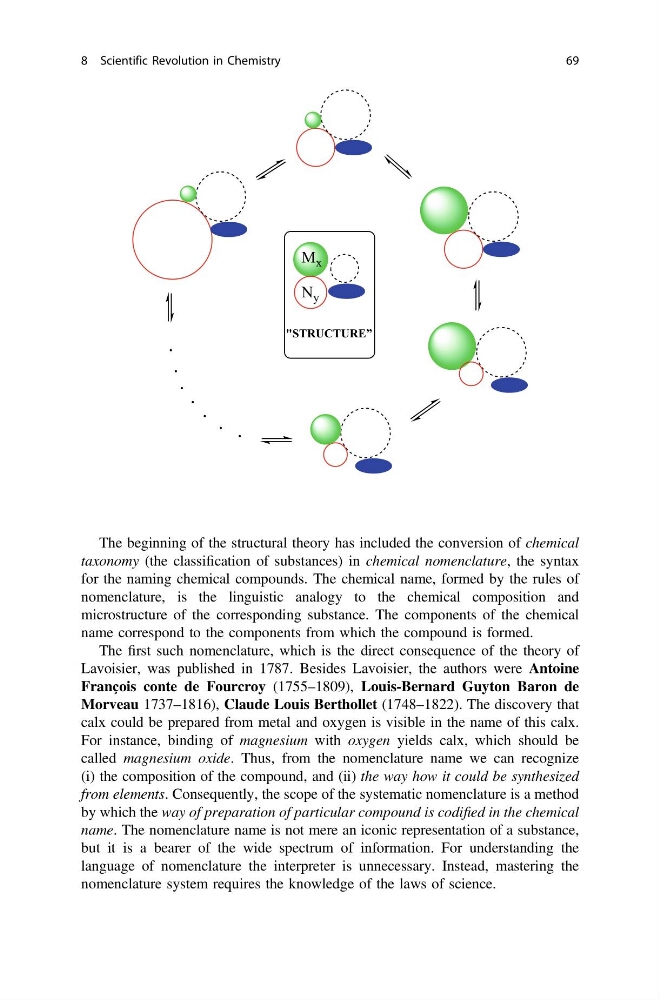
The beginning of the structural theory has included the conversion of chemical
taxonomy (the classification of substances) in chemical nomenclature, the syntax
for the naming chemical compounds. The chemical name, formed by the rules of
nomenclature, is the linguistic analogy to the chemical composition and
microstructure of the corresponding substance. The components of the chemical
name correspond to the components from which the compound is formed.
The first such nomenclature, which is the direct consequence of the theory of
Lavoisier, was published in 1787. Besides Lavoisier, the authors were Antoine
François conte de Fourcroy (1755–1809), Louis-Bernard Guyton Baron de
Morveau 1737–1816), Claude Louis Berthollet (1748–1822). The discovery that
calx could be prepared from metal and oxygen is visible in the name of this calx.
For instance, binding of magnesium with oxygen yields calx, which should be
called magnesium oxide. Thus, from the nomenclature name we can recognize
(i) the composition of the compound, and (ii) the way how it could be synthesized
from elements. Consequently, the scope of the systematic nomenclature is a method
by which the way of preparation of particular compound is codified in the chemical
name. The nomenclature name is not mere an iconic representation of a substance,
but it is a bearer of the wide spectrum of information. For understanding the
language of nomenclature the interpreter is unnecessary. Instead, mastering the
nomenclature system requires the knowledge of the laws of science.
M x
N y
"STRUCTURE”
Scheme 3
8 Scientific Revolution in Chemistry
69
taxonomy (the classification of substances) in chemical nomenclature, the syntax
for the naming chemical compounds. The chemical name, formed by the rules of
nomenclature, is the linguistic analogy to the chemical composition and
microstructure of the corresponding substance. The components of the chemical
name correspond to the components from which the compound is formed.
The first such nomenclature, which is the direct consequence of the theory of
Lavoisier, was published in 1787. Besides Lavoisier, the authors were Antoine
François conte de Fourcroy (1755–1809), Louis-Bernard Guyton Baron de
Morveau 1737–1816), Claude Louis Berthollet (1748–1822). The discovery that
calx could be prepared from metal and oxygen is visible in the name of this calx.
For instance, binding of magnesium with oxygen yields calx, which should be
called magnesium oxide. Thus, from the nomenclature name we can recognize
(i) the composition of the compound, and (ii) the way how it could be synthesized
from elements. Consequently, the scope of the systematic nomenclature is a method
by which the way of preparation of particular compound is codified in the chemical
name. The nomenclature name is not mere an iconic representation of a substance,
but it is a bearer of the wide spectrum of information. For understanding the
language of nomenclature the interpreter is unnecessary. Instead, mastering the
nomenclature system requires the knowledge of the laws of science.
M x
N y
"STRUCTURE”
Scheme 3
8 Scientific Revolution in Chemistry
69