

chemical elements in his book Traité Élémentaire de Chimie, the work that is the
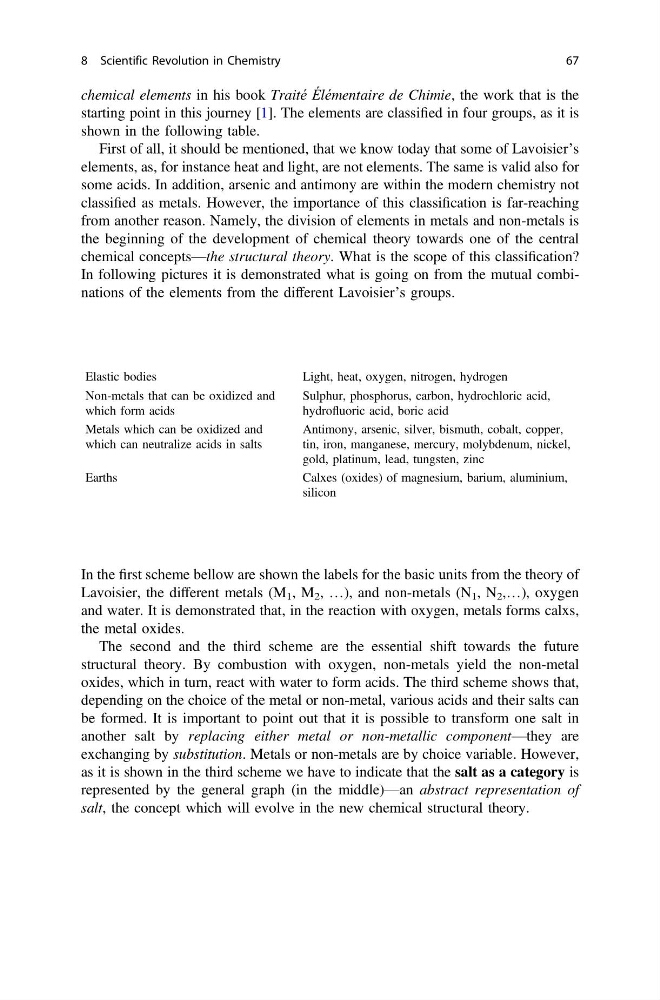
starting point in this journey [1]. The elements are classified in four groups, as it is
shown in the following table.
First of all, it should be mentioned, that we know today that some of Lavoisier’s
elements, as, for instance heat and light, are not elements. The same is valid also for
some acids. In addition, arsenic and antimony are within the modern chemistry not
classified as metals. However, the importance of this classification is far-reaching
from another reason. Namely, the division of elements in metals and non-metals is
the beginning of the development of chemical theory towards one of the central
chemical concepts—the structural theory. What is the scope of this classification?
In following pictures it is demonstrated what is going on from the mutual combinations of the elements from the different Lavoisier’s groups.
In the first scheme bellow are shown the labels for the basic units from the theory of
Lavoisier, the different metals (M 1 , M 2 , …), and non-metals (N 1 , N 2 ,…), oxygen
and water. It is demonstrated that, in the reaction with oxygen, metals forms calxs,
the metal oxides.
The second and the third scheme are the essential shift towards the future
structural theory. By combustion with oxygen, non-metals yield the non-metal
oxides, which in turn, react with water to form acids. The third scheme shows that,
depending on the choice of the metal or non-metal, various acids and their salts can
be formed. It is important to point out that it is possible to transform one salt in
another salt by replacing either metal or non-metallic component—they are
exchanging by substitution. Metals or non-metals are by choice variable. However,
as it is shown in the third scheme we have to indicate that the salt as a category is
represented by the general graph (in the middle)—an abstract representation of
salt, the concept which will evolve in the new chemical structural theory.
List and classification of chemical elements in the work Traité Élémentaire de Chimie (Lavoisier
1789)
Elastic bodies
Light, heat, oxygen, nitrogen, hydrogen
Non-metals that can be oxidized and
which form acids
Sulphur, phosphorus, carbon, hydrochloric acid,
hydrofluoric acid, boric acid
Metals which can be oxidized and
which can neutralize acids in salts
Antimony, arsenic, silver, bismuth, cobalt, copper,
tin, iron, manganese, mercury, molybdenum, nickel,
gold, platinum, lead, tungsten, zinc
Earths
Calxes (oxides) of magnesium, barium, aluminium,
silicon
8 Scientific Revolution in Chemistry
67
starting point in this journey [1]. The elements are classified in four groups, as it is
shown in the following table.
First of all, it should be mentioned, that we know today that some of Lavoisier’s
elements, as, for instance heat and light, are not elements. The same is valid also for
some acids. In addition, arsenic and antimony are within the modern chemistry not
classified as metals. However, the importance of this classification is far-reaching
from another reason. Namely, the division of elements in metals and non-metals is
the beginning of the development of chemical theory towards one of the central
chemical concepts—the structural theory. What is the scope of this classification?
In following pictures it is demonstrated what is going on from the mutual combinations of the elements from the different Lavoisier’s groups.
In the first scheme bellow are shown the labels for the basic units from the theory of
Lavoisier, the different metals (M 1 , M 2 , …), and non-metals (N 1 , N 2 ,…), oxygen
and water. It is demonstrated that, in the reaction with oxygen, metals forms calxs,
the metal oxides.
The second and the third scheme are the essential shift towards the future
structural theory. By combustion with oxygen, non-metals yield the non-metal
oxides, which in turn, react with water to form acids. The third scheme shows that,
depending on the choice of the metal or non-metal, various acids and their salts can
be formed. It is important to point out that it is possible to transform one salt in
another salt by replacing either metal or non-metallic component—they are
exchanging by substitution. Metals or non-metals are by choice variable. However,
as it is shown in the third scheme we have to indicate that the salt as a category is
represented by the general graph (in the middle)—an abstract representation of
salt, the concept which will evolve in the new chemical structural theory.
List and classification of chemical elements in the work Traité Élémentaire de Chimie (Lavoisier
1789)
Elastic bodies
Light, heat, oxygen, nitrogen, hydrogen
Non-metals that can be oxidized and
which form acids
Sulphur, phosphorus, carbon, hydrochloric acid,
hydrofluoric acid, boric acid
Metals which can be oxidized and
which can neutralize acids in salts
Antimony, arsenic, silver, bismuth, cobalt, copper,
tin, iron, manganese, mercury, molybdenum, nickel,
gold, platinum, lead, tungsten, zinc
Earths
Calxes (oxides) of magnesium, barium, aluminium,
silicon
8 Scientific Revolution in Chemistry
67