

combustion. Or, Carl Wilhelm Scheele (1742–1786) performs similar experiments
by heating salts which have released “fire air” characterised by the same properties
as the “dephlogisticated air” prepared by Pristley. Evidently, the obsession with
Empedoclean-Aristotelian concept that air is an element was so strong, that, in spite
to the clear experimental observations, it has “blocked” every glance that air could
be a mixture of differing elemental substances.
Lavoisier had a sort of enlightenment and courage to see in this discovery more
than an isolated phenomenon and the explanation of only one category of chemical
changes. He steps out from the routine of the phlogiston theory with the idea about
the air as an element, and he has changed the paradigm by showing that the
“dephlogisticated air” is really the chemical element, i.e. mere it is one component
of air. But, what about water?
Hydrogen, which Cavendish called “flammable air”, was a subject of experiments of a large number of chemists during the 18th century. By systematic
experimentation, Cavendish has shown that his “flammable air” explodes in the
mixture with “dephlogisticated air”, if this mixture is in ration 2,02 : 1, what he has
precisely measured. The product of this explosion was water in the form of drops
collected on the walls of the closed vessel in which the reaction has occurred. Just
to remember, the “dephlogisticated air” is a common air in which metals and
non-metals can burn, and “phlogisticated air” appears after the combustion when
phlogiston is released from burning substances.
What would be more logical than the fact, that these two airs, flammable and
dephlogistonized, are two different gaseous substances whose mixture explodes and
yields water. But then, water is also not an element. Again, the inability to step out
from the Empedoclean paradigm about water as an element has prevented the
logical conclusion about water as a compound that consists from two gases, hydrogen (flammable air), and oxygen (dephlogisticated air). Instead, Pristley and
Scheele have explained their experiments within the phlogiston concept: the
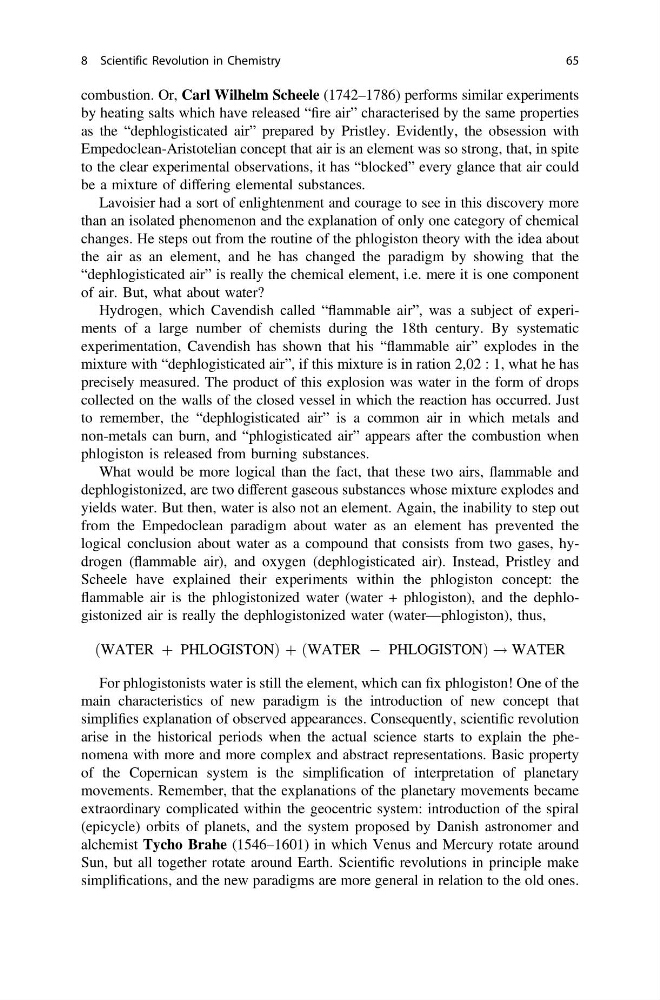
flammable air is the phlogistonized water (water + phlogiston), and the dephlogistonized air is really the dephlogistonized water (water—phlogiston), thus,
WATER þ PHLOGISTON
ð
Þ þ WATER À PHLOGISTON
ð
Þ ! WATER
For phlogistonists water is still the element, which can fix phlogiston! One of the
main characteristics of new paradigm is the introduction of new concept that
simplifies explanation of observed appearances. Consequently, scientific revolution
arise in the historical periods when the actual science starts to explain the phenomena with more and more complex and abstract representations. Basic property
of the Copernican system is the simplification of interpretation of planetary
movements. Remember, that the explanations of the planetary movements became
extraordinary complicated within the geocentric system: introduction of the spiral
(epicycle) orbits of planets, and the system proposed by Danish astronomer and
alchemist Tycho Brahe (1546–1601) in which Venus and Mercury rotate around
Sun, but all together rotate around Earth. Scientific revolutions in principle make
simplifications, and the new paradigms are more general in relation to the old ones.
8 Scientific Revolution in Chemistry
65
by heating salts which have released “fire air” characterised by the same properties
as the “dephlogisticated air” prepared by Pristley. Evidently, the obsession with
Empedoclean-Aristotelian concept that air is an element was so strong, that, in spite
to the clear experimental observations, it has “blocked” every glance that air could
be a mixture of differing elemental substances.
Lavoisier had a sort of enlightenment and courage to see in this discovery more
than an isolated phenomenon and the explanation of only one category of chemical
changes. He steps out from the routine of the phlogiston theory with the idea about
the air as an element, and he has changed the paradigm by showing that the
“dephlogisticated air” is really the chemical element, i.e. mere it is one component
of air. But, what about water?
Hydrogen, which Cavendish called “flammable air”, was a subject of experiments of a large number of chemists during the 18th century. By systematic
experimentation, Cavendish has shown that his “flammable air” explodes in the
mixture with “dephlogisticated air”, if this mixture is in ration 2,02 : 1, what he has
precisely measured. The product of this explosion was water in the form of drops
collected on the walls of the closed vessel in which the reaction has occurred. Just
to remember, the “dephlogisticated air” is a common air in which metals and
non-metals can burn, and “phlogisticated air” appears after the combustion when
phlogiston is released from burning substances.
What would be more logical than the fact, that these two airs, flammable and
dephlogistonized, are two different gaseous substances whose mixture explodes and
yields water. But then, water is also not an element. Again, the inability to step out
from the Empedoclean paradigm about water as an element has prevented the
logical conclusion about water as a compound that consists from two gases, hydrogen (flammable air), and oxygen (dephlogisticated air). Instead, Pristley and
Scheele have explained their experiments within the phlogiston concept: the
flammable air is the phlogistonized water (water + phlogiston), and the dephlogistonized air is really the dephlogistonized water (water—phlogiston), thus,
WATER þ PHLOGISTON
ð
Þ þ WATER À PHLOGISTON
ð
Þ ! WATER
For phlogistonists water is still the element, which can fix phlogiston! One of the
main characteristics of new paradigm is the introduction of new concept that
simplifies explanation of observed appearances. Consequently, scientific revolution
arise in the historical periods when the actual science starts to explain the phenomena with more and more complex and abstract representations. Basic property
of the Copernican system is the simplification of interpretation of planetary
movements. Remember, that the explanations of the planetary movements became
extraordinary complicated within the geocentric system: introduction of the spiral
(epicycle) orbits of planets, and the system proposed by Danish astronomer and
alchemist Tycho Brahe (1546–1601) in which Venus and Mercury rotate around
Sun, but all together rotate around Earth. Scientific revolutions in principle make
simplifications, and the new paradigms are more general in relation to the old ones.
8 Scientific Revolution in Chemistry
65