

structure of the micro world that is analogous to the celestial mechanics. Clearly,
Newton was in his science close to the concept of the discrete atomistic picture of
matter. But yet, not in vain. Although his ambition to find mechanical laws in
alchemical experiments has exceeded the real scientific practice of that time,
Newton has still contributed to the developement the new important chemical
concept: the chemical affinity. Newton has proposed two sorts of affinity. First is the
mechanical affinity by which the elemental particles—say, atoms—attract each
other on larger distance, and repel each other on smaller distances, and the second is
the elective affinity, i.e. the inherent property of substances to react with other
substances. In modern words, the elective affinity is a sort of chemical reactivity,
the property of substances to react with each other with various rates. Introduction
of this term was revolutionary for chemistry, because besides of the classification of
substances, Newton has initiated also the classification of reactivity. Let us mention, that in the second half of the last century it has appeared a textbook of organic
chemistry that was based on the classification of reactions, not on classifications of
compounds! [2]. In addition, the Newtonian mechanical affinity opened the way to
the future appearance of the most important chemical concept—the chemical bond!
Mechanical affinity was also in focus of interest of the Croatian scientist, the
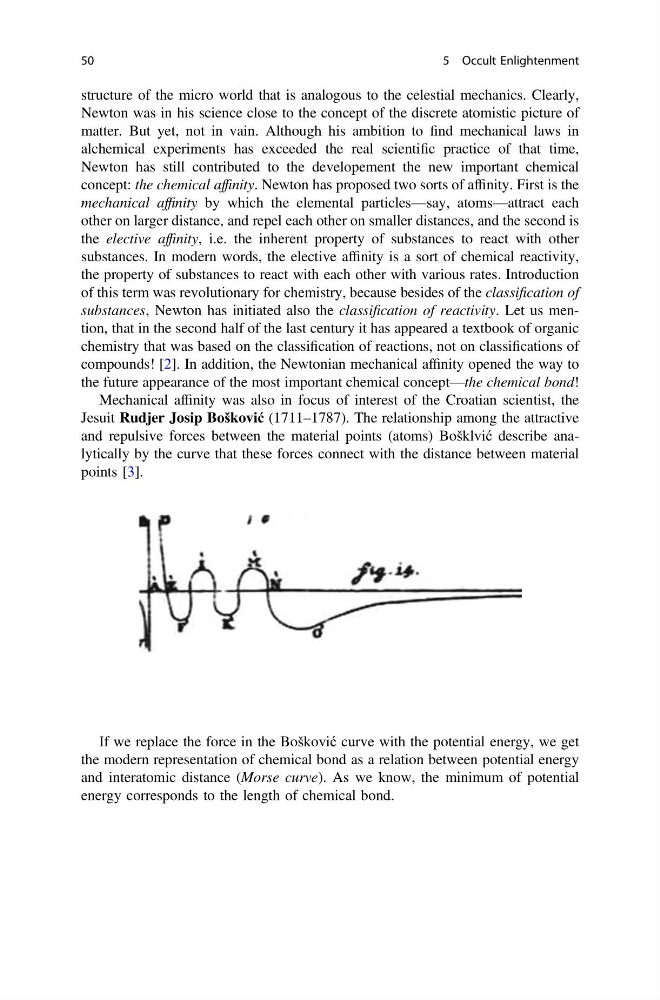
Jesuit Rudjer Josip Bošković (1711–1787). The relationship among the attractive
and repulsive forces between the material points (atoms) Bošklvić describe analytically by the curve that these forces connect with the distance between material
points [3].
If we replace the force in the Bošković curve with the potential energy, we get
the modern representation of chemical bond as a relation between potential energy
and interatomic distance (Morse curve). As we know, the minimum of potential
energy corresponds to the length of chemical bond.
Bošković curve that represents the dependence of attractive/repulsive force (ordinate)
on the distance of material points (abscise).
50
5 Occult Enlightenment
Newton was in his science close to the concept of the discrete atomistic picture of
matter. But yet, not in vain. Although his ambition to find mechanical laws in
alchemical experiments has exceeded the real scientific practice of that time,
Newton has still contributed to the developement the new important chemical
concept: the chemical affinity. Newton has proposed two sorts of affinity. First is the
mechanical affinity by which the elemental particles—say, atoms—attract each
other on larger distance, and repel each other on smaller distances, and the second is
the elective affinity, i.e. the inherent property of substances to react with other
substances. In modern words, the elective affinity is a sort of chemical reactivity,
the property of substances to react with each other with various rates. Introduction
of this term was revolutionary for chemistry, because besides of the classification of
substances, Newton has initiated also the classification of reactivity. Let us mention, that in the second half of the last century it has appeared a textbook of organic
chemistry that was based on the classification of reactions, not on classifications of
compounds! [2]. In addition, the Newtonian mechanical affinity opened the way to
the future appearance of the most important chemical concept—the chemical bond!
Mechanical affinity was also in focus of interest of the Croatian scientist, the
Jesuit Rudjer Josip Bošković (1711–1787). The relationship among the attractive
and repulsive forces between the material points (atoms) Bošklvić describe analytically by the curve that these forces connect with the distance between material
points [3].
If we replace the force in the Bošković curve with the potential energy, we get
the modern representation of chemical bond as a relation between potential energy
and interatomic distance (Morse curve). As we know, the minimum of potential
energy corresponds to the length of chemical bond.
Bošković curve that represents the dependence of attractive/repulsive force (ordinate)
on the distance of material points (abscise).
50
5 Occult Enlightenment