

Bolus of Mendes (3rd century B.C.), who is in literature known as
Pseudo-Democritus, was especially important for protochemistry. First writings
about substances, medicine practice and magic origin from him. More details are
known about Maria the Jewess and Cleopatra [3, 4] (1st century). Mary Jewish
has invented a series of laboratory procedures and instruments, inter alia the
kerotakis (jηqosaji1), the device that has been a combination of sublimer and
extractor. The solid substances were heated and vaporized from the bottom of the
vessel, and corresponding vapours have passed through the grating and finally
condensed, solidified. Evidently, vapour, or pneuma is imagined as a sort of feature
that evolved from the substance on the bottom, and which is then transferred by
condensation to another substance, the metal on the upper grid. The observed
colour changes were used as an argument that supports the concept about transfer of
features between different substances. Similar procedure of evaporization of the
pneuma-vapour from liquid and its condensation in another vessel was distillation.
This is one of the oldest laboratory procedure, which is with minor variations also
used today. The apparatus consists from the same main components: vapour condenser (ambix), and fraction collector (bikos).
Thus, the theoretical background of the first chemistry became complete: the
“structure of matter” consists from two parts, the unshaped substance and the
feature. By evaporation and re-condensation, the features could optionally be
transferred between the black basic substances, and all this procedure is controlled
by observation of the colour change.
Continuous repetition of procedures, and focusing on these cycles of experiments together with the intellectual immersion in this metaphysical world did not
live chemist to be personally indifferent. Zosimos of Papanopolis (350–420) was
one of the first protochemists who has attached the significance of the experimental
performance to the personal psychological and mystical experience. His experience
of changes of substances, Zosimos has associated with the personal adventures in
the dreams. The protochemical procedures Zosimos has described as parables
which reflects spiritual metamorphosis: nigredo—the obscuration to reach the
primordial state, followed with enlightenment. Transformation, conversion that
appeared as a central event in Christian theology, philosophy and ritual has been
related to the practical chemical labour: HOC EST CORPUS MEUM—This is my
body became HOCUS-POCUS on a popular level. Conversion should begin with
blackening, i.e. the return to the unshaped proto-substance that has been symbolized
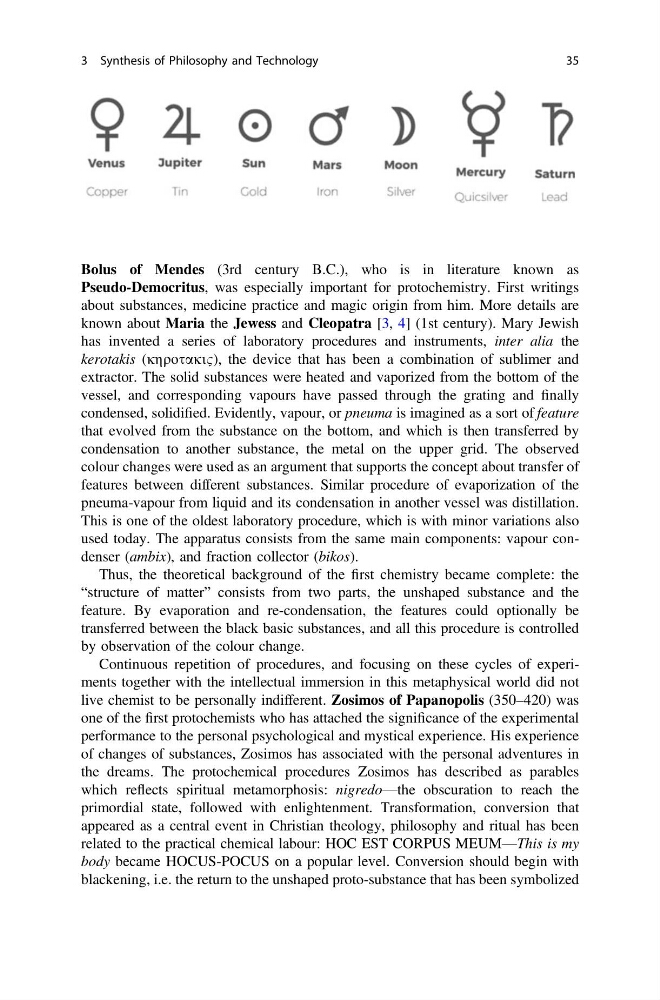
Protochemical symbols of metals and their planetary analogues
3 Synthesis of Philosophy and Technology
35
Pseudo-Democritus, was especially important for protochemistry. First writings
about substances, medicine practice and magic origin from him. More details are
known about Maria the Jewess and Cleopatra [3, 4] (1st century). Mary Jewish
has invented a series of laboratory procedures and instruments, inter alia the
kerotakis (jηqosaji1), the device that has been a combination of sublimer and
extractor. The solid substances were heated and vaporized from the bottom of the
vessel, and corresponding vapours have passed through the grating and finally
condensed, solidified. Evidently, vapour, or pneuma is imagined as a sort of feature
that evolved from the substance on the bottom, and which is then transferred by
condensation to another substance, the metal on the upper grid. The observed
colour changes were used as an argument that supports the concept about transfer of
features between different substances. Similar procedure of evaporization of the
pneuma-vapour from liquid and its condensation in another vessel was distillation.
This is one of the oldest laboratory procedure, which is with minor variations also
used today. The apparatus consists from the same main components: vapour condenser (ambix), and fraction collector (bikos).
Thus, the theoretical background of the first chemistry became complete: the
“structure of matter” consists from two parts, the unshaped substance and the
feature. By evaporation and re-condensation, the features could optionally be
transferred between the black basic substances, and all this procedure is controlled
by observation of the colour change.
Continuous repetition of procedures, and focusing on these cycles of experiments together with the intellectual immersion in this metaphysical world did not
live chemist to be personally indifferent. Zosimos of Papanopolis (350–420) was
one of the first protochemists who has attached the significance of the experimental
performance to the personal psychological and mystical experience. His experience
of changes of substances, Zosimos has associated with the personal adventures in
the dreams. The protochemical procedures Zosimos has described as parables
which reflects spiritual metamorphosis: nigredo—the obscuration to reach the
primordial state, followed with enlightenment. Transformation, conversion that
appeared as a central event in Christian theology, philosophy and ritual has been
related to the practical chemical labour: HOC EST CORPUS MEUM—This is my
body became HOCUS-POCUS on a popular level. Conversion should begin with
blackening, i.e. the return to the unshaped proto-substance that has been symbolized
Protochemical symbols of metals and their planetary analogues
3 Synthesis of Philosophy and Technology
35