

Contrary to the Aristotelian physics and metaphysics, Democritean and
Leukipian viewpoints about atoms comprise also the first ideas about the structure,
configuration, and proto-shapes, the concepts which have reached its culmination in
the formation of the structural theory in the nineteenth century. However, we have
to keep in mind that both notions, element, and atom are in principle abstract.
Reality and materiality of atom was not completely accepted until the beginning of
the twentieth century.
Epicurus of Samos (341–270 B.C.) has extended the concept about the discrete,
discontinue nature of the matter by adding two ideas for which we could tell that
they belong to the core of modern science. Besides the material, Epicurus introduce
also temporal atoms, say, time is also discontinuous! Interestingly, the definition of
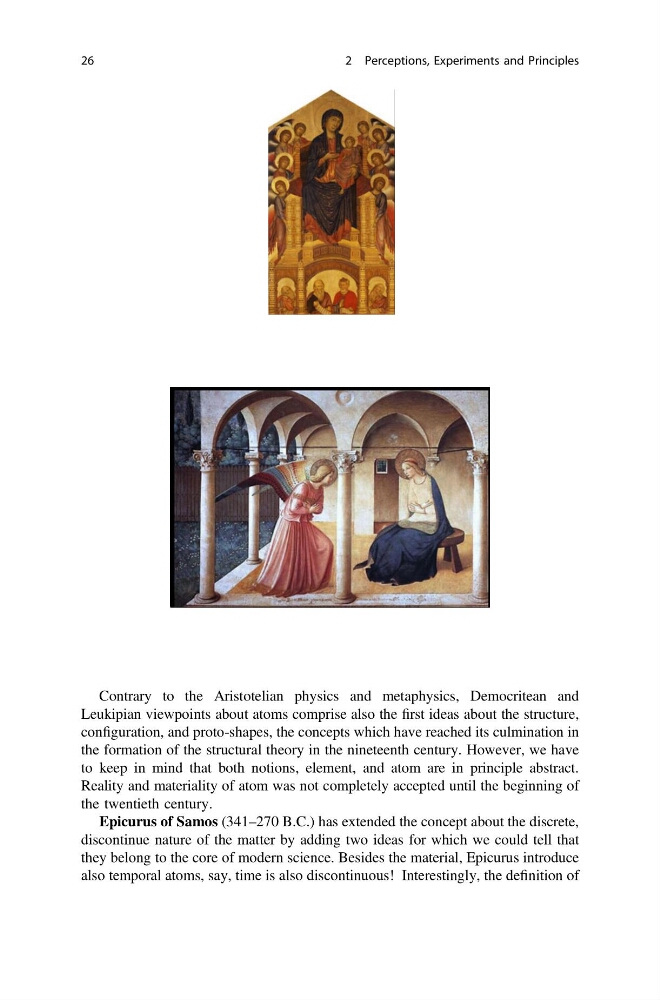
Cimabue: Maestà di Santa Trinità, 1280–1285, Galleria Uffizi, Firenca
Beato Angelico: L’Annunciazione del corridoio Nord, 1440–1450, Museo nazionale di San
Marco, Firenze
26
2 Perceptions, Experiments and Principles
Leukipian viewpoints about atoms comprise also the first ideas about the structure,
configuration, and proto-shapes, the concepts which have reached its culmination in
the formation of the structural theory in the nineteenth century. However, we have
to keep in mind that both notions, element, and atom are in principle abstract.
Reality and materiality of atom was not completely accepted until the beginning of
the twentieth century.
Epicurus of Samos (341–270 B.C.) has extended the concept about the discrete,
discontinue nature of the matter by adding two ideas for which we could tell that
they belong to the core of modern science. Besides the material, Epicurus introduce
also temporal atoms, say, time is also discontinuous! Interestingly, the definition of
Cimabue: Maestà di Santa Trinità, 1280–1285, Galleria Uffizi, Firenca
Beato Angelico: L’Annunciazione del corridoio Nord, 1440–1450, Museo nazionale di San
Marco, Firenze
26
2 Perceptions, Experiments and Principles