

In the philosophy of science, we can simply conclude that the research within
every complexity level requires special epistemology that is not reducible to the
epistemologies from other levels. This could be convenient explanation why science consists from special disciplines such as physics, chemistry, biology, etc.
Consideration of the authenticity of chemistry starting with complexity of the
nature and emergence of irreducible laws and concepts, as well as absence of
chemistry in classical philosophy of science, must involve also questions about the
historical circumstances within which appeared philosophy of science as an original
discipline. Circumventing the detailed analysis of the history of philosophy of
science, because it is a matter for an extra book, we must focus on those facts that
could be most important for studying the relationship between chemistry and this
philosophical discipline.
As I will demonstrate later in the lectures, it seems that chemistry through most
of its history appears close to the borderline between science and “non-science”, or,
between science and “skill”. From the 13th century till the scientific revolution after
the Enlightenment period, chemistry has even not been a part of the university
education. Reasons for such position of chemistry cannot be associated only to the
ENZYME CATALYSED REACTIONS
NON-CATALYSED REACTIONS
RATE
CONSTANT
in s -1
10 5
1
10 -5
10 -10
10 -15
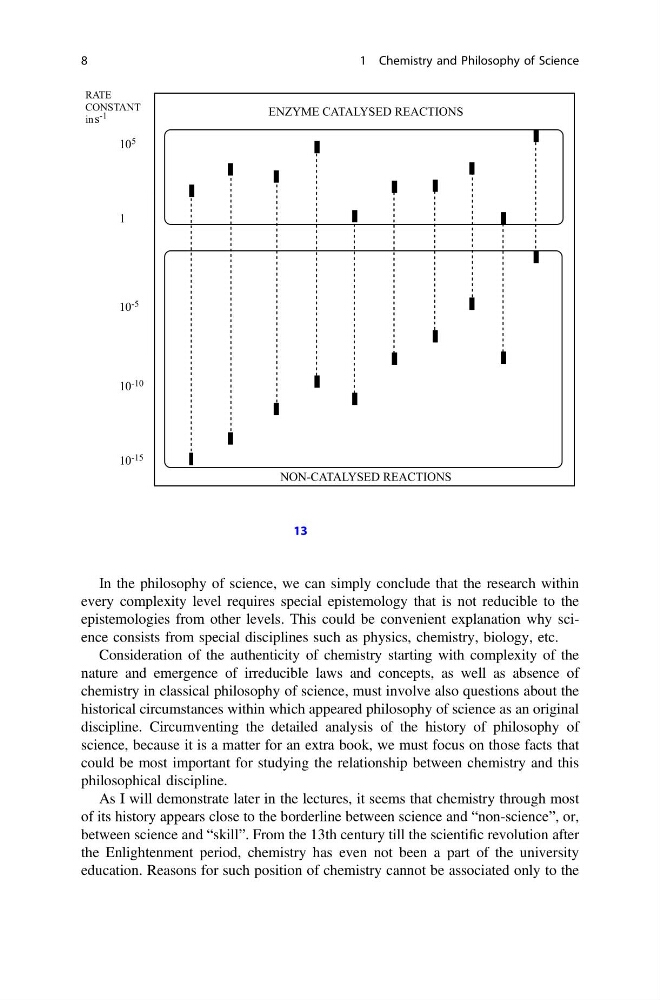
Comparison of the enzyme catalysed and non-catalysed reaction rates. The figure is
construdted from the data from ref [13]
8
1 Chemistry and Philosophy of Science
every complexity level requires special epistemology that is not reducible to the
epistemologies from other levels. This could be convenient explanation why science consists from special disciplines such as physics, chemistry, biology, etc.
Consideration of the authenticity of chemistry starting with complexity of the
nature and emergence of irreducible laws and concepts, as well as absence of
chemistry in classical philosophy of science, must involve also questions about the
historical circumstances within which appeared philosophy of science as an original
discipline. Circumventing the detailed analysis of the history of philosophy of
science, because it is a matter for an extra book, we must focus on those facts that
could be most important for studying the relationship between chemistry and this
philosophical discipline.
As I will demonstrate later in the lectures, it seems that chemistry through most
of its history appears close to the borderline between science and “non-science”, or,
between science and “skill”. From the 13th century till the scientific revolution after
the Enlightenment period, chemistry has even not been a part of the university
education. Reasons for such position of chemistry cannot be associated only to the
ENZYME CATALYSED REACTIONS
NON-CATALYSED REACTIONS
RATE
CONSTANT
in s -1
10 5
1
10 -5
10 -10
10 -15
Comparison of the enzyme catalysed and non-catalysed reaction rates. The figure is
construdted from the data from ref [13]
8
1 Chemistry and Philosophy of Science