

explanation of the most of the structures in the Nature. This parameter is energy.
Suppose that two entities on the lower complexity level unify in the new structure
that belongs to the higher complexity level. For instance, two atoms are associated
forming the corresponding molecule. The consequence of the formation of molecule is the decrease of total energy of the system because the two-atomic molecule
always possesses less energy than the sum of energies of two isolated atoms. This
energy difference is called the energy of chemical bond. Conversely, if we wish to
split the molecule in the isolated atoms, we have to add to it the energy equal to the
chemical bond energy. On the sub-atomic level, association of proton and neutron
in corresponding atomic nucleus follows the same rule with the release of large
amount of energy (nuclear energy). If the atom would be exposed to such amount of
energy, it would decompose in protons and neutrons. In principle, the chemical
bond energy and nuclear energy, both could be named by using terminus technicus
energy of interaction.
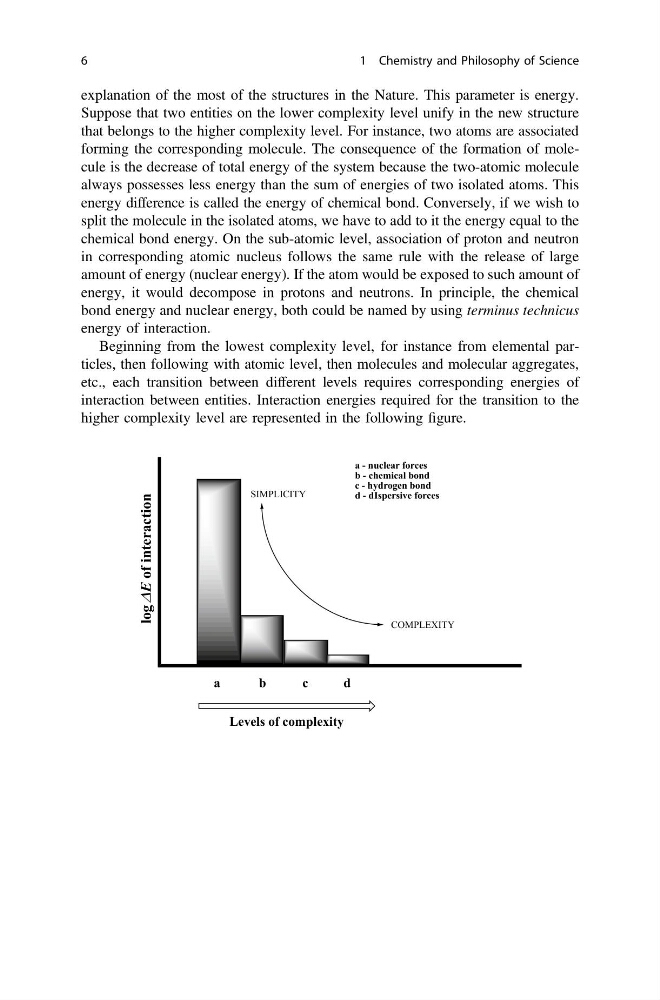
Beginning from the lowest complexity level, for instance from elemental particles, then following with atomic level, then molecules and molecular aggregates,
etc., each transition between different levels requires corresponding energies of
interaction between entities. Interaction energies required for the transition to the
higher complexity level are represented in the following figure.
log E of interaction
a
b
c
d
Levels of complexity
a - nuclear forces
b - chemical bond
c - hydrogen bond
d - dIspersive forces
SIMPLICITY
COMPLEXITY
Complexity classified in the levels in relation with the energy of interaction of particular
categories of particles: atomic nuclei, molecules, and molecular aggregates
6
1 Chemistry and Philosophy of Science
Suppose that two entities on the lower complexity level unify in the new structure
that belongs to the higher complexity level. For instance, two atoms are associated
forming the corresponding molecule. The consequence of the formation of molecule is the decrease of total energy of the system because the two-atomic molecule
always possesses less energy than the sum of energies of two isolated atoms. This
energy difference is called the energy of chemical bond. Conversely, if we wish to
split the molecule in the isolated atoms, we have to add to it the energy equal to the
chemical bond energy. On the sub-atomic level, association of proton and neutron
in corresponding atomic nucleus follows the same rule with the release of large
amount of energy (nuclear energy). If the atom would be exposed to such amount of
energy, it would decompose in protons and neutrons. In principle, the chemical
bond energy and nuclear energy, both could be named by using terminus technicus
energy of interaction.
Beginning from the lowest complexity level, for instance from elemental particles, then following with atomic level, then molecules and molecular aggregates,
etc., each transition between different levels requires corresponding energies of
interaction between entities. Interaction energies required for the transition to the
higher complexity level are represented in the following figure.
log E of interaction
a
b
c
d
Levels of complexity
a - nuclear forces
b - chemical bond
c - hydrogen bond
d - dIspersive forces
SIMPLICITY
COMPLEXITY
Complexity classified in the levels in relation with the energy of interaction of particular
categories of particles: atomic nuclei, molecules, and molecular aggregates
6
1 Chemistry and Philosophy of Science