

structure is a cause that molecules have corresponding properties, but molecular
emergent properties cannot change atomic structure. But now, in this lecture, we
have argued also that the higher level has effect on the lower level by setting up the
boundary conditions that enable the purpose, the scope of the higher-level entity.
We as humans appear on the top complexity level, and all we are doing has
particular goal for which we set up the boundary conditions to science as such.
In this frame, chemistry opens the philosophical, or, better the sociological
question of general importance: what is the relation between the fundamental and
the applied research? If the applied research is determined in the top-down way, i.e.
from the requirements of human existence, then the main stream in today’s science
is justified. What is the basic science in this context: the science triggered merely by
curiosity? But on the other hand, curiosity, as well as aesthetical requirements,
belong to the most sophisticated characteristics of man. Curiosity results with
explanation, understanding, and new visions on the nature and society. Science has
its aesthetical component, the beauty of theories, the beauty of representations or
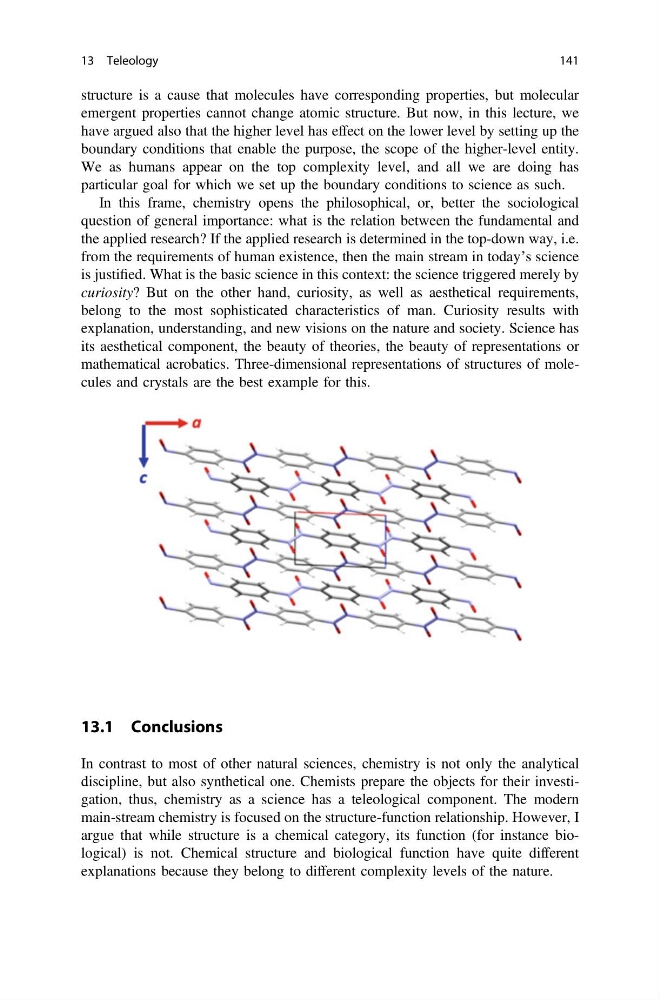
mathematical acrobatics. Three-dimensional representations of structures of molecules and crystals are the best example for this.
13.1 Conclusions
In contrast to most of other natural sciences, chemistry is not only the analytical
discipline, but also synthetical one. Chemists prepare the objects for their investigation, thus, chemistry as a science has a teleological component. The modern
main-stream chemistry is focused on the structure-function relationship. However, I
argue that while structure is a chemical category, its function (for instance biological) is not. Chemical structure and biological function have quite different
explanations because they belong to different complexity levels of the nature.
13 Teleology
141
emergent properties cannot change atomic structure. But now, in this lecture, we
have argued also that the higher level has effect on the lower level by setting up the
boundary conditions that enable the purpose, the scope of the higher-level entity.
We as humans appear on the top complexity level, and all we are doing has
particular goal for which we set up the boundary conditions to science as such.
In this frame, chemistry opens the philosophical, or, better the sociological
question of general importance: what is the relation between the fundamental and
the applied research? If the applied research is determined in the top-down way, i.e.
from the requirements of human existence, then the main stream in today’s science
is justified. What is the basic science in this context: the science triggered merely by
curiosity? But on the other hand, curiosity, as well as aesthetical requirements,
belong to the most sophisticated characteristics of man. Curiosity results with
explanation, understanding, and new visions on the nature and society. Science has
its aesthetical component, the beauty of theories, the beauty of representations or
mathematical acrobatics. Three-dimensional representations of structures of molecules and crystals are the best example for this.
13.1 Conclusions
In contrast to most of other natural sciences, chemistry is not only the analytical
discipline, but also synthetical one. Chemists prepare the objects for their investigation, thus, chemistry as a science has a teleological component. The modern
main-stream chemistry is focused on the structure-function relationship. However, I
argue that while structure is a chemical category, its function (for instance biological) is not. Chemical structure and biological function have quite different
explanations because they belong to different complexity levels of the nature.
13 Teleology
141