

classification of the category of identity explained in previous lectures, though,
electrons possess the primary identity, the identity of substance.
To make his concept of chemical bond as a pair of electrons persuasive, Lewis
has proposed the basic heuristic fundamental model about the distribution of
electrons in atoms.
The independent discovery that has been drawn from the classical theory of
valence, which is known as an octet rule, helped Lewis to complete his theory about
electronic structure of atoms and molecules. German chemist Richard Wilhelm
Heinrich Abegg (1869–1910) has referred to the possibility that the valence is
composed from two components: the valence, and the counter-valence, respectively
[2]. As the electrochemical dualistic theories have suggested, the chemical affinity
(chemical bond), since its nature is “electrical”, must include a sort of “valence
polarity“. Abegg’s valences and counter-valences have the opposite charge. For
instance, chlorine can have the valence +7 in perchlorates, and the counter-valence
−1 in chlorides. By connecting the concept of the valences and counter-valences
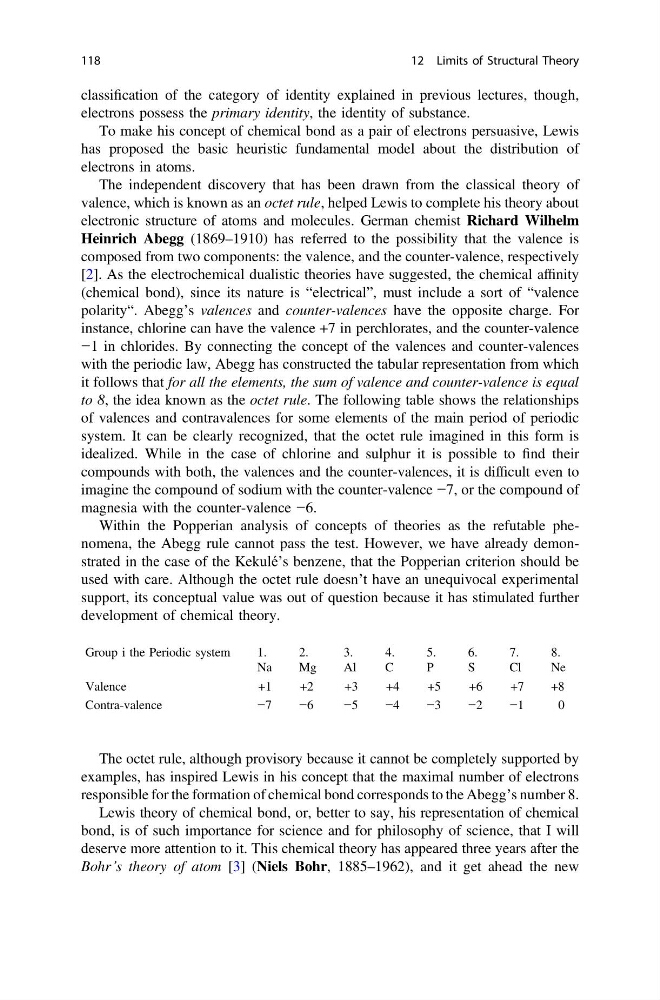
with the periodic law, Abegg has constructed the tabular representation from which
it follows that for all the elements, the sum of valence and counter-valence is equal
to 8, the idea known as the octet rule. The following table shows the relationships
of valences and contravalences for some elements of the main period of periodic
system. It can be clearly recognized, that the octet rule imagined in this form is
idealized. While in the case of chlorine and sulphur it is possible to find their
compounds with both, the valences and the counter-valences, it is difficult even to
imagine the compound of sodium with the counter-valence −7, or the compound of
magnesia with the counter-valence −6.
Within the Popperian analysis of concepts of theories as the refutable phenomena, the Abegg rule cannot pass the test. However, we have already demonstrated in the case of the Kekulé’s benzene, that the Popperian criterion should be
used with care. Although the octet rule doesn’t have an unequivocal experimental
support, its conceptual value was out of question because it has stimulated further
development of chemical theory.
Group i the Periodic system
1.
Na
2.
Mg
3.
Al
4.
C
5.
P
6.
S
7.
Cl
8.
Ne
Valence
+1
+2
+3
+4
+5
+6
+7
+8
Contra-valence
−7
−6
−5
−4
−3
−2
−1
0
The octet rule, although provisory because it cannot be completely supported by
examples, has inspired Lewis in his concept that the maximal number of electrons
responsible for the formation of chemical bond corresponds to the Abegg’s number 8.
Lewis theory of chemical bond, or, better to say, his representation of chemical
bond, is of such importance for science and for philosophy of science, that I will
deserve more attention to it. This chemical theory has appeared three years after the
Bohr’s theory of atom [3] (Niels Bohr, 1885–1962), and it get ahead the new
118
12 Limits of Structural Theory
electrons possess the primary identity, the identity of substance.
To make his concept of chemical bond as a pair of electrons persuasive, Lewis
has proposed the basic heuristic fundamental model about the distribution of
electrons in atoms.
The independent discovery that has been drawn from the classical theory of
valence, which is known as an octet rule, helped Lewis to complete his theory about
electronic structure of atoms and molecules. German chemist Richard Wilhelm
Heinrich Abegg (1869–1910) has referred to the possibility that the valence is
composed from two components: the valence, and the counter-valence, respectively
[2]. As the electrochemical dualistic theories have suggested, the chemical affinity
(chemical bond), since its nature is “electrical”, must include a sort of “valence
polarity“. Abegg’s valences and counter-valences have the opposite charge. For
instance, chlorine can have the valence +7 in perchlorates, and the counter-valence
−1 in chlorides. By connecting the concept of the valences and counter-valences
with the periodic law, Abegg has constructed the tabular representation from which
it follows that for all the elements, the sum of valence and counter-valence is equal
to 8, the idea known as the octet rule. The following table shows the relationships
of valences and contravalences for some elements of the main period of periodic
system. It can be clearly recognized, that the octet rule imagined in this form is
idealized. While in the case of chlorine and sulphur it is possible to find their
compounds with both, the valences and the counter-valences, it is difficult even to
imagine the compound of sodium with the counter-valence −7, or the compound of
magnesia with the counter-valence −6.
Within the Popperian analysis of concepts of theories as the refutable phenomena, the Abegg rule cannot pass the test. However, we have already demonstrated in the case of the Kekulé’s benzene, that the Popperian criterion should be
used with care. Although the octet rule doesn’t have an unequivocal experimental
support, its conceptual value was out of question because it has stimulated further
development of chemical theory.
Group i the Periodic system
1.
Na
2.
Mg
3.
Al
4.
C
5.
P
6.
S
7.
Cl
8.
Ne
Valence
+1
+2
+3
+4
+5
+6
+7
+8
Contra-valence
−7
−6
−5
−4
−3
−2
−1
0
The octet rule, although provisory because it cannot be completely supported by
examples, has inspired Lewis in his concept that the maximal number of electrons
responsible for the formation of chemical bond corresponds to the Abegg’s number 8.
Lewis theory of chemical bond, or, better to say, his representation of chemical
bond, is of such importance for science and for philosophy of science, that I will
deserve more attention to it. This chemical theory has appeared three years after the
Bohr’s theory of atom [3] (Niels Bohr, 1885–1962), and it get ahead the new
118
12 Limits of Structural Theory